Davy Jones

Variations: David Jones

Davy Jones final

Where there is the sea, there will be Davy Jones. He is the demon of the ocean, the proprietor of Davy Jones’ Locker where all drowned sailors go. Originally from British tales, he has since been expanding his influence across the ocean; as long as sailors fear the deep, this “blackguard hell’s baby” will continue to exist.

There is no limit to the shapes Davy Jones can appear in. He is the whale, the shark, the whirlpool, the giant squid, the hurricane, all the fears of sailors. He has been described with huge saucer eyes, triple rows of teeth, a tail, and horns, with blue smoke pouring from his nostrils. When the sailors of the Cachalot landed an enormous, barnacle-crusted bull sperm whale with a twisted lower jaw, some of them declared they had killed Davy Jones himself.

Davy Jones rules over the lesser demons and spirits of the sea, and they do his bidding. He can be seen in various forms on the rigging of doomed ships, gleefully announcing their impending destruction. All who die at sea and sink to the bottom of the ocean – Davy Jones’ Locker – are his.

The first literary appearance of Davy Jones was in Defoe’s Four Years Voyages, as a passing remark. The origin of the name is unknown. One unlikely possibility is a corruption of Duffy Jonah, the ghost (Duppy) of the Biblical Jonah associated with storms at sea. Another possibility is that he was based on a real person. There was a sailor, mutineer, and eventual pirate by the name of David Jones in the early 1600s, and the Locker may have been expression he was fond of. Unfortunately there is no fully convincing explanation for the origin and etymology of Davy Jones.

References

Bullen, F. T. (1906) The Cruise of the Cachalot. MacMillan and Co., London.

Defoe, D. (1726) The Four Years Voyages of Capt. George Roberts. A. Bettesworth, London.

Smith, A. The Perils of the Sea: Fish, Flesh, and Fiend. In Davidson, H. E. and Chaudhri, A. (2001) Supernatural Enemies. Carolina Academic Press, Durham.

Smollett, T. (1882) The Adventures of Peregrine Pickle. George Routledge and Sons, London.

Puaka

Variations: Puwaka, Puaki

Puaka

The Puaka (“Pig”) is a Dusun demon that guards water in eddies, and resembles a pig with a razor-sharp tongue. Puakas like to feed from trees, and stand on each other’s backs until they reach the branches.

When you meet a Puaka, it will attack if you move, and come to a halt if you stop. If it catches up with you, it will lick your bones clean. To lose the Puaka it is recommended to cross a stream; the creature may follow you across the stream, but once on dry land it will pause to lick itself dry, licking the flesh off its bones in the process.

“Puaka” and similar terms have meant pig in a number of languages – puaka in Rarotongan, Mangarevan, Rotuma, and Malay, vuaka in Fiji, puwaka in Malay, pua’a in Samoan, puaa in Tahitian, Marquesan, and Hawaiian, buaka in Tongan, and poaka in Maori. While this has been alternately compared to the Sanskrit sukara, the Latin porcus, and the English porker, the word seems to have had its own unique Polynesian origin. In some areas puaka has come to denote the pig-like demon; sometimes it loses its meaning as “pig” altogether, possibly due to the influence of Islam.

References

Mackenzie, D. A. (1930) Myths from Melanesia and Indonesia. Gresham Publishing Company, Ltd., London.

Boongurunguru

Variations: Bonguru

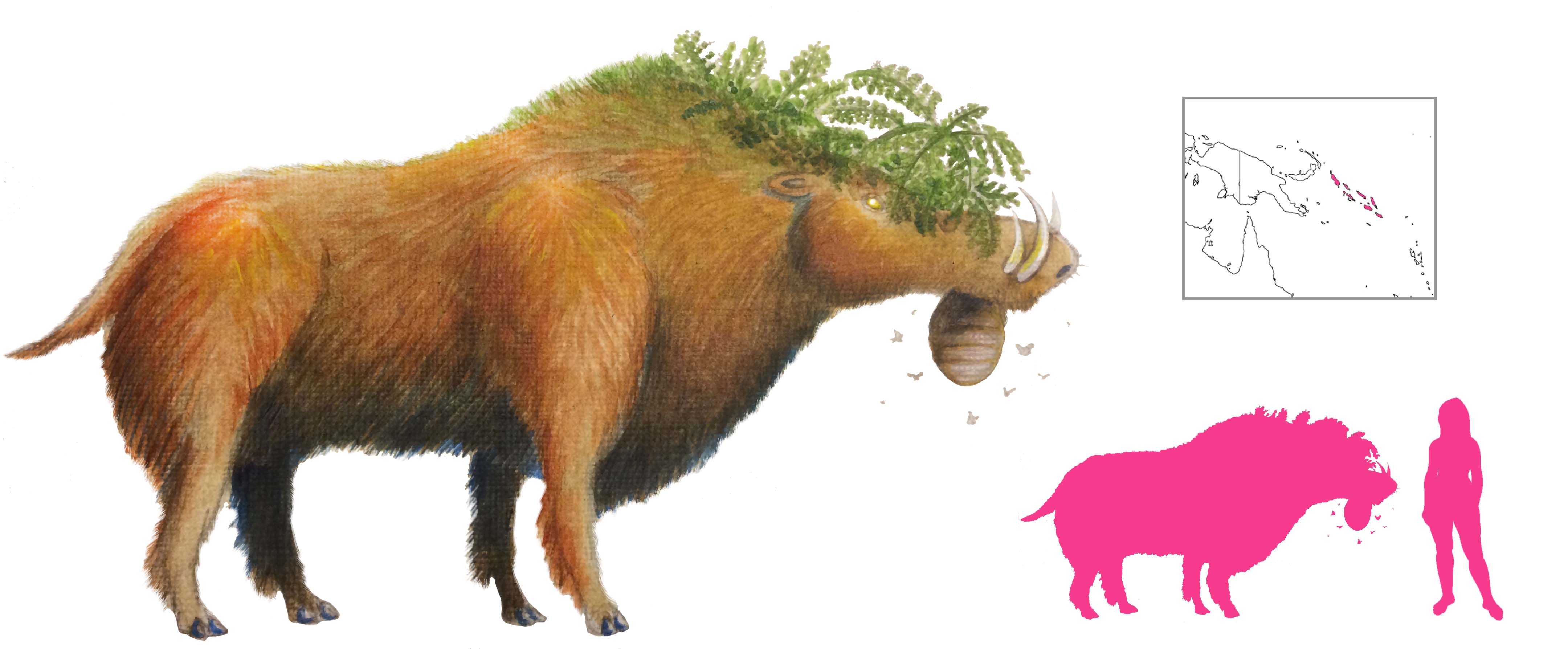
Boongurunguru

According to the mythology of the Solomon Islands, there was once a time when the waters flooded the Earth. This great flood, the Ruarua, engulfed all of the islands, even the 4,000 feet high San Cristoval hills; those drowned in it turned into stone pillars, which can still be seen at Mwata. It was Umaroa, leader of the Muara clan, who saved his people by taking them, a sacred stone, and pairs of all the animals on board a great canoe. When the waters receded, Umaroa made landfall at Waimarai in the Arosi district, and offered a sacrifice in thanks. From there an adaro descended from a rainbow and guided them to their new home.

Umaroa is now buried there, and his sacred stone was laid on top of him. The area is now rich with magic, and visitors have to observe certain rules to avoid bad luck. Any trees cut down and left there will cause the lumberjacks to wander in circles, always returning to the cut tree. If there is a rainbow above the river, it cannot be crossed without making an offering to the adaro first. Names have particular strength there; ropes cannot be called ari but instead must be referred to as kunikuni (“to let down”), otherwise snakes will be summoned immediately.

Of the spirits there, the most terrifying is Boongurunguru, the “pig-who-grunts”, the demon pig of Umaroa. He takes the form of a huge boar with ‘ama’ama ferns growing on his flattened head, and a buzzing nest of hornets located under his chin. He leads a herd of boars, all of them Boongurunguru, through the forest, goring and trampling anyone in their path. The appearance of a Boongurunguru foretells death; if the entire herd enters a village, everyone there will die. The boars get smaller and smaller as they approach a village, finally sneaking in at the size of mice, but they are no less deadly at that size.

If one hears Boongurunguru grunting and mentions that there must be pigs nearby, they are immediately surrounded by hundreds of venomous snakes – in front, behind, on either side, and falling out of the air.

This is because Boongurunguru has standards, and objects to being called a pig.

References

Fox, C. E. (1924) The Threshold of the Pacific. Kegan Paul, Trench, Trubner and Co., Ltd., London; Alfred A. Knopf, New York

Mackenzie, D. A. (1930) Myths from Melanesia and Indonesia. Gresham Publishing Company, Ltd., London

Ragache, C. C. and Laverdet, M. (1991) Les animaux fantastiques. Hachette.