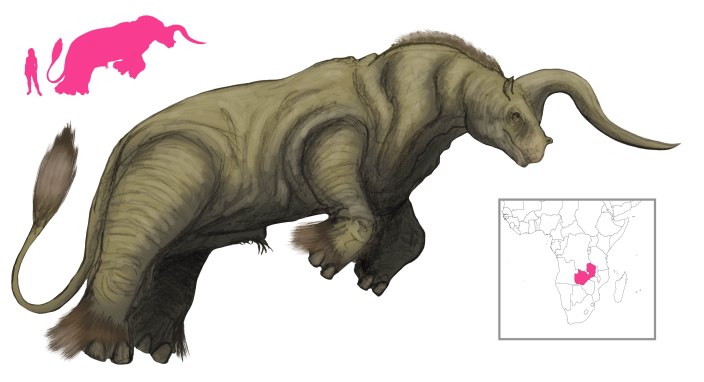
The Ichisonga is a pachyderm-slayer from the folklore of the Lambas of Zambia, usually found in the Kafue River. It is a herbivorous water beast that resembles a rhinoceros and has a horn on its forehead.
Although a grass-eater, the ichisonga has a special hatred for the hippopotamus. If an ichisonga hears a hippo, it leaves the Kafue River, traveling along the bank so the hippo does not scent it. Then it re-enters the water, goes for the largest bull hippo, and stabs it to death with its horn.
If an elephant is killed nearby, the ichisonga will roar and drive the hunters away from the carcass. It then stays near the elephant’s remains for days until the carcass rots. The ichisonga is motivated by uŵulwishya – jealousy.
References
Doke, C. M. (1931) The Lambas of Northern Rhodesia. George G. Harrap and Company Ltd., London.
 A Book of Creatures
Hates Hippos, hates Elephants, what else does it hate? Rhinos, Wilderbeasts, Lions?
LikeLiked by 1 person
Probably everything
LikeLike
Some of these monsters are so well conceived by the locals, one can’t help wondering if they are real. At the very least the Ichisonga sounds like a recently extinct species that the Lamba people’s oral traditions have retained the memory of. Your Dixon-esque illustration of it brings me to the conclusion that a crime has been committed by reality that this creature isn’t alive.
LikeLike
Aw thanks! It’s part of a larger cultural tradition that probably has the rhino at its core (remember that the mokele mbembe also has a horn and kills hippos).
LikeLike
Someone needs to open a therapy office for 90% of the creatures in this site
LikeLiked by 2 people
Mythology doesn’t seem to like large African safari creatures much. I LIKE hippos. And elephants.
LikeLiked by 1 person
Probably because elephants are the biggest and scariest thing, so anything that can kill them must be even scarier.
LikeLike
Like the roc, for instance.
LikeLiked by 1 person
Il y a t’il un lien avec l’Emela ntouka et les autres “dinosaures vivants” d’Afrique (ninki nanka, nguma monene, muhuru … )
Je les trouvent tous fascinants 🙂
LikeLiked by 1 person
Considering how it is similar to Emela-Ntouka, would it be safe to say that Emela Ntouka is a misinterpretation of this creature? A monster story meant to only be a story and then taken literally and cherrypicked by cryptozoologists and creationists alike?
LikeLiked by 1 person
Yeah, they’re all rhinoceros derivatives imo.
LikeLike
Pingback: mythologies from zambia – World Mythology
Pingback: MYTHOLOGIES FROM ZAMBIA – Indigenous Peoples Literature
How do the locals call rhinos in their language(s)? I doubt they couldn’t tell the difference between a familiar animal like a rhinoceros and something different. Not saying it’s impossible that rhinos could have influenced the myth, they certainly could have. But it sounds a bit too convenient to me.
LikeLiked by 1 person
To be fair I didn’t say a rhino influenced the myth, the text literally says it “resembles a rhinoceros”. It could be a holdover of older beliefs and myths about the rhino, like how you could find unicorns and rhinos in the same book after rhinos became known for what they are. Hard to tell for sure, really.
Incidentally rhino is kakwele, according to the same source.
LikeLike
The best explanation I personally heard comes from how relatively recent the Congo rainforest is, only appearing until the last ice age. Beforehand, as little as a few thousand years ago, the Congo was once covered in veldt and savannah, the same time when tribes first arrived to inhabit the area. It was also home to various savannah-dwelling animals including lions, bush elephants, and rhinos. With rhino-like creatures being such a widespread folkloric trope, it is very likely that it is a distant tribal memory of a time when rhinos lived alongside the ancestors of modern Congolese forest peoples. Their cryptozoological reinterpretation as undiscovered species largely comes from ill-equipped western explorers turning them into Rorschach tests and modified them to suit whatever idea they wanted via baseless speculation.
LikeLiked by 1 person
That’s fascinating! There’s honestly so many interesting questions that could be asked about folklore and interactions with megafauna but then they get distilled down to “dinosaur” instead…
LikeLiked by 1 person
I found the answer here: (https://cryptoresponsereturns.weebly.com/emela-ntouka.html)
The art and website were made by an artist I’ve been following since High School named Tim Morris. It’s his own version of a book called Cryptozoologicon, which was created to address the general problem with some cryptid animals while also providing fun speculations by the authors of what they would really be as real animals.
LikeLiked by 1 person
Oh yeah, I love Tim Morris’ work! We were both contributors to Spec back in the day. ^_^
LikeLike
I like the idea of living dinosaurs as a fiction trope, but guys like inexperienced creationists looking for them in the real world ruin the fun of it for me.
LikeLiked by 1 person
I also do research and make art of mythical creatures, and you are partly what inspired me:
(https://www.deviantart.com/theropen/gallery/80376948/modern-mythologies-related-work)
(https://www.youtube.com/@theropen1997)
LikeLiked by 1 person
First off, those are awesome. And second hiiii fellow Arab-Canadian it seems! 🙂
LikeLiked by 1 person
Yep, born and raised in Jordan but too autistic to have learnt how to speak Arabic. I have family living in Vancouver and so here I am
LikeLiked by 1 person
That’s awesome!
LikeLike
Thanks for the answer. Off topic question: do you accept suggestions for other animals to draw? If you do, where should I write? I’ll understand if you say no, I just would like to give some ideas.
LikeLiked by 1 person
Yes, definitely, but cannot guarantee I will get around to them anytime soon.
LikeLike
No problem, I understand. Put real life first. I’ll think of some animals and i’ll let you know.
LikeLiked by 1 person
Thank you.
LikeLike
Here’s one:
Bisso Galeto.
The Bisso Galeto is a legendary animal from the Veronese valleys in northeastern Italy (Veneto region). Described as having the body and head of rooster with a large red crest, the tail of a snake (the animal’s name is Venetian for snake little rooster) and wings full of thorns, and as being highly poisonous, it has the ability to change and adapt its size/ length to fit every space (yes, like the Occamy from Fantastic Beasts, maybe JK Rowling took inspiration from it but i don’t know for sure). It’s born from an egg layed by an old rooster after been hatched by a snake for 9 years. It lives in woods and valleys but can also be born inside houses, which is al lethat event for inhabitants as they would die by night by the animal’s poisonous breath. Its stare can kill, dry the plants and contaminate water, and both its aforementioned breath and bite are deadly. Trying to wound it with cold weapons is inadvisable, as its poison would go back up the weapon and reach the knight’s hand, then spread through its body and even reaching the horse killing both. The best way to kill a Bisso Galeto is to put a mirror in front of it, because it dies if it sees its reflection. Its only natural enemies are the weasel, who can kill it but die due to its poison, and the rooster who can kill it by singing.
A variant of the myth describes the Bisso Galeto as a large snake whose poison is a serum that can change mood and personality, making the bite’s victims nervous and evil; the local question “sa gheto, te galo smorsegà el Bisso Galéto?” (“what’s wrong with you, did the Bisso Galeto bite you?” in Venetian Language) is used to indicate a naughty child.
Many of its features are shared with the basilisk, and its sometimes confused with it. It’s even referred to as “basalisco” in the Lessini Mountains where it’s believed to be the most truthful of all local legendary creatures. it’s often said to be able to fly thanks to small membranous wings placed on its body sides. This is believed to come from the green whip snake’s habitude of jumping from a tree’s branch to another.
The Bisso Galeto is believed to be responsible for the local syphilis epidemics in the 15th Century. This animal is sometimes associated with the devil or viewed as an incarnation of Evil itself. It’s similar to the Abraxas under aspects and, like the latter, it can take on a positive value and become a protector of fishermen and farmers.
Sorry for the walltext.
LikeLiked by 1 person
This is awesome, thank you.
LikeLike
I wrote a long description of an animal and yet my comment isn’t here. I’m sure I saved it.
LikeLike
I hadn’t approved it yet.
LikeLike
I wrote a suggestion but it doesn’t show up. Could it be because I deactivated cookies?
LikeLike
I hadn’t approved it yet either.
LikeLike
Nevermind, I see all comments now. By the way, is there a page where people can write suggestions? So I won’t have to write under this article alll the time.
LikeLiked by 1 person
You could just email me if you want :>
LikeLike
hfr
LikeLike