Amphisbaena

Variations: Amphisbaina, Alchismus, Amphisilene, Amphistere, Amphiptere, Ankesime, Auksimem, Double-head, Double-marcheur (French); Doble Andadora; Blind Snake

amphisbaena

The Amphisbaena, “goes both ways”, is one of the many snakes encountered by Lucan and his army in the deserts of Libya. It has also been reported from Lemnus, but it is unknown to the Germans. Unlike its biological namesake, the benign, legless burrowing lizards known as amphisbaenas, the Libyan amphisbaena is venomous and deadly, producing double the amount of venom a regular snake would. Sand boas are another candidate for the amphisbaena’s identity, but they too are harmless.

Two heads are an amphisbaena’s distinguishing feature, with one head in the normal place and one at the end of the tail. How these heads affect locomotion is unclear. An amphisbaena may move like a regular snake, one head trailing behind, but changing directions instantly and going forward or backwards with equal ease. Alternatively, both heads could lead, leaving the body following behind in a loop. An amphisbaena’s sight is poor, but its eyes glow. Physically it resembles an earthworm, with an indistinguishable head and tail. It is blackish earth-colored, with a rough, spotted skin. It is very muscular and tough-scaled, and is an excellent digger.

In addition to the amphisbaena described above, Pammenes tells of two-headed snakes with two feet near the tail in Egypt. Borges reports a creature from the Antilles called the doble andadora (“goes both ways”), also known as the two-headed snake and the mother of ants. It feeds on ants and can reattach itself if chopped in half. The association with ants is the same as that of the legless lizards that share the amphisbaena’s name, and probably refers to the same animal. As with every other snake, the amphisbaena of medieval bestiaries was burdened with legs and wings, and the use of the term became even more confused. Any creature in medieval art with an extra head on the end of its tail can be safely labeled an amphisbaena, although at this point the Greek two-headed snake is long forgotten. The heraldic amphisbaena eventually was corrupted into amphistere, amphiptere, and amphisian basilisk, from where it was assumed to have a pair of wings as well as an extra head!

Amphisbaenas are very cold-resistant, and are the first snakes to come out after winter, ahead of the first cuckoo song. Their temperament is correspondingly hotter than that of other snakes. They feed on earthworms, beetles, and especially ants, digging into their nests, its tough skin protecting it from their bites and stings. Solinus believed amphisbaenas gave birth through the tail-end mouth. They take good care of their eggs, guarding them until they hatch and showing love to their offspring.

Amphisbaena venom is unremarkable and causes the same symptoms as viper bites – inflammation and slow, painful death. Besides drinking coriander, the antidotes for amphisbaena bite are the same as those used for vipers. Amphisbaenas themselves are hard to kill, except with a vine-branch. One amphisbaena woke Dionysus from his rest, and in retaliation he crushed it with a vine-branch.

Several remedies have been derived from amphisbaenas. A walking-stick covered with amphisbaena skin keeps away venomous animals, and an olive branch wrapped in amphisbaena skin cures cold shiverings. An amphisbaena attached to a tree will ensure that the logger will not get cold and the tree will fall easily. If a pregnant woman steps over a dead amphisbaena, she will abort instantly, as the vapor arising from the dead snake is so toxic as to suffocate the fetus. However, if a pregnant woman carries a live amphisbaena in a box with her, the effect is nullified.

The two heads of the amphisbaena understandably led to a healthy amount of criticism. Thomas Browne denied that amphisbaenas could exist, stating that an animal with two anteriors was impossible. Al-Jahiz recounts an interview with a man who swore that he saw an amphisbaena, and, unconvinced, chalked it up to fear-induced exaggeration. “From which end does it move?” he asked the man. “Where does it eat from, and where does it bite from?” The man replied “It doesn’t move forward, but it gets around by rolling, like boys roll on sand. As for eating, it eats lunch with one head and dinner with the other. And as for biting, it bites with both heads at the same time!”

References

Aelian, trans. Scholfield, A. F. (1959) On the Characteristics of Animals, vol. II. Harvard University Press, Cambridge, Massachusetts.

Aelian, trans. Scholfield, A. F. (1959) On the Characteristics of Animals, vol. III. Harvard University Press, Cambridge, Massachusetts.

Aldrovandi, U. (1640) Serpentum, et Draconum Historiae. Antonij Bernie, Bologna.

Borges, J. L.; trans. Hurley, A. (2005) The Book of Imaginary Beings. Viking.

Cuba, J. (1539) Le iardin de santé. Philippe le Noir, Paris.

Druce, G. C. (1910) The Amphisbaena and its Connexions in Ecclesiastical Art and Architecture. Archaeological Journal, v. 67, pp. 285-317.

Isidore of Seville, trans. Barney, S. A.; Lewis, W. J.; Beach, J. A.; and Berghof, O. (2006) The Etymologies of Isidore of Seville. Cambridge University Press, Cambridge.

Al-Jahiz, A. (1966) Kitab al-Hayawan. Mustafa al-Babi al-Halabi wa Awladihi, Egypt.

Kitchell, K. F. (2014) Animals in the Ancient World from A to Z. Routledge, Milton Park, Abingdon, Oxon.

Lucan, trans. Rowe, N. (1720) Pharsalia. T. Johnson, London.

Macloc, J. (1820) A Natural History of all the Most Remarkable Quadrupeds, Birds, Fishes, Serpents, Reptiles, and Insects in the Known World. Dean and Munday, London.

Palliot, P. (1660) La Vraye et Parfaite Science des Armoiries. Pierre Palliot, Dijon.

Parker, J. (1894) A Glossary of Terms Used in Heraldry. James Parker and Co., Oxford.

Pliny; Bostock, J. and Riley, H. T. trans. (1857) The Natural History of Pliny, v. III. Henry G. Bohn, London.

Topsell, E. (1658) The History of Serpents. E. Cotes, London.
 

Cherruve

Variations: Cheruvoe, Cheurvoe, Cheurvue, Cherufe

Cherruve

The Cherruve is the Chilean spirit of comets and asteroids. Originally no more than the Araucanian meteorite, the cherruve’s role has since expanded to include lava, volcanoes, fiery exhalations, will-o-the-wisps, whirlwinds, and animate stone axes.

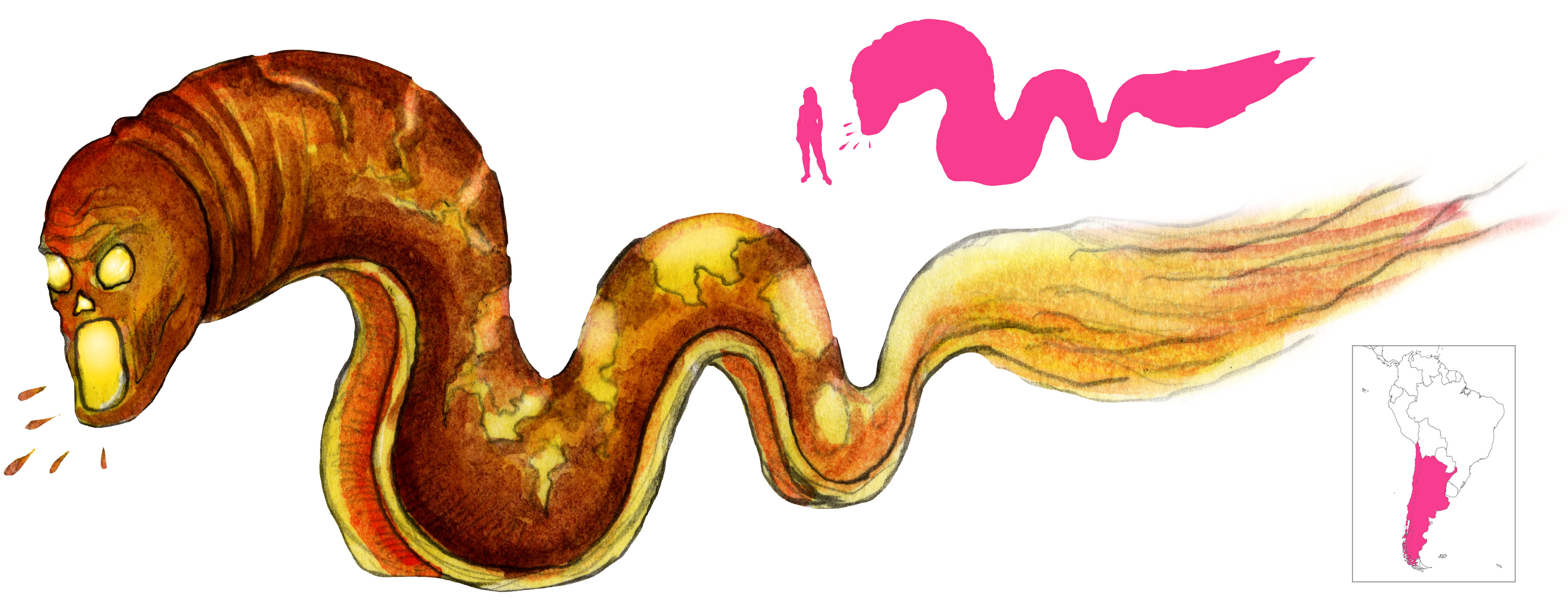
Cherruve appearance varies from area to area, but it is usually described as a comet, or a great serpentine creature with a human head and lava dribbling from its mouth. Its appearance has been anthropomorphized to various degrees and conflated with aspects of European mythology; in the Andes it becomes a huge seven-headed dragon; elsewhere it is confused with dragons, devils, and giants, or bipedal goats with flaming eyes.

Cherruves live underground and in volcanoes, and streak across the sky by night. The appearance of a cherruve in the sky heralds the spread of an epidemic, the death of a great leader, or other misfortunes, while the cherruve’s vomit is lava and its movements underground cause earthquakes. They make thunder by tossing human heads. The more dragon-like cherruves may demand the sacrifice of Mapuche maidens, and will withhold the flow of rivers if their demands are not met.

Comets, asteroids, and meteors are all cherruves, as are meteorites and oddly-shaped volcanic rocks. Cherruve rocks are collected by sorcerers, who use them to carry out their evil purposes by sending them at their enemies. They are ordered to suck blood and inflict death and disease, and can operate on their own, returning diligently to their masters after performing their duties.

Cherruves are also capable of feeling more human emotions. One cherruve married a Cloud, and their beautiful daughter, ethereal and pale, was Snow. Despite the cherruve’s jealous attempts to keep his wife under lock and key, she was abducted by his mortal enemy Wind. Every now and then Wind would blow Cloud over the volcano, and her tears became rain, while the cherruve’s own despair turned into destructive eruptions. The cherruve redoubled his efforts to protect Snow, and kept her from leaving the mountain during the daylight hours. Snow’s curiosity about the world outside continued to grow, and one day she finally managed to escape her father and climb out into the light. She marveled at the sun, the songs of birds, the colors, all infinitely beautiful and unknown to her. The longer she stayed outside, the happier she was, and yet the weaker she felt. Her mother tried to protect her, but the spiteful Wind carried the Cloud away. When Snow sat down, exhausted, the love-stricken Sun came down to give her a kiss. When the cherruve finally caught up with his daughter, he found nothing but a puddle of crystalline water.

References

Faron, L. C. (1964) Hawks of the Sun. University of Pittsburgh Press, Pittsburgh.

Guevara, T. (1908) Psicolojia del pueblo araucano. Imprenta Cervantes, Santiago de Chile.

Latcham, R. E. (1924) La organización social y la creencias religiosas de los antiguos araucanos. Imprenta Cervantes, Santiago de Chile.

Lenz, R. (1897) Estudios Araucanos. Imprenta Cervantes, Santiago de Chile.

Pino-Saavedra, Y.; Gray, R. (trans.) (1967) Folktales of Chile. The University of Chicago Press, Chicago.

Soustelle, G. and Soustelle, J. (1938) Folklore Chilien. Institut International de Coopération Intellectuelle, Paris.

Lyngbakur

Variations: Lyng-bakur, Lyngbakr, Ling-back, Heather-back; Jasconius, Iascanus; Hólma-fiskur, Hólmafiskur (Island Fish)

Lyngbakur

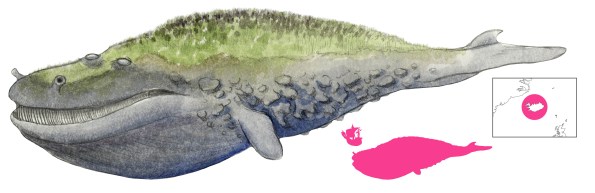
The Lyngbakur is the largest of all the illhveli, the largest of the whales, indeed one of the largest creatures in the sea. In Icelandic lore only the hafgufa (or kraken) is bigger than it, and the two giants are frequently interchangeable.

Despite its enormous size, the lyngbakur is rarely seen, and it does not go out of its way to sink ships the way its smaller brethren do. Most of the time its back is the only thing seen, looking like an island covered with a growth of heather. Its eyes are dorsally located, giving the impression of circular pools of water. From a distance the lyngbakur seems jet-black, but on closer inspection it is a mossy grey. It is tailed and finned like other whales.

The lyngbakur is a slow swimmer, and tends to doze at the surface, looking indistinguishable from a heather-covered island. It is possible to go right up and land on it, but the whale eventually awakes and dives, and anyone still on it will be drowned. Some fishermen in southern Iceland stayed two days on the whale’s back before it sunk, but they had the presence of mind to escape while they could. Trying to draw water from the “pools” on the island is certain to awaken it. The lyngbakur feeds only once every three years, but when it does it engulfs anything in its path, fish, birds, and whales alike.

The saga of Arrow-Odd relates the titular hero’s adventures, which include an encounter with a lyngbakur sent by his enemy Ogmund. He stopped by a large heather-covered island, and had five of his crew disembark to find drinking water. Before long the island began to move, going underwater and drowning the unfortunate crewmen.

Saint Brendan moored at a small island covered with sparse vegetation and with no sand on its shores. He and his followers spent the night praying on the island, but left next morning in a hurry as the ground began to shake. They returned to their ship in time, where they found out that they had been on the back of a Jasconius or Iascanus, a great whale that seems to be none other than the lyngbakur. The next time they encountered the whale, Saint Brendan fearlessly sang Easter Mass on it, and none were harmed.

It is said that there is only one lyngbakur, and it will live until Armageddon.

References

Davidsson, O. (1900) The Folk-lore of Icelandic Fishes. The Scottish Review, October, pp. 312-332.

Edwards, P. and Pálsson, H. (1970) Arrow-Odd: A Medieval Novel. New York University Press, New York.

Hlidberg, J. B. and Aegisson, S.; McQueen, F. J. M. and Kjartansson, R., trans. (2011) Meeting with Monsters. JPV utgafa, Reykjavik.

For the purposes of this book, deities, ghosts, and humans have been excluded. This is often down to a judgement call – some creatures are equal parts ghost and fairy, for instance.

After the primary name, a list of variations will be given. These include spelling variations, regional names, and other creatures that may be considered the same. The main text will clarify.

The primary art will always be subjective to some extent, and the artist will fill in blanks as they see fit. For what is known about the creature’s appearance, refer to the text.

The main art will be accompanied by a distribution map and a scale comparison. These will aim to be as accurate as possible, but the fact remains that they are often only educated guesses. Again, the text will contain the essential information.

Finally, all entries will have a references section. Lack of references has always been something that annoyed me, and I hope to remedy this somewhat.

I am indebted to your-vector-maps.com for their world map. The model in the scale images is currently exploring space on the Pioneer probes.