IT’S DANGEROUS TO GO ALONE! TAKE THIS.
A spectacular rendition of Ezekiel’s vision, with only one cherub and ophan (presumably drawing all 4 pairs would have been mindbreaking) by Matthaeus Merian, for his Icones Biblicae.

Got asked about Wenceslas Hollar’s depiction of an encounter between a basilisk and a weasel. The herb the weasel is using is the rue, of which I’ve said in my Basilisk entry,
“The only plant immune to the withering gaze of the basilisk is rue, which is consumed by weasels to protect themselves from their enemies. Remedies for basilisk envenomation will always contain rue.”
But the weasel literally wreathing itself in the stuff is a nice touch. Like fighting vampires with multiple garlands of garlic around your neck? Read more about the basilisk here.

What were the monsters that attacked the Nautilus in 20,000 Leagues Under the Sea? Jules Verne doesn’t help much because, while he recounts the Alecton’s encounter with a giant squid, he uses the terms calmar (squid) and poulpe (octopus) interchangeably. His artist Edouard Riou (whose images are shown above) didn’t seem to know either, and draws both an octopus (left) and a squid (right, note the clubbed tentacle).
Why not just call them krakens? After all, there is a brief exchange between Conseil and Ned Land, which I shall proceed to translate:
“… Those beasts, they’re called krak…”
“Crack is enough”, replied the Canadian ironically.
“Krakens”, retorted Conseil…
Have you ever encountered the Mosquito of the North Country? You thought they were pretty well developed animals with keen appetites didn’t you? Then you can appreciate what Paul Bunyan was up against when he was surrounded by the vast swarms of the giant ancestors of the present race of mosquitoes […]
Paul determined to conquer the mosquitoes before another season arrived. He thought of the big Bumble Bees back home and sent for several yoke of them. These, he hoped would destroy the mosquitoes. Sourdough Sam brought out two pair of the bees, overland on foot. There was no other way to travel for the flight of the beasts could not be controlled. Their wings were strapped with surcingles, they checked their stingers with Sam and walking shoes were provided for them. Sam brought them through without losing a bee.

The cure was worse than the original trouble. The Mosquitoes and the Bees made a hit with each other. They soon intermarried and their off-spring, as often happens, were worse than their parents. They had stingers fore-and-aft and could get you coming or going.

W. B. Laughead, Paul Bunyan and his Big Blue Ox (1922)
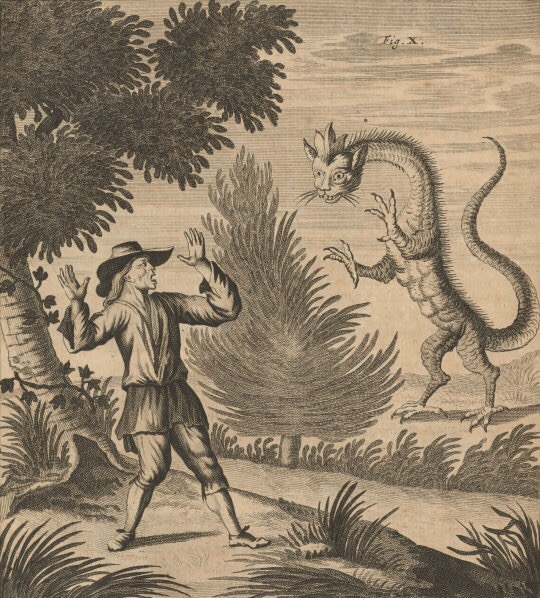
Here we have a menacing alpine dragon – what would be called a tatzelwurm nowadays (a regional name that has since come to conveniently apply to alpine dragons as a whole, but back then they were all simply dragons). Note the feline features. Maybe those were greatly exaggerated wildcat encounters?
Or maybe they just needed an excuse for coming home late after too much lager…
Image from Johann Jakob Scheuchzer’s Itinera Alpina.