Variations: Caspilli, Neemora (Persian)
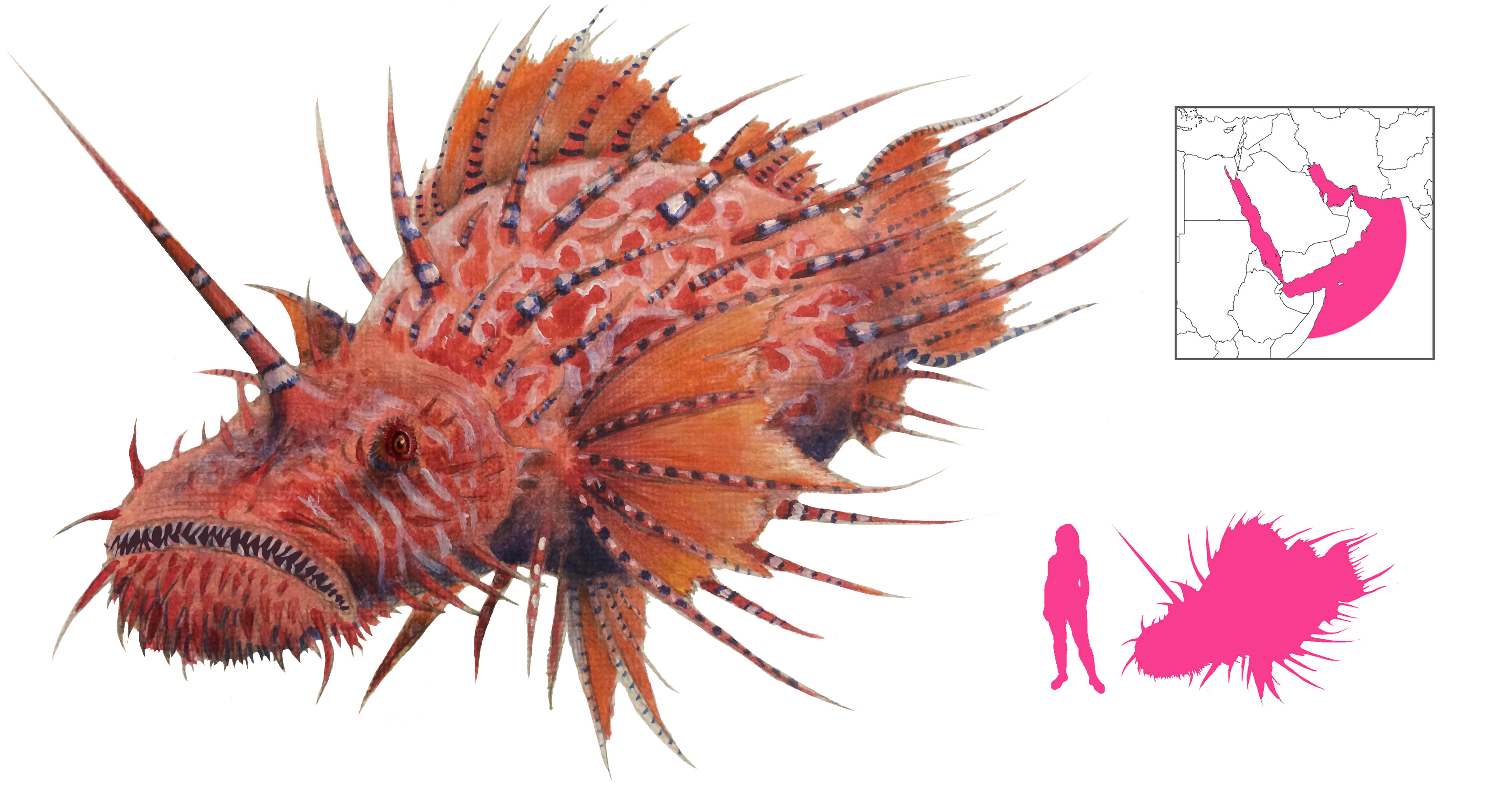
The Caspilly is a “marvelously large, and strong” fish from the Indian Ocean, described by Ambroise Paré on the basis of two separate accounts by André Thevet.
Thevet placed it in the Arabian Gulf, saying that it is known to the Arabs as caspilly, and to the Persians as neemora. The caspilly is almost as wide as it is long, but no more than two feet long. It has no scales, and its skin is spiky and barbed like that of a shark. On its forehead is a lancet-like spine, a foot and a half in length, that it keeps tucked along its nape. When it is hungry, it goes for the first fish it sees, stabbing it in the belly with its horn until its prey bleeds to death. Its teeth are venomous and bites are deadly. Applying a dead caspilly to a bite, on the other hand, will cure it. The horn is of great medicinal value, and caspilly are shot with arrows from a safe distance to retrieve such a prize.
Thevet also reports a nameless fish from the Peruvian sea, with a swordlike horn three feet long. This fish is a specialized whale killer. Upon seeing a whale, the fish will hide underneath before stabbing it in the navel with its horn, leaving the whale to writhe in its death throes and capsize nearby ships. Once the whale is dead, it can be eaten at leisure.
Paré economically combines both accounts, giving the caspilly a four-foot-long horn and making it the terror of the Arabian sea. He adds that the Arabs of the region hunt caspillys with giant hooks baited with camel meat. Any caspilly who greedily takes the bait will tire itself out on the line, eventually slowing down enough to be shot with arrows, brought onto ship, and bludgeoned to death. Caspilly flesh is edible, and caspilly alicorn is just as potent against venom as that of the unicorn.
In all likelihood the Caspilly was born from accounts of swordfish and killer whales, contaminated by lionfish and porcupinefish. The venomous bite may have been derived from the famed toxicity of pufferfish. Aldrovandi cautiously included it with his Herinaceus marinus, the porcupinefish, as Herinaceus arabus, the Arab hedgehog.
References
Aldrovandi, U. (1642) Monstrorum historia cum Paralipomenis historiae omnium animalium. Bononiae.
Paré, A. (1582) Discours d’Ambroise Paré – De la Licorne. Gabriel Buon, Paris.
Paré, A. (1614) Les Oeuvres d’Ambroise Paré. Nicolas Buon, Paris.
Thevet, A. (1575) La Cosmographie Universelle. Guillaume Chaudiere, Paris.
 A Book of Creatures