Original Creature – Do Not Steal
From Planché, J. R. (1859) The pursuivant of arms, or Heraldry founded upon facts. Robert Hardwicke, London.
Hello again! Here’s the solutions to the Ortus Sanitatis Quiz. How did you do? Judging by the responses, not too many people were eager to hazard a guess, but that’s fine, here’s where you get to see that you were right all along.

First up is one of the dreaded gold-digging ants. You’d think they’d know by then what ants look like, but their large size seems to have discombobulated many contemporary authors into depicting them as vertebrates of some sort.
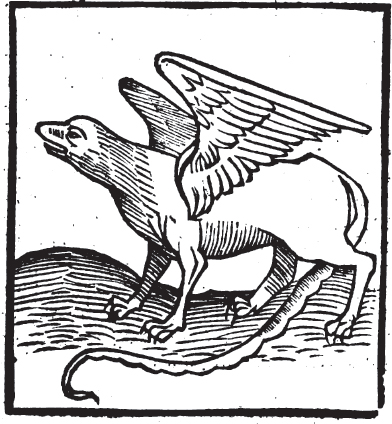
Another animal that a lot of bestiaries got confused about was the chameleon. If you’ve never seen a chameleon before – hell, if you’ve never seen a lizard before – it’s probably hard to picture it. Some figured that, going by its name, it’s some sort of camel-lion hybrid. Or a griffinesque thing, who knows? Chameleons are weird.
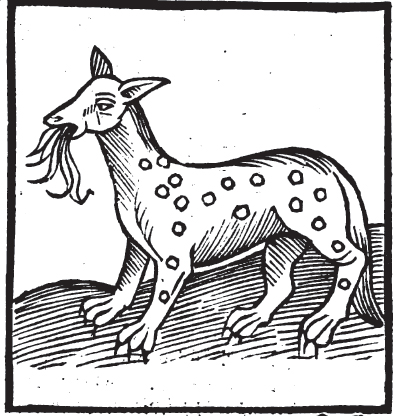
This one’s easier. The spots and fragrant breath identify it as a panther.
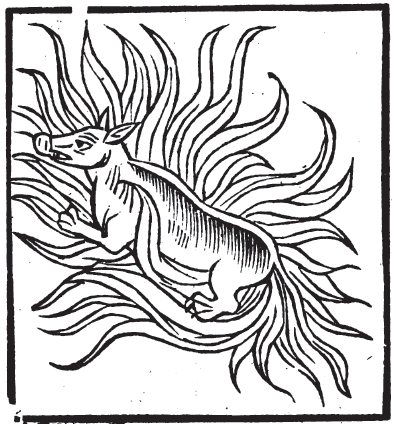
And the fire wreathing this piglike thing clearly sets it apart as a salamander.
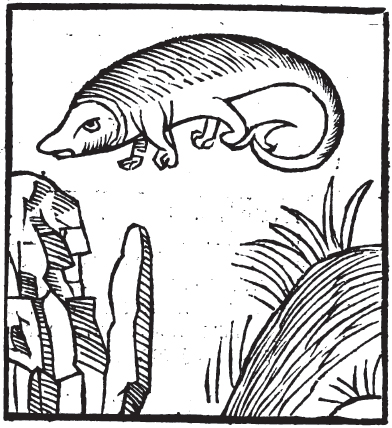
“What’s a scorpion like? It’s got… a sting on its tail right? But what’s the rest like? Eh, who cares”.

This baffling bird is a caprimulgus, goatsucker, or nightjar. The authors of the Ortus Sanitatis figured it needed some way to dispense its stolen milk. And in fact…
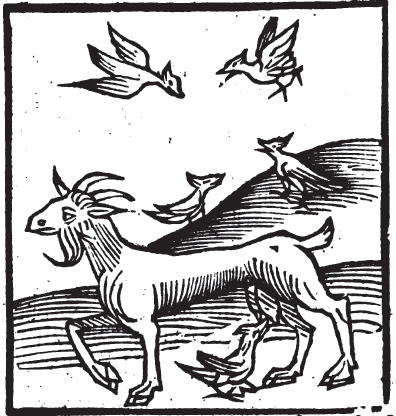
… this one’s also a nightjar! Trick question, I included two goatsuckers. This one shows it in the actual act of feeding on a nonplussed goat.
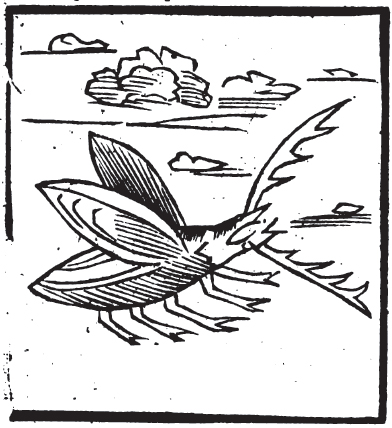
This one’s easy. Stag beetle! Or Vikavolt, who knows.
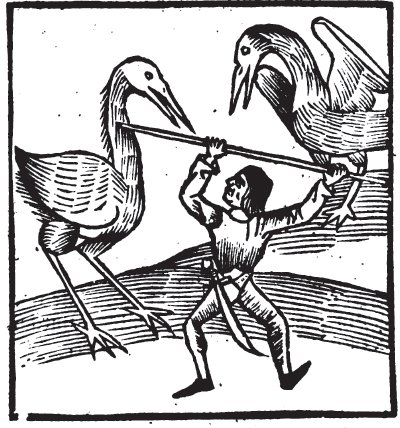
And those aren’t giant birds, they’re cranes fighting a pygmy.
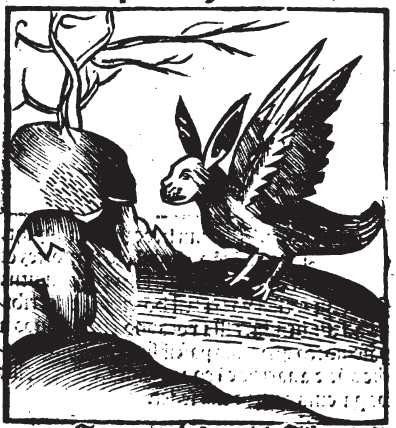
The lagopus, “rabbit foot”, is more commonly called the ptarmigan today. But the authors figured that a rabbit-footed bird probably had more rabbit to it than that.
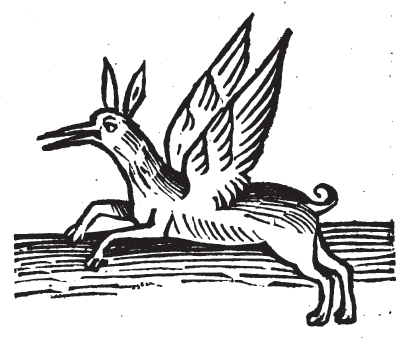
This one’s tricky. It’s an opimachus, or “snake fighter”. The term originally referred to a type of insect, but here I think there was some confusion with the secretary bird.
Is this the origin of the opinicus? I do believe so!
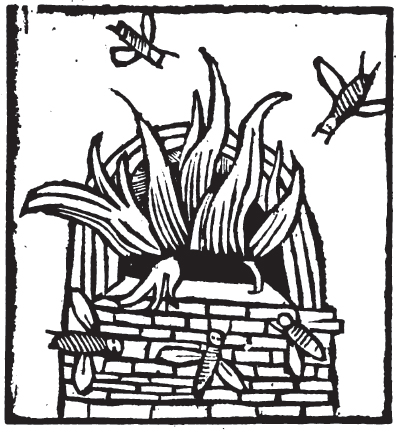
Insects going in and out of a fire? Pyrallis, obviously.
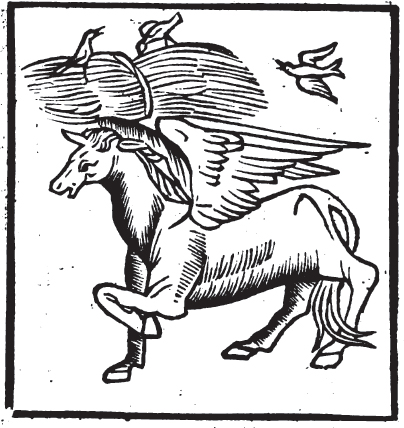
An ostrich is a struthiocamelus. That means it’s part camel, right? A camel-bird. Yeah. A camel-bird. With wings. That can’t fly.

Something tells me the artist never saw a dolphin before.

Or an oyster.
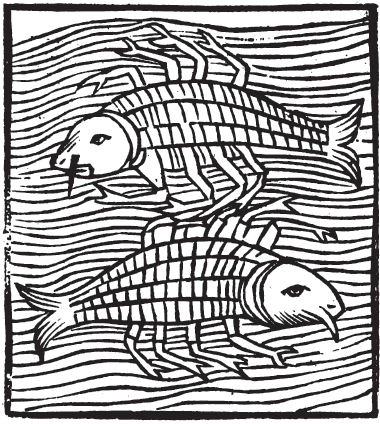
Or an octopus. See, the ancient Greeks (for instance) knew what a polypus looked like because they fished it up and ate it. But get yourself a landlocked medieval European and tell them that there’s a sea creature with eight legs… well, it’s a fish right?
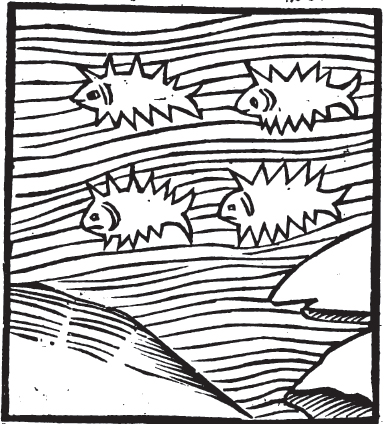
Starfish are also fish.
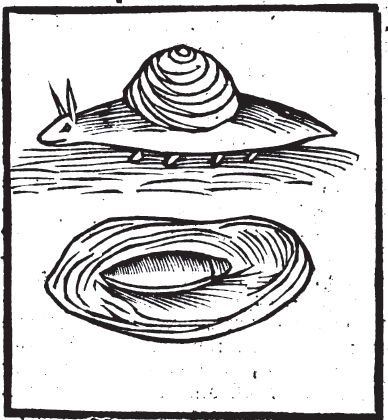
“Turtles are animals with shells? The only thing I know that has a shell is a snail… so… it’s a snail with legs?”
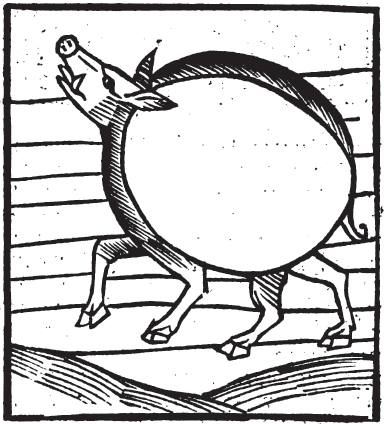
Giant tortoises are delicious.
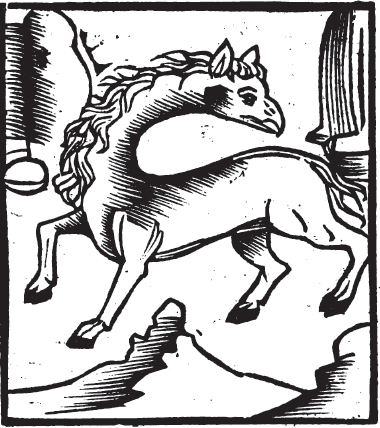
And finally, everyone’s favorite river-horse, the hippopotamus. Someone took the horse part a bit too literally.
How did you do? Give yourself a pat on the back if you knew at least half of them!
Come one, come all! Step right up and take the ABC Ortus Sanitatis Quiz! Amaze your friends – mystify your enemies with your encyclopedic knowledge of creatures!
The rules are simple. Presented and numbered here are twenty (20) unretouched creatures from the pages of the Ortus Sanitatis. Your task, should you choose to accept it, is to identify them all. Some are laughably easy. Some are fiendishly difficult. Some are trick questions. Which is which?
If you already know the solution because you’ve read the Ortus Sanitatis, don’t spoil it for other readers! A detailed analysis of the answers will be posted later. Have fun [sic]!
1
2
3
4
5
6
7
8
9
10
11
12
13
14
15
16
17
18
19
20
 “Now wait a darn minute!” you may find yourself asking. “The Freybug isn’t a modern monster, even if it’s obscure. It’s the Norfolk black dog. It got itself a starring role in William O’Connor’s Dracopedia series (which you should review) and even got name-checked as a Hound in Final Fantasy (pictured). It even got its own Wikipedia entry!” You’d be right as usual, good reader. But I would like to draw attention to the dearth of information regarding this Freybug. What is it? Where did it come from? Why was it used in the Dracopedia and Final Fantasy?
It’s all about the name really. Final Fantasy needed another black dog name, and the Dracopedia needed something fancy and frightening for the letter F. Besides, it has the words frey and bug. Two great tastes that taste great together.
As with many obscure creatures, Giants, Monsters, and Dragons is the ultimate source. What does GMaD tell us?
This is the name of a monster in the medieval traditions and folklore of England. It took the form of a monstrous black dog that patrolled the country lanes at night terrifying late travelers and making them flee in horror. It is mentioned in an English manuscript of 1555.
There is only one reference provided, which hilariously is Rose’s other book, Spirits, Fairies, Gnomes, and Goblins. And SFGaG says the following.
This is the name of a demon of the roads in English folk beliefs of the Middle Ages. It was described as a Black Dog fiend and referred to in an English document of 1555.
References? None whatsoever. Dead end. I know I’ve complained about it a lot but I’ll say it again.
Source.
Your.
Damn.
Creatures.
This is the only freybug reference I can consistently find. I have no idea where the Norfolk thing came from, considering Shuck is the Norfolk black dog. And Shuck wouldn’t take well to competition, I’d wager.
As things stand we have only Rose’s word for it that the freybug is from an “English manuscript” from 1555. One that’s conveniently uncited. Unless further evidence surfaces (and I have no doubt Rose has access to all sorts of cool manuscripts) I’m inclined to consider this a Borgesian literary in-joke. And if it is, it certainly would be a modern creature. Quod erat demonsterandum.
Welcome to the ABC 2017 Wrap-Up, the part of the blog where I talk about the state of ABC and what this means for me, for you, and for the rest of the known universe. It’s been a long, lousy, lolloping year, one in which I made major changes to ABC – changes which are either wise choices or the worst decisions I’ve ever made.
What can I say about them? Let’s dive right in and find out.
ABC Past

I started A Book of Creatures in the distant, murky past of 2015. I was young and optimistic then, full of grandiose and ill-advised hopes. I had made my own handwritten and hand-drawn encyclopedia when I was in middle school, and the idea never quite left me. As my artistic abilities reached acceptable levels, I wanted to write a book of creatures.
I wanted ABC to be the ultimate reference to mythical entities. In my original idea I wanted to cover everything from obscure fishes like the caspilly (above, my version below) to fairies and dwarfs and goblins and even including entries for the folkloric conceptions of animals (i.e. how have ravens, snakes, whales, centipedes, etc. been interpreted by different cultures). It was an ambitious project but at the time it seemed feasible. If I do three entries a week, then… quick math… I should be done in a few years right? How bad can it be? No fear, right?
I was wrong. Dead wrong. Götterdämme-wrong. The more I wrote, the more I painted, the more I researched, the more I continued to find creatures. Oh, and it was such an adventure finding them! Reading obscure and esoteric books to find details on things that other bestiaries take for granted… it was fun! … and it was also time-consuming. And the more detail I lavished on unknown things like giant tadpoles and medicinal mermaids, the more I shuddered at having to eventually tackle things like giants and elves and dwarfs and fairies, which have had libraries’ worth of books written on them. I thought I’d have to pad out ABC, but there was more creatures than I could handle on my own.
To top it off life started to intrude, little by little, and my ability to handle things started to fall apart – as did I. I won’t write you my life story, but I found myself having to cut back on the frequency of updates. Then I stopped writing creature entries altogether.
ABC Present

Why did I stop? From the start I’d always wanted ABC to be a print book. A solid, colorful encyclopedia that you can take off the shelf anytime and read cover to cover, or ” dip into [the] pages at random, just as one plays with the shifting patterns of a kaleidoscope”, as Borges put it. If I posted everything online, what would be a publisher’s incentive to print the book? What would be your incentive to buy it?
That’s why I stopped. I left everything up here for now because it’s all Important and Valuable Information that should be freely available, but I decided to put it on hold for now until something more concrete materializes for the book. Instead I’m posting other things, book reviews and obscure modern monsters and behind-the-scenes stuff which was requested at the time.
I also trimmed the fat significantly, reviewing and rewriting my definition of “creature” multiple times. As things stand, ABC will not be including things like fairies and goblins and gnomes – creatures that are more or less human in every sense except for magical ability. For now this scope is far too broad for ABC – at least, too broad for the approach I’ve taken.
ABC Future
What does this mean for the future?
I want to continue updating this site with material. It’s my raison d’etre, as it were. I can continue with the asides, or maybe put sketches and snippets of what I’m working on now. I might even go back to posting entries if I feel like I’ve advanced enough.
More importantly, I’m working on the final product. ABC had about 200 or 300 entries when I stopped updating. Including those, I currently have almost 700 entries and counting for the final book. Some of those are pretty much complete, others are works in progress and yet others are outlines. The way I’ve been going about it is going through my references one by one and making sure to enter that information. The art will happen later; I believe finalizing a first draft is higher priority.
As things stand it looks like crowdfunding publishing is the way to go. I will only start working on this seriously once the book is nearing completion. I don’t want to raise hopes and funds over a half-baked product. The downside of this is that, well, it might take a while.
But that’s what 2018 is for. That’s what I’ll be working on.
What about you? Any comments? Anything you’d like to see? Any aspersions to cast? Please let me know!
Otherwise I’ll be right here.
Beastfully yours,
ABC
The year is rapidly drawing to a close, and we’re getting closer and closer to ABC’s big wrap-up announcements of 2017. But I’ve still got some things I want to share. Namely, my primary source for how I’ve been interpreting the illhveli – the Evil Whales of Iceland. That’s right, I’m talking about Jon Gudmundsson’s illustrated Natural History of Iceland. Let’s take a look at the more relevant entries!

Gudmundsson’s raudkembingur has a mane on its nape and a reptilian phizog. Not bad!

The hrosshvalur is something else. What’s up with that eye? It could also be a killer-whale-esque white marking or something, but a lot of the hrosshvalur’s lore has to do with its eye(s). So it’s an eye, I say. It’s also got a spiffy dappled look to it, which I went with for the final product, but no mane.

Everyone’s favorite corpse-whale, the narwhal. Actually I lied. Nobody likes narwhals.
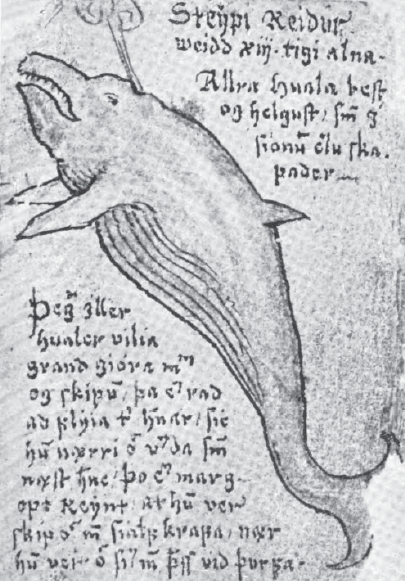
And I wouldn’t dream of posting this without including the hero figure of the whales, the steypireydur or blue whale. Here it is in all its glory. If you plan on writing a fantasy novel and want a Christ/Gandalf/Aslan analogue, be different and use a blue whale.
References
Hermansson, H. (1924) Jon Gudmundsson and his Natural History of Iceland. Islandica, Cornell University Library, Ithaca.
How did you do on the recent picture quiz? If you guessed anything related to Lucerne or Mount Pilatus, you are absolutely right. And you’d also be right if you said the words Kircher or Scheuchzer. But what on earth is this thing? It’s not a regular tatzelwurm, it doesn’t have cat features or look small and snaky. It looks Chinese, if anything. What’s it doing in Lucerne?
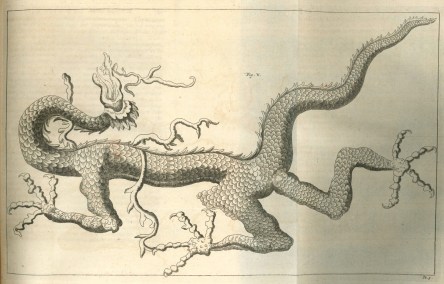
I’m going to tell you a story. The marvelous tale of Vietor, the cooper of Lucerne. His adventures are told in Kircher’s Mundus Subterraneus. Scheuchzer copies the story and adds the image you see above in his Itinera Alpina.
Vietor was a humble cooper (that is, he makes barrels) who lived in Lucerne around 1420. He set out one day to fetch wood on the slopes of Mount Pilatus, only to fall through a deep pit. The cave Vietor ended up had no exit save the one he fell in from, and the walls were too steep and dangerous to scale. Somehow this situation got even worse when two hideous dragons showed up!
Fortunately for Vietor, his prayers were answered and the dragons were not allowed to harm him (or maybe they were already harmless? The text makes it clear that it’s a miracle though). They weren’t much help either. The dragons spent their time sleeping or eating a sort of oozy liquid that came out of the rocks. Vietor followed their example. On this meager diet and in the slithery companionship of the dragons he survived from November 6 to April 10 – 6 months. On the last day the dragons took to the air to find greener fields, and Vietor held on to the second dragon’s tail as it took off.
Thus Vietor escaped his imprisonment in the cave and returned to Lucerne, where he had long been thought dead. But his liquid diet had ruined his digestive system, and he died two months later.
I bet you’re wondering what the dragon image has to do with all this. Well, before Vietor died he had the dragons and himself embroidered on a chasuble, which was presented to Saint Leodegarius’ Church in Lucerne. Scheuchzer reproduces the image of one of the dragons.
And that’s where Scheuchzer gets sassy about it, pointing out that it looks a lot like an imperial Chinese dragon. So what exactly happened? My guess is that a piece of far Eastern embroidery somehow ended up in Lucerne*, and the story of Vietor grew around that piece of cloth long after its origin was forgotten. At any rate all records of the event were destroyed in a fire.
*Now there’s an Indiana Jonesesque adventure plot if I’ve ever seen one.
Which just goes to prove how much cultural cross-pollination was constantly happening. Folklore and mythology doesn’t happen in a vacuum.
Vietor’s dragonscapades were also colorfully retold in Usborne’s Stories For Young Children by Christopher Rawson and Stephen Cartwright. It’s also where I first read the story, long before embarking on ABC. Here he has the more common name of Victor.
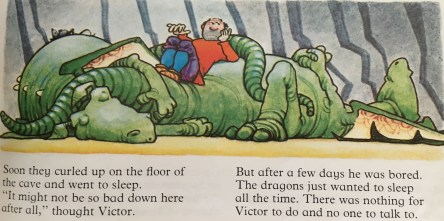
It also has a lovely wormy Lambton worm.
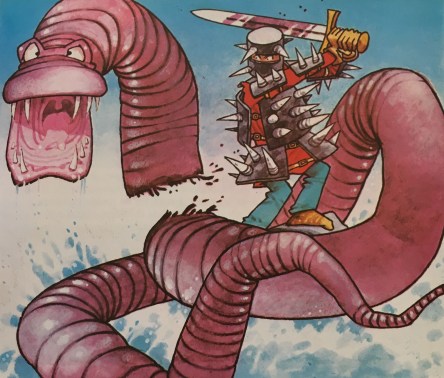
“””””for young children”””””
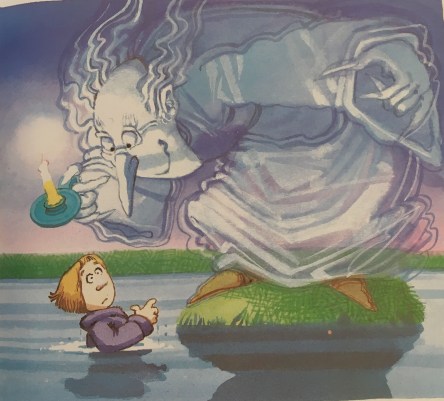
… as well as this cool Candlejack Willy the Wisp [sic].
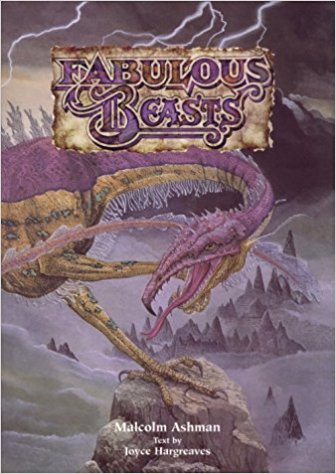
Fabulous Beasts
Malcolm Ashman and Joyce Hargreaves
There are two kinds of modern bestiary (and by bestiary I mean books of fantastic creatures, as opposed to real bestiaries which are books of creatures as moral lessons): the visual and the textual. They aren’t set in stone but fit on a spectrum. I should make a sliding scale graphical representation of it someday. Where was I? Oh, right. Long before a certain bespectacled wizard kid showed up, this was a top hit for beast-related keywords. It fits far on the visual side of the scale. And it is quite the piece of eye candy. Let’s have a gander!
It can be bought here and here.
Scope
“[F]antastic creatures of myth and legend… from every corner of the world”. The focus is, however, Classical and Medieval European as expected. In fact about half of the creatures covered are Greco-Roman.
It’s a bit broader in scope than ABC, including things like gods (Pan, Quetzalcoatl), transformed humans (Blodeuedd, Werewolves), transformed gods (Zeus in swan and bull forms), and ghosts of sorts (Herne the Hunter).
Organization
Some 50 creatures are divided into four sections: Birds, Dragons and Serpents, Half Human, and Animals (meaning Mammals). The divisions are basic but with a smaller number of creatures they do fine (even if you could argue that some creatures go in different categories; fabulous beasts always did defy classification).
Text
The text is by Joyce Hargreaves, and it’s serviceable. Does a good job of retelling classic tales, as well as things like Borges’ creatures.
There are some parts where there’s some disconnect between text and art – Typhon has a body covered with feathers apparently, but it’s not shown there (unrelated but this book seems to be the origin of the Typhon-with-a-donkey’s-head meme?).
Images
If you’re buying this book, you’re buying it for the illustrations by Malcolm Ashman. And oh, what illustrations they are. The Simurgh, the Nile Goose, the Lambton Worm coiled around rolling hills… they’re all colorful (pencil drawings excluded) and evocative. They’re definitely worth the price of entry, and stand up to repeated viewing.
There are some interesting takes on things. The Cyclops is made completely monstrous – I’m talking crocodile osteoderms on the legs here. The Lamia follows classic snake-tailed conventions but shares the book with a full-color Echidne. Two snake-women in one book? Why not? The Heavenly Cock, Rainbird, and Phoenix are all done up as golden pheasants and birds of paradise and are beautiful to behold. The Roc looks like an Andean condor, which bothers the ornithologist in me, but it looks awesome.
I’m also going to take the brave stance of saying that nobody, but nobody draws pervy animals like Ashman does. Check out his Europa’s bull and Leda’s swan. Zeus isn’t even trying to hide how lecherous he is for hot mortals. Seriously, they’re scary. Gah.
Research
No references, but as mentioned it visibly draws on Borges’ Book of Imaginary Beings as well as the usual stable of giants, monsters, and dragons. Things like the Rainbird are practically illustrated Borges entries. The Peryton tale is retold with a straight face (again). The Simurgh follows Borges’ favored description, itself from Flaubert and originally not applicable to the Simurgh!
The main problem is that there really isn’t anything new to learn for the advanced teratologist. If you’re a regular reader of ABC, then you probably already know about things like the Nemean Lion and the Erymanthian Boar and the Manticore.
Summary
A beautiful, beautiful book that takes familiar creatures and makes them look good. Definitely recommended for the stellar illustrations, but don’t expect to learn anything new or find novel references. A solid rating of 4 in my opinion.
Who remembers Atari? That’s a rhetorical question because, despite being in the right age bracket for it, for a number of reasons I’ve never actually played on it. But I knew it existed. And I knew some ads for Atari games. One of them really fired up my imagination. That’s right, I’m here to talk about Space Cavern.
Images from Atarimania.
Space Cavern ran an ad in magazines that looked a little something like this.
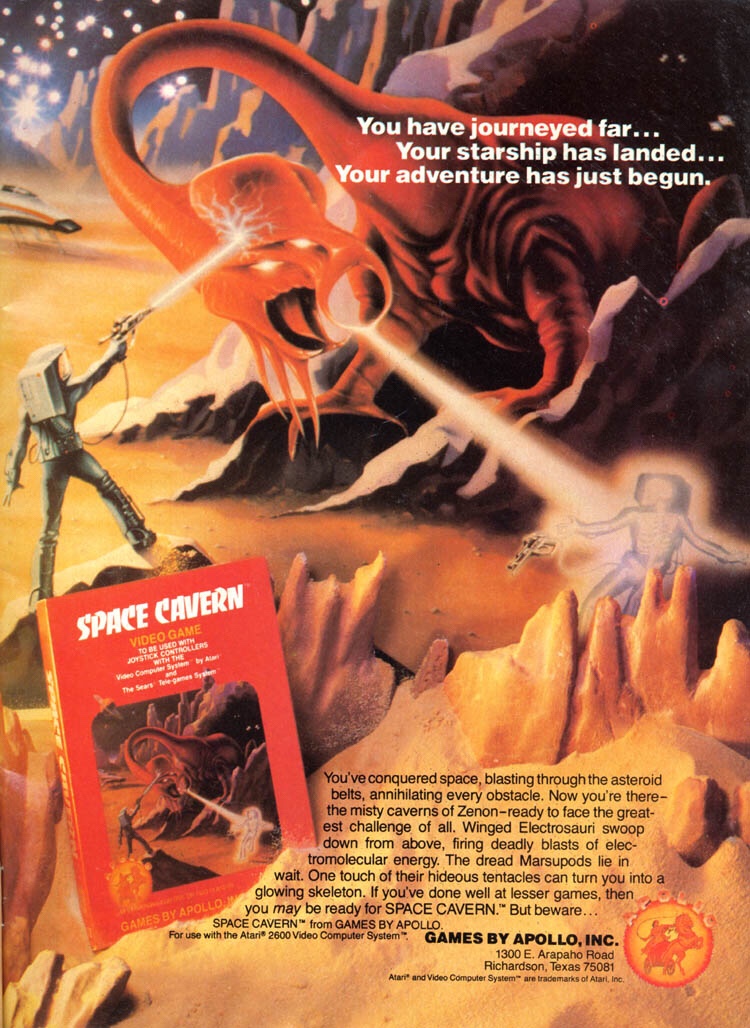
How awesome is that? Judging by the description that thing is a marsupod. Does it have four eyes or are those spots of bioluminescence? Is that its brain? Is it a demon sauropod that zaps you with lightning? Who knows, it’s metal as all hell. And it scared me somewhat too – I didn’t want to become a skeleton!
Electrosauri are nowhere in sight though. I always though they must look something like pterosaurs. Electric pterosaurs.
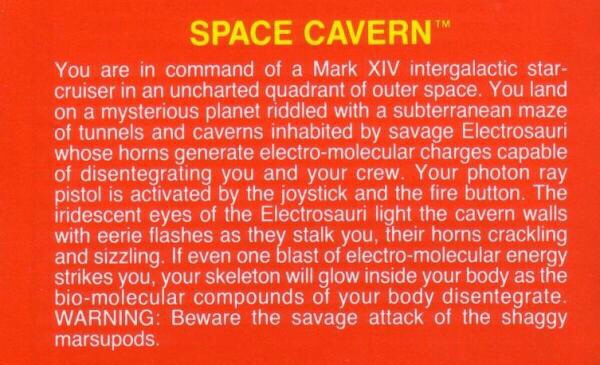
The official description calls marsupods “shaggy”. That… thing… up there does not look shaggy. Unless you’re being charitable about its chin danglers. Still no visual representation of an electrosaurus (?), which makes me sad.
Of course there was a bit of artistic license taken in the art. Actual gameplay looks a little something like this.
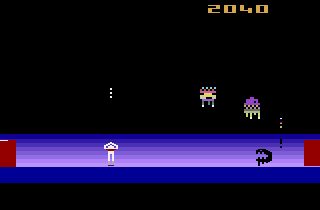
The electrosauri are the Space Invader things floating over the horizon, while the marsupod is the evil Pacman emerging from the right-hand side of the screenshot. I don’t know how they got a demon sauropod out of that, please don’t ask.
You know the gag would have worked with just one swordfish, but Dr. Seuss had to go and draw over 20 swordfishes, each one of them different. Now that’s what I call creature-based dedication (crebadication?).
Found in The Tough Coughs as he Ploughs the Dough (pronounced “the tuff cuffs as he pluffs the duff”).

 A Book of Creatures