Welcome to the ABC 2017 Wrap-Up, the part of the blog where I talk about the state of ABC and what this means for me, for you, and for the rest of the known universe. It’s been a long, lousy, lolloping year, one in which I made major changes to ABC – changes which are either wise choices or the worst decisions I’ve ever made.

What can I say about them? Let’s dive right in and find out.

ABC Past

img_3019

I started A Book of Creatures in the distant, murky past of 2015. I was young and optimistic then, full of grandiose and ill-advised hopes. I had made my own handwritten and hand-drawn encyclopedia when I was in middle school, and the idea never quite left me. As my artistic abilities reached acceptable levels, I wanted to write a book of creatures.

I wanted ABC to be the ultimate reference to mythical entities. In my original idea I wanted to cover everything from obscure fishes like the caspilly (above, my version below) to fairies and dwarfs and goblins and even including entries for the folkloric conceptions of animals (i.e. how have ravens, snakes, whales, centipedes, etc. been interpreted by different cultures). It was an ambitious project but at the time it seemed feasible. If I do three entries a week, then… quick math… I should be done in a few years right? How bad can it be? No fear, right?

I was wrong. Dead wrong. Götterdämme-wrong. The more I wrote, the more I painted, the more I researched, the more I continued to find creatures. Oh, and it was such an adventure finding them! Reading obscure and esoteric books to find details on things that other bestiaries take for granted… it was fun! … and it was also time-consuming. And the more detail I lavished on unknown things like giant tadpoles and medicinal mermaids, the more I shuddered at having to eventually tackle things like giants and elves and dwarfs and fairies, which have had libraries’ worth of books written on them. I thought I’d have to pad out ABC, but there was more creatures than I could handle on my own.

To top it off life started to intrude, little by little, and my ability to handle things started to fall apart – as did I. I won’t write you my life story, but I found myself having to cut back on the frequency of updates. Then I stopped writing creature entries altogether.

ABC Present

Caspilly

Why did I stop? From the start I’d always wanted ABC to be a print book. A solid, colorful encyclopedia that you can take off the shelf anytime and read cover to cover, or ” dip into [the] pages at random, just as one plays with the shifting patterns of a kaleidoscope”, as Borges put it. If I posted everything online, what would be a publisher’s incentive to print the book? What would be your incentive to buy it?

That’s why I stopped. I left everything up here for now because it’s all Important and Valuable Information that should be freely available, but I decided to put it on hold for now until something more concrete materializes for the book. Instead I’m posting other things, book reviews and obscure modern monsters and behind-the-scenes stuff which was requested at the time.

I also trimmed the fat significantly, reviewing and rewriting my definition of “creature” multiple times. As things stand, ABC will not be including things like fairies and goblins and gnomes – creatures that are more or less human in every sense except for magical ability. For now this scope is far too broad for ABC – at least, too broad for the approach I’ve taken.

ABC Future

What does this mean for the future?

I want to continue updating this site with material. It’s my raison d’etre, as it were. I can continue with the asides, or maybe put sketches and snippets of what I’m working on now. I might even go back to posting entries if I feel like I’ve advanced enough.

More importantly, I’m working on the final product. ABC had about 200 or 300 entries when I stopped updating. Including those, I currently have almost 700 entries and counting for the final book. Some of those are pretty much complete, others are works in progress and yet others are outlines. The way I’ve been going about it is going through my references one by one and making sure to enter that information. The art will happen later; I believe finalizing a first draft is higher priority.

As things stand it looks like crowdfunding publishing is the way to go. I will only start working on this seriously once the book is nearing completion. I don’t want to raise hopes and funds over a half-baked product. The downside of this is that, well, it might take a while.

But that’s what 2018 is for. That’s what I’ll be working on.

What about you? Any comments? Anything you’d like to see? Any aspersions to cast? Please let me know!

Otherwise I’ll be right here.

Beastfully yours,

ABC

The year is rapidly drawing to a close, and we’re getting closer and closer to ABC’s big wrap-up announcements of 2017. But I’ve still got some things I want to share. Namely, my primary source for how I’ve been interpreting the illhveli – the Evil Whales of Iceland. That’s right, I’m talking about Jon Gudmundsson’s illustrated Natural History of Iceland. Let’s take a look at the more relevant entries!

gudraud

Gudmundsson’s raudkembingur has a mane on its nape and a reptilian phizog. Not bad!

gudhross

The hrosshvalur is something else. What’s up with that eye? It could also be a killer-whale-esque white marking or something, but a lot of the hrosshvalur’s lore has to do with its eye(s). So it’s an eye, I say. It’s also got a spiffy dappled look to it, which I went with for the final product, but no mane.

gudnah

Everyone’s favorite corpse-whale, the narwhal. Actually I lied. Nobody likes narwhals.

gudstey

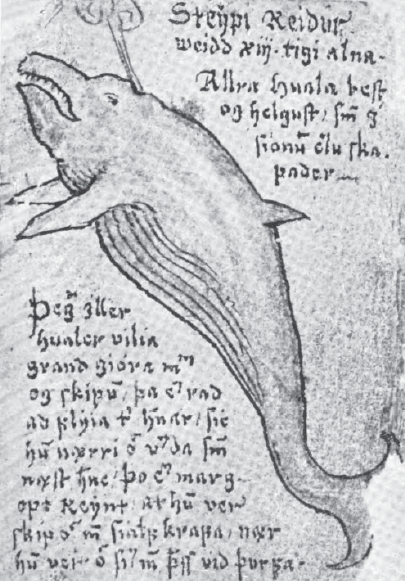
And I wouldn’t dream of posting this without including the hero figure of the whales, the steypireydur or blue whale. Here it is in all its glory. If you plan on writing a fantasy novel and want a Christ/Gandalf/Aslan analogue, be different and use a blue whale.

References

Hermansson, H. (1924) Jon Gudmundsson and his Natural History of Iceland. Islandica, Cornell University Library, Ithaca.

What did Scylla look like? Homer gives her six heads armed with triple rows of teeth on her shoulders. Ovid gives her six dog’s heads at her waist and twelve dog’s legs. Neither of them mention the long mermaidy fish-tail that she’s usually depicted with in art (where she’s a sort of mermaid with a dog or two grafted to her waist).

So which is right? One or all of them? Rodney Matthews’ excellent illustration from The Usborne Book of Greek and Norse Legends (1987) bravely tries to include as much as possible.

All in a very alien sort of look. No twelve legs though.

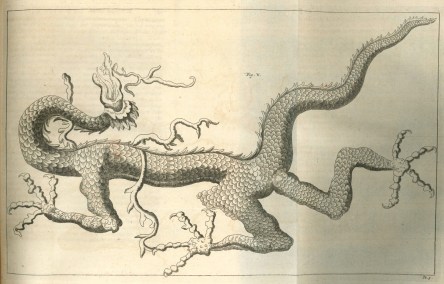
How did you do on the recent picture quiz? If you guessed anything related to Lucerne or Mount Pilatus, you are absolutely right. And you’d also be right if you said the words Kircher or Scheuchzer. But what on earth is this thing? It’s not a regular tatzelwurm, it doesn’t have cat features or look small and snaky. It looks Chinese, if anything. What’s it doing in Lucerne?

IMG_9642

I’m going to tell you a story. The marvelous tale of Vietor, the cooper of Lucerne. His adventures are told in Kircher’s Mundus Subterraneus. Scheuchzer copies the story and adds the image you see above in his Itinera Alpina.

Vietor was a humble cooper (that is, he makes barrels) who lived in Lucerne around 1420. He set out one day to fetch wood on the slopes of Mount Pilatus, only to fall through a deep pit. The cave Vietor ended up had no exit save the one he fell in from, and the walls were too steep and dangerous to scale. Somehow this situation got even worse when two hideous dragons showed up!

Fortunately for Vietor, his prayers were answered and the dragons were not allowed to harm him (or maybe they were already harmless? The text makes it clear that it’s a miracle though). They weren’t much help either. The dragons spent their time sleeping or eating a sort of oozy liquid that came out of the rocks. Vietor followed their example. On this meager diet and in the slithery companionship of the dragons he survived from November 6 to April 10 – 6 months. On the last day the dragons took to the air to find greener fields, and Vietor held on to the second dragon’s tail as it took off.

Thus Vietor escaped his imprisonment in the cave and returned to Lucerne, where he had long been thought dead. But his liquid diet had ruined his digestive system, and he died two months later.

I bet you’re wondering what the dragon image has to do with all this. Well, before Vietor died he had the dragons and himself embroidered on a chasuble, which was presented to Saint Leodegarius’ Church in Lucerne. Scheuchzer reproduces the image of one of the dragons.

And that’s where Scheuchzer gets sassy about it, pointing out that it looks a lot like an imperial Chinese dragon. So what exactly happened? My guess is that a piece of far Eastern embroidery somehow ended up in Lucerne*, and the story of Vietor grew around that piece of cloth long after its origin was forgotten. At any rate all records of the event were destroyed in a fire.

*Now there’s an Indiana Jonesesque adventure plot if I’ve ever seen one.

Which just goes to prove how much cultural cross-pollination was constantly happening. Folklore and mythology doesn’t happen in a vacuum.

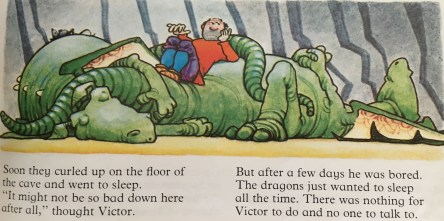
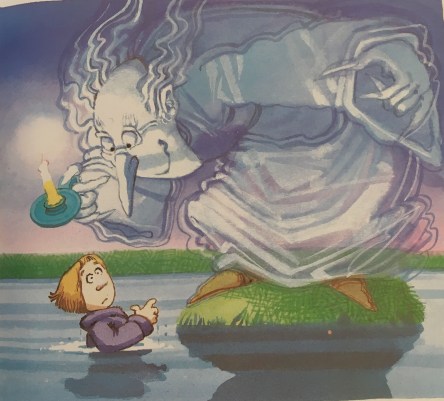
Vietor’s dragonscapades were also colorfully retold in Usborne’s Stories For Young Children by Christopher Rawson and Stephen Cartwright. It’s also where I first read the story, long before embarking on ABC. Here he has the more common name of Victor.

1

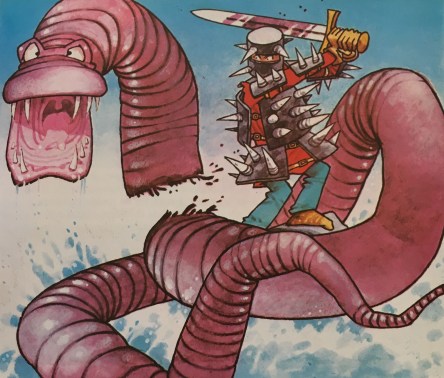
It also has a lovely wormy Lambton worm.

2

“””””for young children”””””

3

… as well as this cool Candlejack Willy the Wisp [sic].

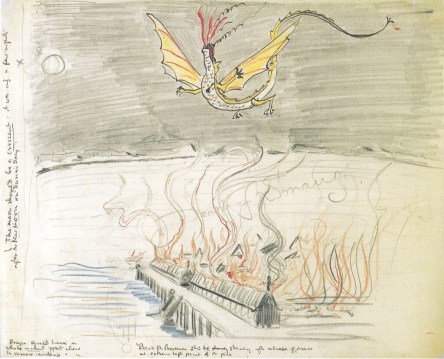
Tolkien’s color pencil sketch of Smaug means a lot to me, not least that it was the cover of my first Hobbit book and I was convinced, pre-reading, that that twisty flying thing was The Hobbit. With feathery red plumes on its head and a little smiley face where Smaug’s chin is.

But I digress. Check out Tolkien’s notes on the margins. “Bard the Bowman should be standing after release of arrow at extreme left point of the piles”, “Dragon should have a white naked spot where the arrow enters”, and best of all, “The moon should be a crescent: it was only a few nights after the New Moon on Durin’s Day”. Oh Tolkien you wonderful nerd.

You know the gag would have worked with just one swordfish, but Dr. Seuss had to go and draw over 20 swordfishes, each one of them different. Now that’s what I call creature-based dedication (crebadication?).

Found in The Tough Coughs as he Ploughs the Dough (pronounced “the tuff cuffs as he pluffs the duff”).