carnivores-logo

Ah yes, the 90s, back when men were XTREME, women were XTREME, and toys were THE KOOLEST EVER. Toy manufacturers were constantly outdoing themselves in making XTREME action figures, and in a post-Transformers landscape, the importance of a storyline to enhance the play pattern was recognized.

Makers of toy cars in particular had to reinvent themselves. Making die-cast toys was becoming increasingly expensive, forcing them to cut corners (more on that in a later post); worse, they were losing in popularity to the XTREME newcomers. That’s when increasingly bizarre lines of “cars” were produced and died with a whimper. They were not huge sellers, but they were pretty cool- sorry, I mean XTREME. This post is dedicated to one such short-lived line.

Matchbox’s Carnivores (Carnivores, get it?) were short-lived and obscure by any account. There was only one wave produced in 1995, and nothing else after that. The backstory was fairly flimsy – car-monsters battling each other in an XTREME post-apocalyptic landscape – and the marketing was half-hearted (Skull Shooter, for instance, didn’t even get advertised on the back of the packaging). They did make a catchy ad for them with a bit of claymation, though. Nowadays they lurk in the dark recesses of eBay.

What connection do I have with them? Back in 1995, I was presented with the opportunity of having either a Carnivore or The Illustrated Book of Myths. I chose the latter, obviously, but the toys and their box art remained etched in my young mind. It wasn’t until years later that I found out what those things were.

There were seven Carnivores in total. All of them had “Ax-L Action”, which is to say that the wheels made their legs move around like they were crawling forward. Two of those were “deluxes” slightly larger than the others and with more action features. As for the creatures themselves, well… let’s see what they have to offer. I will be using the box art because it’s even more gloriously monstery than the toys.
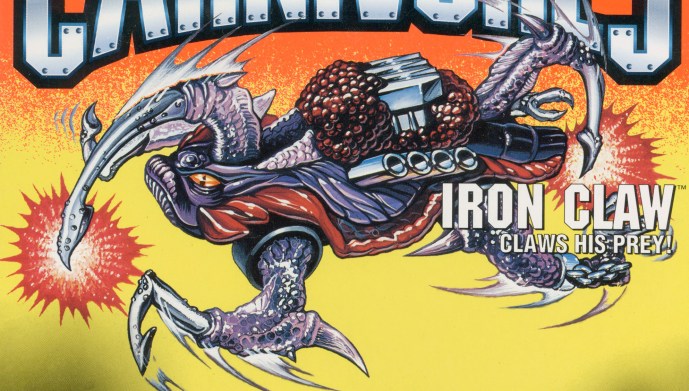
iron-claw

Iron Claw is fairly typical of the “basic” line, with crawling legs and a simple action feature – in this case, pressing the back claw causes the front claw to stab downwards. Iron Claw himself (only male pronouns are used, because girls aren’t allowed to play with XTREME car monsters) appears to be some kind of slug (or at least a mollusc), with a round sucker mouth, the eponymous iron claws, and an engine block in his back uncomfortably surrounded with tubercular tumorous tissue. He’s beautiful.
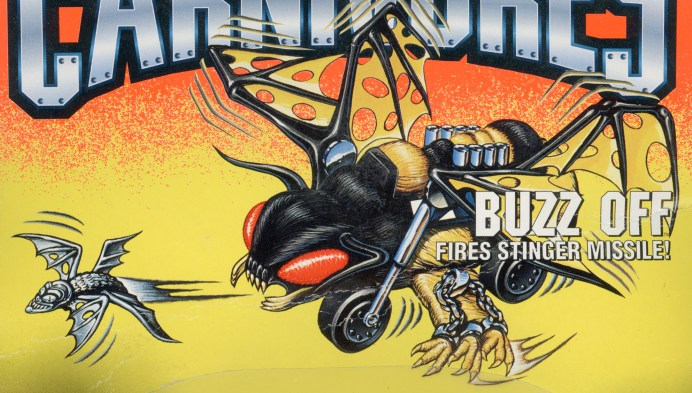
buzz-off

Buzz Off is much easier to narrow down: a giant car-wasp, with ragged membranous wings and three pairs of legs. And bull horns, apparently. But what’s with the chains? You will note that almost all the Carnivores have broken chains on their legs. Were they once tied up? Are they a top secret government experiment gone wrong? The world may never know.

Buzz Off’s gimmick is a “stinger missile”, a missile that can be spring-loaded and fired a short distance. It also appears to be sentient. Maybe they chat with each other in between dismembering prey.
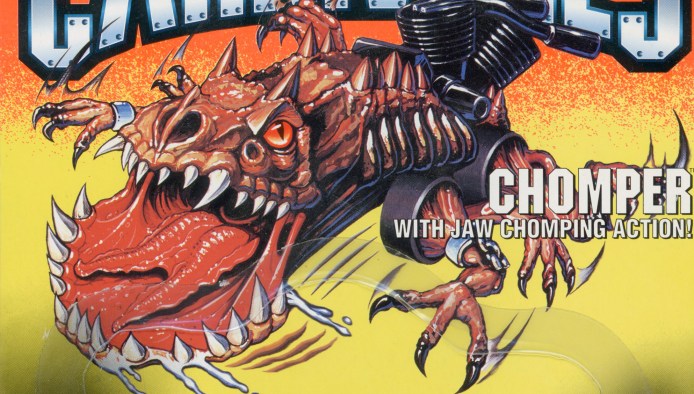
chomper

A huge mouth, teeth, drool, wrinkly skin… Yup, this hits all the right buttons. Chomper’s gimmick is straightforward: he chomps stuff. This is the sort of thing that could keep you busy forever. Chomper seems rather toadlike, but I want to imagine that it’s a mutated horned lizard. And can also shoot blood from its eyeballs.

spitfire

Spitfire is apparently some kind of squid? But it also has a ring of teeth and tentacles with claws attached to them? Yeah, I don’t know either. This one’s gimmick is spewing “deadly venom” – OK, water – that you load up and fire by pressing the soft plastic engine block on the back.
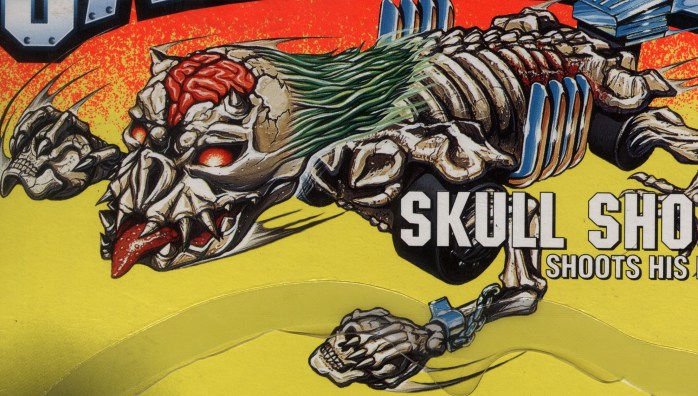
skull-shooter

Skull Shooter, the zombie skeleton of the bunch, is the “secret” Carnivore, being largely unadvertised. He’s grabbing a pair of human skulls, so apparently the Carnivores share the Earth with us, and it gives us a sense of scale. He doesn’t seem to correspond with any known animal as far as I can tell.

Oh, and he shoots his own spring-loaded head off as a weapon. Metal.

venom-spitter

Venom Spitter is one of the two “deluxe” Carnivores, and is a large creature that’s mostly mouth and which has stolen Spitfire’s venom-spewing powers. It’s not clear what it’s mean to be, but the first thing I think of when I see that huge mouth and those tusks is a hippopotamus.

bite-wing

Bite Wing, finally, is the other “deluxe” and is the most unconventional Carnivore, being not a car but a helicopter that evolved from some kind of mutated bat. It also has what seems to be an insect’s thorax and abdomen, so it’s another one of those darn GMOs.

It comes with not one, but two “parasite bombs” that look like secondarily flightless vampire bats. And they too seem to have a mind of their own. Do they make small talk while being carried by their “parent”? Do they monitor Carnivore activity from on high?Are they good cops or loose cannons? Do they like lattes? So many questions, but the closure of the line in 1995 means that there will never be answers.

Carnivores are © Matchbox.

A short interlude to explain a bit about how the art for A Book of Creatures is made. Like every artist, I’m my own worst critic and think my work is awful, but I do feel obliged to explain how I make the things that I believe could have been done so much better if only I’d used more ultramarine.

Most of the art in ABC is acrylics and pencil, with touchups on Photoshop. Some paintings (the Sinad, Dijiang, and all the Libyan snakes) were done in watercolor and pencil, for no real reason other than “it seemed like a good idea at the time”. The extent of Photoshop adjusting varies from 0 to extensive, depending on how much I hated the final result. To my eternal shame, I have not yet figured out how to paint on Photoshop, but I swear I will one day. Eventually…

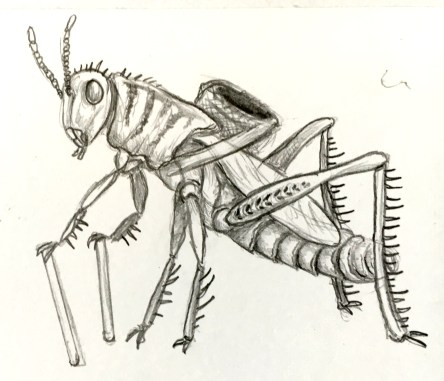
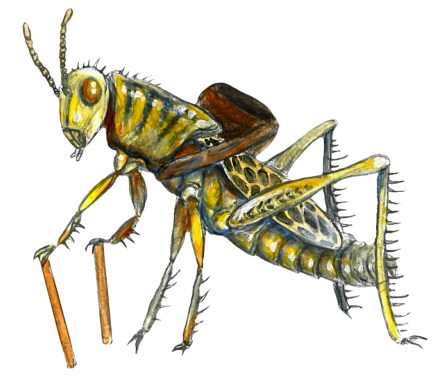
For my example, I will be following the creation of Haakapainiži, everyone’s favorite murderous anthropophagous eye-gouging grasshopper. Like all good paintings, Haakapainiži started out with a sketch, and before the sketch came the research. I knew Haakapainiži should be a grasshopper, but what kind of grasshopper? I love lubber grasshoppers, and their reduced wings, spikes, and poison seemed ideal for a ground-based menace like Haakapainiži.

1

Once the rough sketch is done, I start filling in details. This includes the basket, patterns, and textures. Probably because I’m used to painting animals, I don’t like to add lots of unnecessary detail for the sake of adding detail. This may or may not be a good thing. Spikes were an obvious addition, as were the little chevrons on the thighs. The stripes were added to give more of a predatory look.

I cannot stress how important it is to make a good underlying drawing. In my experience with acrylics, bad painting can be saved by good drawing, but no amount of good painting can save a bad drawing.

2

Now the fun starts. I usually use acrylics like watercolors, laying successive washes of increasingly dark colors, then picking out shadows and highlights. It was at this stage I decided to give Haakapainiži a colorful network pattern on his wings, like real lubbers have. It was also at this stage that I smudged paint on the paper. Fortunately, that’s what Photoshop erasing is for! And you thought thought an artist’s life was glamorous…

3

Light washes are followed up with darker ones, stronger colors. I decided to stick with a yellow palette in keeping with the desert theme, but actual lubber grasshoppers are really pretty and colorful. Don’t eat them.

4

Finally, I added shades of red in the eyes and around the body, and made the painting more three-dimensional by putting blue in the shadows and picking out highlights with undiluted white paint.

5

All that was left to do was erase everything that wasn’t Haakapainiži and do the usual entry format. For a change, I thought it was good enough that it didn’t need much adjusting in Photoshop besides tweaking levels.

And that’s how it’s done!

You may be reading A Book of Creatures, but have you considered reading other books of creatures? Perhaps you just finished reading The Crystal Witch’s Encyclopedia of Elemental Birds and Beasts and are wondering whether or not it’s adequately researched? Or maybe you’re just one of my annoying fans convinced that I have the last word to say about mythical creatures? (I do) Your sleepless nights are over, as today’s Wednesday Interlude brings us the recurring feature of book reviews. In the thorough ABC style you’ve come know and love, the reviews will address everything a monster hunter would find important. And what better way to start than with Carol Rose’s Giants, Monsters & Dragons? Check it out on Amazon, and on Alibris.

Do note that all comments on Giants, Monsters & Dragons apply equally to its companion book Spirits, Fairies, Leprechauns and Goblins.

51sMuM-qVyL


Giants, Monsters & Dragons

by Carol Rose

Giants, Monsters & Dragons (GMD from here on) is about as close as you can get to a cornerstone of modern bestiaries. No other book is as influential, having served as the basis for countless pages of online information and leading to the popularization of many obscure creatures. It is not, however, without its faults, as we shall soon see.

Scope

GMD aims to cover a dizzying array of creatures, by and large “monstrous”, with the more humanoid entities covered in Spirits, Fairies, Leprechauns and Goblins. Rose outlines the criteria at the beginning as 1) the creature must not be divine or have divine powers, and 2) must be mythological, folkloric, or have some supernatural origin. Of course, no classification scheme is perfect, and this includes such entries for Titans (surely on the rank of gods?) and creatures from popular modern fiction such as Olog-hai – neither of which will make it anywhere in ABC.

What is undeniable is the vast amount of creatures on offer. The best-represented are English, Classical, and United States “Fearsome Critters”, but the book spans the globe, bringing in the Mi-ni-wa-tu and the Cheeroonear alike. For many of us, this is the first time we came across the Butatsch Cun Ilgs and the Carcolh, even if they were misnamed. Rose has done an amazing job putting this menagerie between two covers, and so the quantity – if not the quality – is exemplary.

Organization

GMD is organized by alphabetical order, which is a safe, standard choice for an encyclopedia. The entries are connected to the numbered bibliography and are amply cross-referenced, although some entries could do with a bit more referencing beyond “monster”. There are extensive appendices organizing creature by locality and general type as well, making GMD very user-friendly.

Text

Rose’s text is factual and academic, with little in the way of amusing asides or artistic flourishes. Entries start with “X is the name of a…” This is not a criticism; this format of writing, while lacking in poetry, is perfect for a serious encyclopedic volume, while other books overdo the florid descriptions.

Images

The illustrations are all black and white, copyright-expired type pictures. They are not especially evocative or interpretive, but do a good job of showing what people at the time thought. At their best when actually depicting the creature in question (e.g. the Aloés on page 14), they are at their worst when used as generics for something much weirder (e.g. “Sea serpents much like the fearsome Muirdris” on page 259, or the unicorn giant for the Aeternae on page 5). As with the text, I have no problem with any of this, and they work just fine for an encyclopedic work. What does bother me is the lack of attribution for the images beyond “Scala Art Resource” or the like, and the lack of original context.

Research

This is where my primary criticisms come in. As an English author, Rose is (as are most bestiary writers) necessarily biased towards English-language creatures. Non-English creatures can end up with butchered names, such as the retention of superfluous definite articles in “lou carcolh” and “al-mi’raj”, the use of “djinn” in the singular (and the separation of “djinn” and “jinn”), and the painful mangling of “angka”. Others are harder to pinpoint, such as “butatsch cun ilgs” becoming “butatsch-ah-ilgs”.

GMD’s bibliography clocks in at almost 200 references, but many are themselves compilation bestiaries, such as Borges’ Book of Imaginary Beings, Barber and Riches’ Dictionary or Meurger and Gagnon’s Lake Monster Traditions. In many cases, those bestiaries are the sole reference for an entry, and these can in turn pass on errors. The “Celphie” as reported by Barber and Riches is one such example, as are the multiple misattributions and jokes concocted by Borges. The “zaratan” entry is a particularly bad offender, not only passing on Borges’ misspelling but also misrepresenting the chain of literary events, mistaking the modern translator Palacios for a medieval author (“… the Zaratan has entered Arab and Islamic legends through the work of the ninth-century zoologist Al-Jahiz, later refuted by the Spanish naturalist and author Miguel Palacios in his version of the Book of Animals, and thence copied into a ninth-century Anglo-Saxon bestiary…”).

Not as much of a problem on their own, these research and linguistic errors have since propagated and have become hard to eradicate. They are straightforward to correct with the right sources, but without them it is all too easy to take them at face value.

Summary

Giants, Monsters & Dragons has some concerning research issues, and lacks eye-candy artwork, but for a complete encyclopedia of a lot of mythical creatures you can do no better. While I would suggest not taking everything in it for granted, this remains an unavoidable milestone of the genre. Besides, I’ve read it a lot so I’ve got a soft spot for it. 4 out of 5 gigelorums, down to 3 if you’re a strict rater, research errors bother you, and you have no access to primary sources.

4

As part of the Wednesday Interludes, I will also be including paeans to certain creatures I believe are woefully underrated. These will all be fairly modern, pop-culture creatures, and so will not be part of ABC, but I’ll be darned if I don’t give them a deserving moment in the limelight. There will be no particular rhyme or reason to them, but a fair few of them will be from BD (that’s Franco-Belgian comics to you, you uncultured swine), which are less well known in the English-speaking world.

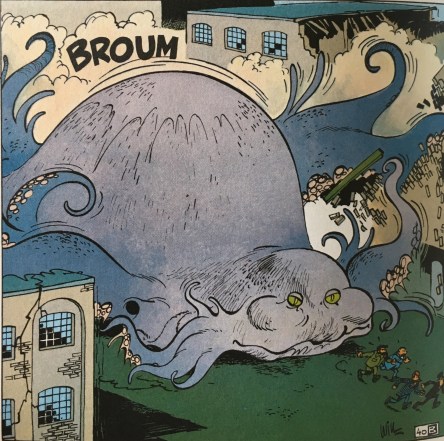
What better way to start than with the nameless Giant Purple Slug? This monster is quite possibly my favorite pop-culture monster of all time, and was responsible for some of the most wonderful, pleasant dreams I had as a child. It is the primary “antagonist” of the 1972 Tif et Tondu book Sorti des Abimes (“Out of the Abyss”, more or less). A bit of background… Tif et Tondu is a Belgian BD by Will and Rosy that follows the adventures of private investigators Tif (the bald guy) and Tondu (the hairy guy, amusingly enough). Their tales fall mostly on the science-fiction side. Today the series is mostly remembered for introducing Monsieur Choc, the urbane, well-dressed, knight-helmeted international criminal mastermind.

But in Sorti des Abimes, it is not Monsieur Choc but a gigantic gastropod that causes consternation for our heroes. The adventure is set in the docks of London, where their friend the Countess Amélie “Kiki” d’Yeu is looking for her confiscated Great Dane. She finds him in a pound, along with something big, tentacley, and drooling green slime. (All art by Will, buy his books!).

sorti des abimes 1.jpg

The “thing” escapes its confines and slithers into the Thames, where it is sighted swimming through the canals and generally making the most delightful floppery ooshy sounds.

sorti des abimes 2

Of course, Our Heroes (O. H.) find out about this and won’t have any of it. I mean, the slug does eat its way through the Thames, chews through a few ship hulls, and drives a steamer aground, but what’s a few fish and ships between friends? Nonetheless, they find out that it’s an abyssal slug brought to the surface by a misguided biologist at the pound. Turns out that, having never seen the light of day, ultraviolet rays cause the slug to grow out of control. O. H. track it down to a dock, where – have I mentioned how much I love/am terrified of the dark outlines of huge things under the water?


sorti des abimes 4

The slug is making a water-based beeline for the sea, and crushing everything along its path. After O. H. try to kill it with a WWII-surviving Junkers Stuka (!), the slug decides it’s had enough and hauls its mass out of the water, looking for all the world like an adorable purple cross of Aplysia and Glaucus.

sorti des abimes 5

It’s not malicious or anything, it just decides to take a more direct route for the sea – a route that leads it to noted landmark Tower Bridge.

sorti des abimes 6


Fortunately for Tower Bridge (what would the Queen say?), O.H. realize that if ultraviolet rays make it grow, infrared rays must clearly have the opposite effect (ignore the spectroscopic and biological problems here, this was a 70s BD). They pelt the poor slug with IR radiation…

sorti des abimes 8

… whereupon it melts into black slime.

sorti des abimes 9

sorti des abimes 10

All it ever wanted was to return to the sea…

As promised, this is going to be the first in a hopefully long-running series of official Wednesday Interludes. Due to popular demand, these will be covering a number of behind-the-scenes topics, including research, bestiary reviews, and my favorite obscure pop-culture monsters.

The first Digression will be a simple one. I have often been asked* “where on Earth do you find these things?” My answer is, inevitably, I follow the breadcrumbs. As any academic will tell you, references are everything, and every claim should be taken with a grain of salt the size of Uluru**. An unreferenced book is practically useless, but as long as there’s one reference, I can follow the trail of literary references back to its estranged home. Often there’s only one ultimate origin from which all the others sprung.

Google Books and Hathitrust have been a godsend in this regard, as has access to a university library*** and fluency in three languages. I have also had a number of wonderful friends and acquaintances (you know who you are) who helped in translating different texts**** where I couldn’t. But, once again, it all involves following the breadcrumb trail to its source, even though some breadcrumbs end up taking on a life of their own.

One good example of this process was brought to me by notable monster hunter Fredrik H., who suggested:

And I wonder if you know something more about … that five-legged Celphie bovine.

Now there’s a start! A strange creature – the beginning of our breadcrumb trail. What is this Celphie*****?

Like the vast majority of creatures you can find online, the Celphie comes from Carol Rose’s Giants, Monsters, and Dragons. I will reserve my thoughts on it for the official review, but suffice to say that it’s the progenitor of most online information of this kind. And sure enough, page 71 informs us:

This is a monstrous hybrid creature in the traditions of medieval Europe. It was described as having a body resembling a cow but with five legs, each of which was human from the elbow down to the hands… said to inhabit the wastes of Ethiopia… (Rose, 2000)

That is definitely monstrous. Where is it from? Rose provides a single reference – Barber and Riches’ A Dictionary of Fabulous Beasts. Following that trail gives us:

Curious Ethiopian beast which had man’s hands for its five feet; its hind-legs from the ankle to the top of the calf were also human. The rest of its body was that of an animal similar to a cow. (Barber and Riches, 1971)

Curiouser and curiouser. There is no mention of medieval Europe – and sure enough, the solitary citation directs us to The Excellent and Pleasant Work of Julius Solinus Polyhistor, translated by A. Golding in 1587. That breadcrumb is as follows, just pretend I put a [sic] after every word:

Almost about the same time also were brought from thence monsters called Celphies, whose hinder feete from the ancle upp to the toppe of the calfe, where like a mans legge, and lyke-wyse hys forefeete resembled a mans hande: notwithstanding, these were never seene of the Romaines but once. (Golding, 1587)

So apparently the good folks of Rome****** got to see Celphies brought back from the wilds of Aethiopia. Note now that Celphies have legs like a man’s legs up to the knee, and arms like a man’s arms in the same way. There is no mention of five legs, a cow’s body, and human hands everywhere. Something must have been lost in the adaptation, the breadcrumb must have crumbled somewhere along the way. But the description is getting clearer. It couldn’t be…? But there’s one more ancient, dusty breadcrumb to tackle – the original Solinus book, De Mirabilibus Mundi. There we get our final hint (with apologies for bad Latin transcription):

…exhibita monstra sunt cephos appellant quor posteriores pedes crure & uestigio humanos artus metiut, priores hominum manus referut… (Solinus, 1473)

Another translation quirk? The original Latin refers to Cephos instead of Celphies, and now it all falls together*******. Human-like limbs, taken from Africa… Celphies are unspecified primates! As further verification, Topsell provides an additional, delicious breadcrumb:

The CEPUS, or Martine Munkey. The Martin called Cepus of the Greek word Kepos, which Aristotle writeth Kebos, and some translate Caebus, some Cephus or Cepphus  or more barbarously Celphus… such being alwayes the most ingenious imitators of men… The games of great Pompey first of all brought these Martines to the fight of the Romans, and afterward Rome saw no more; they are the same which are brought out of Aethiopia and the farthest Arabia; their feet and knees being like a mans, and their forefeet like hands, their inward parts like a mans, so that some of us have doubted what kind of creature this should be… it having a face like a Lion, and some part of the body like a Panther, being as big as a wilde Goat or Roe-buck, or as one of the Dogs of Erithrea, and a long tail… (Topsell, 1658)

And there you have it. The breadcrumbs got weirder and moldier the farthest we went from home, starting with a monkey and ending with a five-legged-cow-thing. Sometimes my research does the opposite, though, and the original ends up stranger than the modern conception!

Either way, it’s all done citationally, my dear Watson.

*By people I’ve hired to ask.
**My claims too! Go out there and do your own research! Correct my misteaks!
***Disclaimer: the author no longer has access to a university library.
****Disclaimer: the author no longer has access to those friends.
*****It’s not an awkward photo of yourself, leave me alone!
******Or a bunch of lettuces. You never know.
*******I hate asterisks too. 😦

References

Barber, R. and Riches, A. (1971) A Dictionary of Fabulous Beasts. The Boydell Press, Ipswich.

Rose, C. (2000) Giants, Monsters, and Dragons. W. W. Norton and Co., New York.

Solinus, G. J. (1473) De Mirabilibus Mundi. N. Jenson, Venice.

Solinus, G. J.; Golding, A. trans. (1587) The Excellent and Pleasant Worke of Caius Julius Solinus. Scholars’ Facsimiles and Reprints, Gainesville, Florida.

Topsell, E. (1658) The History of Four-footed Beasts. E. Cotes, London.

Part of my job in curating ABC involves responding to email. While this can mostly be done from the safety of my email application, every now and then I get correspondence that requires a broader answer for the public good.

Dear ABC,

How many illhveli species are there? I am planning a pleasure trip to Iceland – should I reconsider?

Sincerely,

Alex S.

illhveli scaleDear Alex S.,

The illhveli, or “evil whales” are a very specific grouping of Icelandic whales, which mostly share a few key features. There are 10 species of illhveli. As is evident from the image, they come in a dizzying variety of shapes and sizes, and are not necessarily biologically related. Due to the dangers involved in studying them, the scale given (with a human diver in the bottom left corner) is approximate.

An evil whale is known to be:

  1. Inedible. In fact, it is a crime to eat them, and attempts to do so will result in their flesh disappearing from the cooking pot. The only exception to this is the skeljúngur, which is safe to eat.
  2. Evil. By and large illhveli are dedicated to the destruction of humans and other, benign whales, and take sadistic pleasure in death and destruction. Once again, the skeljúngur is an occasional exception, as it has been known to help worthy humans.

If you have the misfortune to run into an evil whale, try making full speed towards the sun, whose blinding rays will dazzle the whale. If the whale is a raudkembingur, outracing it will cause it to die in frustration. Try making loud noises, or tossing items overboard to distract the whale. Any number of foul substances have been known to deter taumafiskurs, and will probably work on other illhveli as well.

The steypireyður, or blue whale, is the mightiest of the “good” whales and is a valuable ally. It will intercept and fight any illhveli nearby. For that reason, do not harm or impede blue whales; in fact, killing one of those gentle giants may place a terrible curse on you.

Not all evil whales are illhveli; the trolual and the ziphius, for instance, are not illhveli, although they share the Scandinavian waters with the evil whales and are no less bloodthirsty. They are also found alongside the hafgufa or kraken, which is bigger and more terrifying than any of them.

In conclusion, I would say that your chances of getting shipwrecked are quite high, but I wouldn’t let that scupper your travel plans. I would steer clear of the sea if I were you, unless your boat was particularly fast or your captain was an Icelandic sorcerer. Avoid any suspicious-looking islands, but look out for blue whales.

ABC will resume encyclopedic coverage on Friday. Thank you for your patience!

hrossgrr

References

Davidsson, O. (1900) The Folk-lore of Icelandic Fishes. The Scottish Review, October, pp. 312-332.

Hermansson, H. (1924) Jon Gudmundsson and his Natural History of Iceland. Islandica, Cornell University Library, Ithaca.

Hlidberg, J. B. and Aegisson, S.; McQueen, F. J. M. and Kjartansson, R., trans. (2011) Meeting with Monsters. JPV utgafa, Reykjavik.

Larson, L. M. (1917) The King’s Mirror. Twayne Publishers Inc., New York.

The Book of Imaginary Beings by Jorge Luis Borges is, without a doubt, one of the most important literary contributions to the art of the bestiary. Its litany of obscure creatures laid the groundwork for the modern encyclopedia of mythical beasts, and ensured its citation in hundreds of works to come.

Borges was more interested in making an artistic and creative statement than in writing an exhaustively researched academic paper. As such, his references can be murky, unclear, hard to find, and, in some cases, completely fictitious. Later works came to quote Borges without attempting to track down the veracity of his statements. As Hurley notes with chagrin, it is “simply impossible to ferret out all the originals”, and “some of [Borges’] “quotations” are almost certainly apocryphal, put-ons”. The creatures discussed here are in the latter category.

a bao a quThe A Bao A Qu is said to live in the Tower of Victory in Chitor. Its appearance is uncertain, but we know it has tentacles, can see with its whole body, glows blue, and has skin like that of a peach. It follows pilgrims climbing up the stairs of the tower, but can only reach the top if the climber is a blameless person who has achieved Nirvana. Otherwise, it moans with a sound like rustling silk and tumbles down the stairs to the base, where it waits for the next pilgrim.

This story was originally attributed to Captain Richard Francis Burton (el capitán Burton), in an unverifiable footnote to the Arabian Nights. The original English translation changed that to the fictitious treatise On Malay Witchcraft by one C. C. Iturvuru. Was that believed to sound more mysterious? Were editors were concerned that contemporary readers would not be familiar with Burton? At any rate, searching for this entirely fabricated monograph is futile. Good news! This one has actually been tracked down and proved to be real – albeit, under a different name. It’s the Yam Bhaya Akhoot.
peryton

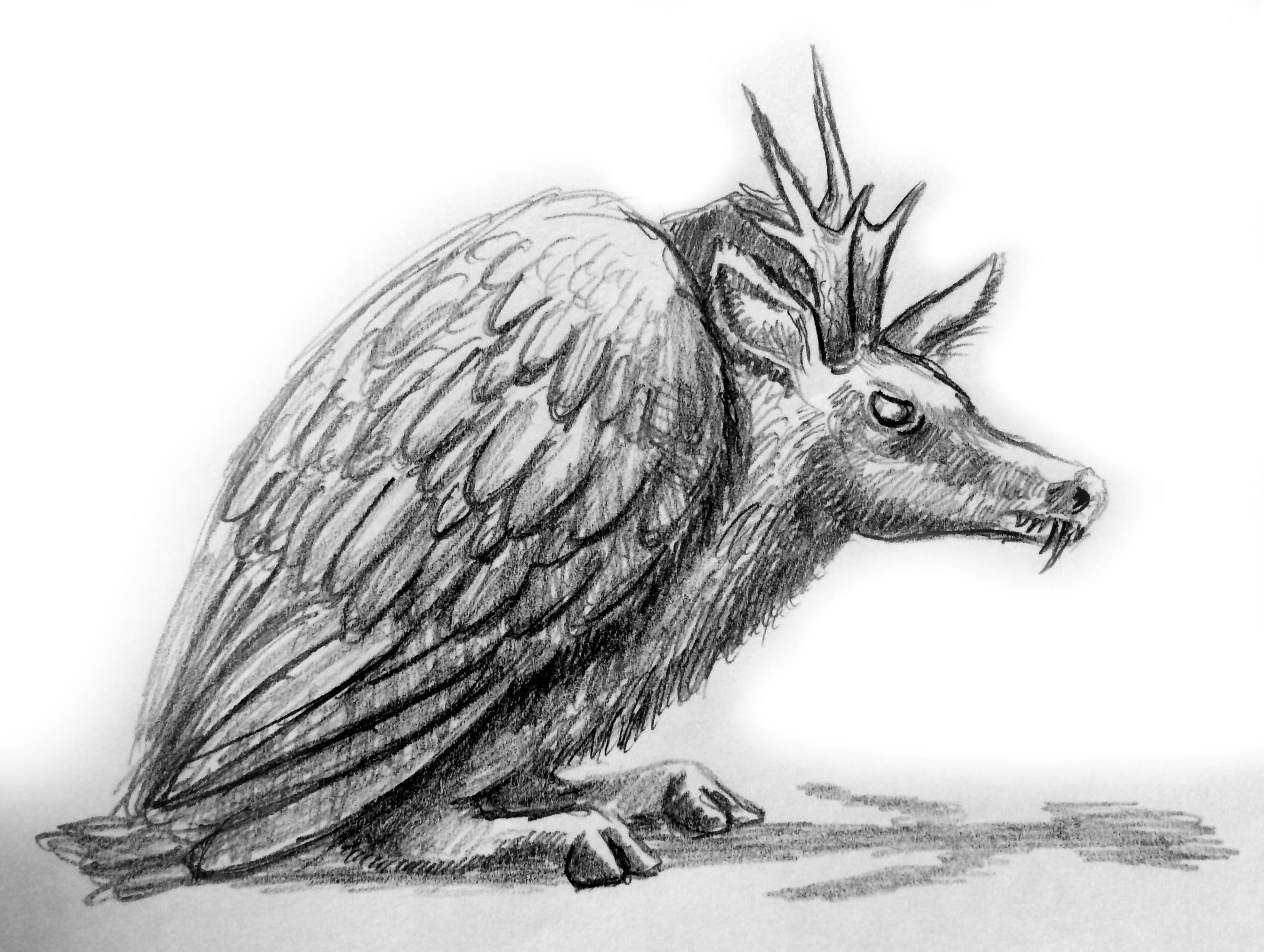
The Peryton, Perytion, or Peritio has achieved even greater fame, stripped of any Borgesian references and included in less discerning bestiaries. This carnivorous monster is a hybrid of deer and bird, with dark green plumage (or blue in Ravenna). Its oddest feature is its shadow, which is human. This is because perytons are believe to be the souls of men that have died away from the blessings of the gods. Perytons seek out humans to kill, but each peryton can only kill one man – after doing so, a peryton’s shadow becomes its own, and it is at peace.

Perytons originated from Atlantis, decimated Scipio’s army, and were foretold to destroy Rome. Borges attributes this to manuscripts written by one Aaron-ben-Chaim from Fez. These manuscripts quoted a nameless Arab author, and all copies conveniently perished in the burning of the Library of Alexandria and the Dresden firebombing.

Are the A Bao a Qu and the Peryton any less real than the basilisk and the unicorn? Repeated countless times, with their origins behind them, they are just as credible as any other nonexistent creature. After all, as told in Tlön, Uqbar, Orbis Tertius, an imagined world can be just as legitimate as the real world. We just have to remember that they remain literary in-jokes born from Borges’ pen.

References

Borges, J. L. (1962) Ficciones. Grove Press, New York.

Borges, J. L.; trans. di Giovanni, N. T. (1969) The Book of Imaginary Beings. Clarke, Irwin, & Co., Toronto.

Borges, J. L. (1978) El Libro de los Seres Imaginarios. Emece Editores, Buenos Aires.

Borges, J. L.; trans. Hurley, A. (2005) The Book of Imaginary Beings. Viking.

Borges, J. L. (2009) Manual de Zoologia Fantastica. Fondo de Cultura Economica, Mexico.

For the purposes of this book, deities, ghosts, and humans have been excluded. This is often down to a judgement call – some creatures are equal parts ghost and fairy, for instance.

After the primary name, a list of variations will be given. These include spelling variations, regional names, and other creatures that may be considered the same. The main text will clarify.

The primary art will always be subjective to some extent, and the artist will fill in blanks as they see fit. For what is known about the creature’s appearance, refer to the text.

The main art will be accompanied by a distribution map and a scale comparison. These will aim to be as accurate as possible, but the fact remains that they are often only educated guesses. Again, the text will contain the essential information.

Finally, all entries will have a references section. Lack of references has always been something that annoyed me, and I hope to remedy this somewhat.

I am indebted to your-vector-maps.com for their world map. The model in the scale images is currently exploring space on the Pioneer probes.

In the face of a natural world of infinite wonder, humanity found it necessary to create beings of their own. These are the creatures of the imagination, invented to explain phenomena, provide cautionary tales, or simply amuse the listeners. Some are garbled accounts of animals too bizarre to comprehend, others are divine attendants, lurking mischief-makers, or even helpful servants.

Our desire for order is almost as strong. Everything has to be described, classified, labeled, and pigeon-holed; there had to be a reason for everything. Thus the medieval bestiary was born, providing both moral guidance and a catalogue of what was known and unknown.

Since then, our interest in catalogues of the bizarre and unusual has never truly waned. J. L. Borges, in writing his Book of Imaginary Beings, set the foundations for the modern bestiary, and others have followed suit.

We will never truly be able to catalogue every last folkloric and mythical entity. It is an exercise in futility, the interest of the scholar and the artist degenerating into obsessive collection of the smallest details. While acknowledging this fact, it still doesn’t hurt to try. This work, which will be updated gradually, is the culmination of a deep interest in the unnatural world combined with years of research. I hope you enjoy it as much as I did putting it together.