Who remembers Atari? That’s a rhetorical question because, despite being in the right age bracket for it, for a number of reasons I’ve never actually played on it. But I knew it existed. And I knew some ads for Atari games. One of them really fired up my imagination. That’s right, I’m here to talk about Space Cavern.

Images from Atarimania.

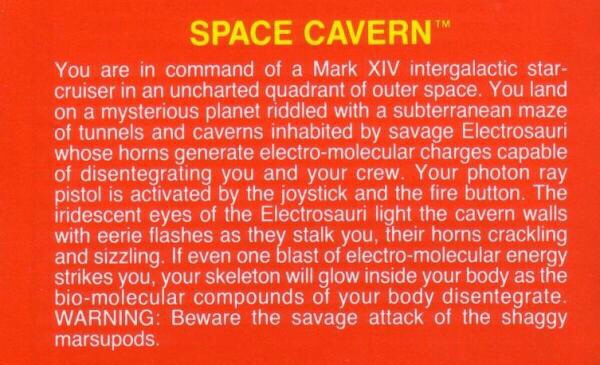
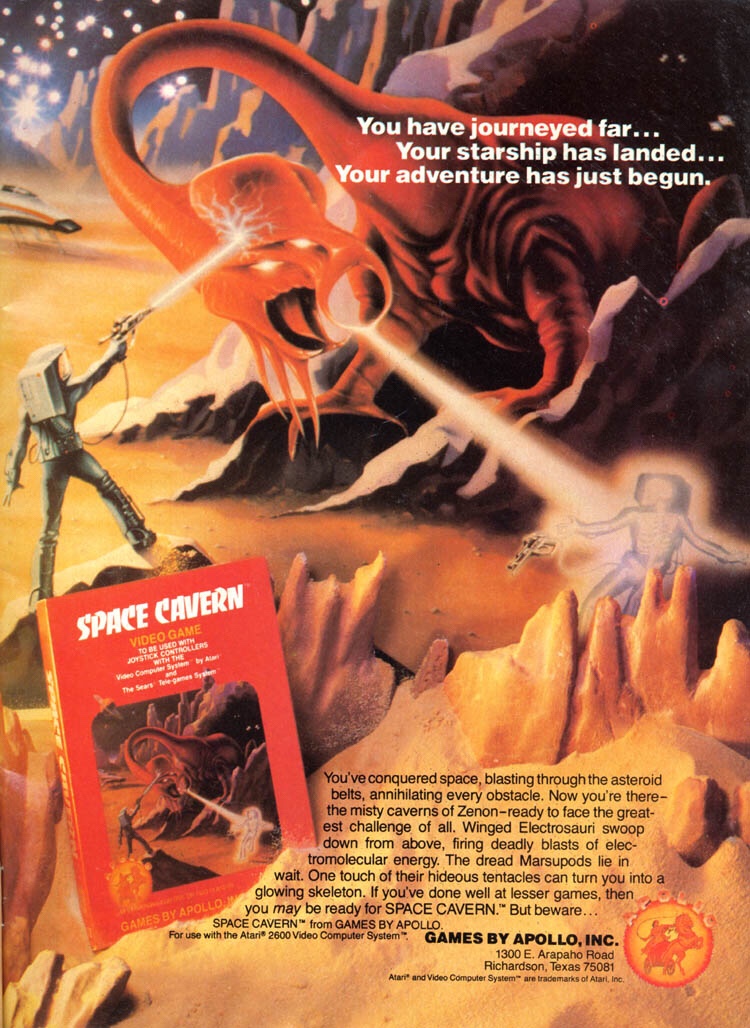
Space Cavern ran an ad in magazines that looked a little something like this.

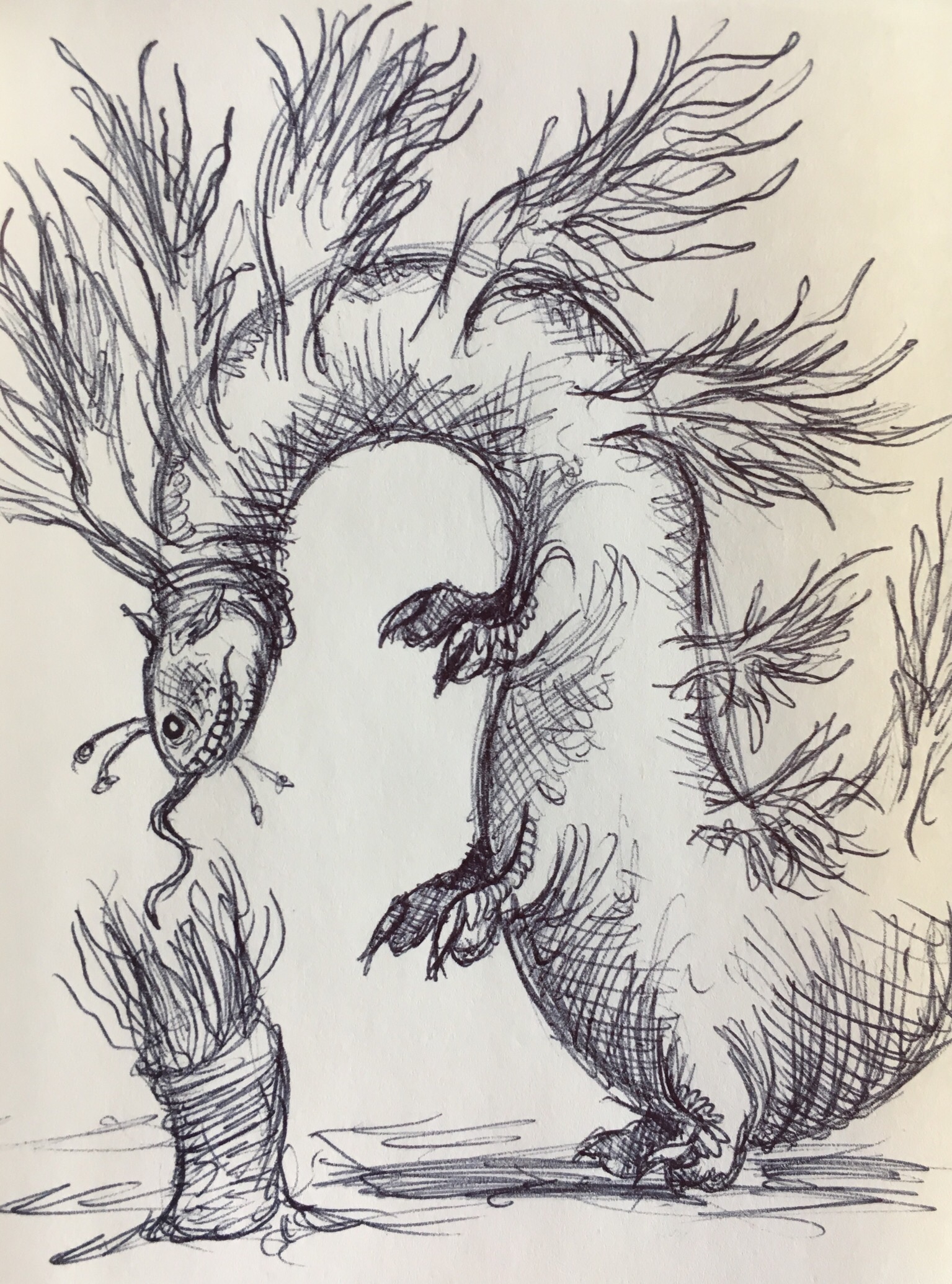
How awesome is that? Judging by the description that thing is a marsupod. Does it have four eyes or are those spots of bioluminescence? Is that its brain? Is it a demon sauropod that zaps you with lightning? Who knows, it’s metal as all hell. And it scared me somewhat too – I didn’t want to become a skeleton!

Electrosauri are nowhere in sight though. I always though they must look something like pterosaurs. Electric pterosaurs.

The official description calls marsupods “shaggy”. That… thing… up there does not look shaggy. Unless you’re being charitable about its chin danglers. Still no visual representation of an electrosaurus (?), which makes me sad.

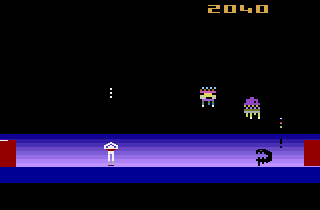
Of course there was a bit of artistic license taken in the art. Actual gameplay looks a little something like this.

The electrosauri are the Space Invader things floating over the horizon, while the marsupod is the evil Pacman emerging from the right-hand side of the screenshot. I don’t know how they got a demon sauropod out of that, please don’t ask.

You know the gag would have worked with just one swordfish, but Dr. Seuss had to go and draw over 20 swordfishes, each one of them different. Now that’s what I call creature-based dedication (crebadication?).

Found in The Tough Coughs as he Ploughs the Dough (pronounced “the tuff cuffs as he pluffs the duff”).

Turns out that magic isn’t necessary at all in dealing with dragons. They can be defeated in a number of ways, many of which are within reach for the average layman. Here at Dragonslayers Inc. we sell a complete line of equipment for the aspiring dragonslayer.

1. Lances

The original and best! Keep out of harm’s way with a pointed stick. Cheap, effective, and deadly, as Saint George proved. Watch out for venomous dragons, though, their poison can travel up the lance and kill you. Great for dragonslayers on a budget!

373px-Martorell_-_Sant_Jordi

2. Swords

Prefer to get up close and personal? Our line of swords, sabers, scimitars, claymores, rapiers, machetes, knives, and stilettos offers a range of options to fit any wallet. Our recommendation? If you’re going to engage in hand to hand combat, try subterfuge. Valued customer Sigurd killed his dragon by digging a pit and hiding in it, stabbing the dragon as it passed above.

Old_Norse_stories_(1900)_(14595045709)

3. Arrows

Arrows work following the same principle as the lance – why come within range of a deadly animal when you can kill it from a safe distance? Our standard arrows require a certain dexterity, as shown by the seven pagan warriors who defeated the Bête de Rô at La Rochelle. They shot exactly seven arrows – two in its eyes, two in its ears, two in its nostrils, and one to nail its lips shut. What a display of marksmanship!

If you’re not as much of a crackshot, our line of Hercules brand poison arrows require only one shot on target to kill.

456px-Mosaico_Trabajos_Hércules_(M.A.N._Madrid)_06

4. Crucifixes

Even cheaper than swords or lances! Vanquish dragons with the sheer power of your faith. As creatures of evil, dragons will shrink from holy items. Saint Martha used her faith to great effect by taming the dreadful Tarasque. If you’re a bit of a showoff like our customer Saint Margaret of Antioch, you can let the dragon swallow you, then burst your way out of its belly. Hardcore!

Abellon-Mag2

5. Spiked Armor

Slay dragons in style with our Lambton brand spiked armor! Guaranteed to make you impossible to squeeze or swallow, as well as giving you that dashing “Egyptian Porcupig” look. With added asbestos layers for flameproofing. Slip into one of these suits and watch dragons impale themselves on you!

461px-Page_facing_202_illustration_in_More_English_Fairy_Tales

6. Deadly Food

We sell a line of dragon bait guaranteed to kill! Combine any number of ingredients including pitch, sulfur, hair, calfskins, and nails to create a lethal cocktail. Just leave in a prominent location, let the dragon eat it, and watch the fireworks! Leave out of reach of children.

7. Lions

Fancy yourself a bit of a beastmaster? Why not check out one of our hunting lions? Not only are they great dragonslaying allies, they make excellent companions and bodyguards. Valued customer Yvain aided a lion in battling a dragon, and they’ve been inseparable since. Adopt one of our lions today!

Yvain-dragon

8. Magic

When all else fails, why not resort to magic? Our exclusive line of Medea brand herbal mixes is guaranteed to put even the most resilient dragon to sleep.

All images from Wikipedia.

The glorious, stirring, edifying tale of the battle of Moore of Moore-hall with the Dragon of Wantley is told in a comic ballad and a later burlesque opera.

In them, the hero Moore of Moore-hall dresses in the time-honored bespoke spiky suit of armor until he looks like “Some Egyptian Porcupig”. He then defeats the dragon in mortal combat by kicking it in its weak spot, which, as can be clearly seen in the illustration by John June…

thou prickouch yes copy

References

Lampe, J. F. (1770) The Dragon of Wantley, A Burlesque Opera. Lowndes, Caslon, Nicoll, and Bladon, London.

enc

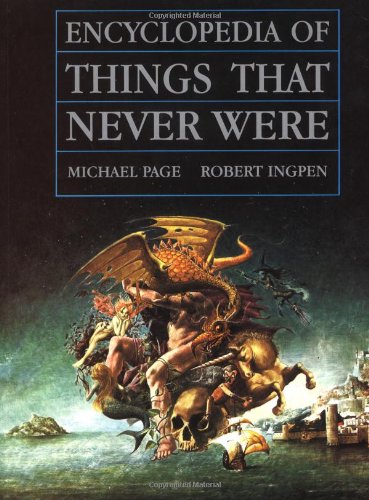
Encyclopedia of Things That Never Were

Michael Page and Robert Ingpen

The Encylopedia of Things That Never Were (EoTTNW for short) is one of the big books of creature reference. And by big I mean it’ll be one of the tallest books on your shelf. It’s not only about creatures either, but it was my introduction to a lot of the more famous and somewhat obscure monsters out there. Is it worth a gander? Let’s find out.

You can get it here and here if you so desire.

Scope

Vast. This has the broadest appeal of any book I’ve reviewed so far. It doesn’t just have creatures, it has gods, heroes, places, esoteric procedures, and literary allusions. You can read up on alectromancy, masks, rattles, swords, and voodoo as well as wizards, dragons, manticores, and gnomes. EoTTNW is an encyclopedia and it’s worthy of that title.

Organization

Six main chapters. Of the Cosmos is gods, heroes, creation myths, and astral beings. Of the Ground and Underground covers terrestrial entites. Of Wonderland discusses places real and imagined. Of Magic, Science, and Invention is about, er, magic, science, and invention. Of Water, Sky and Air does the same for non-terrestrial beings, and Of the Night is about ghosts and vampires and other evil beings.

Each chapter has entries arranged alphabetically, encyclopedia-style in three columns, with artwork taking up to a whole page.

Text

Straightforward and lucid, as befits an encyclopedia. Doesn’t try to be too academic or too flippant, which is good. The pre-chapter essays are nice and atmospheric. A lot of the entries tell a story, too – check out, say, Satan, or Wendigo, or the retelling of the entire Dorian Gray story under “Drawings, Paintings, Portraits etc”.

If you’re just in it for the creatures, those are mainly in chapters 2, 5, and 6. This isn’t a creature book though, more of a big overview of myth and imagination.

Images

Quite lovely and masterfully done. Often somewhat abstract and mood-setting, such as a shapeless Grendel lurching out of the darkness at Beowulf, a tiny ship lost in the Mare Tenebrosum, or a creepy doll-house of omens. There’s the familiar abatwa-and-pet-ant, a sea serpent drowning a whale, Sakarabru looming over a village, the bunyip and the whowie… They’re detailed, colorful, evocative, and sometimes quite spooky.

One problem I do have is the rampant art copying, which is acknowledged off-handedly at the bottom of the very last page. It’s just weird seeing Boticelli’s Venus standing in for the Nereids, or a faithful reproduction of Tenniel’s Jabberwock among the dragons (minus waistcoat, alas). The yakkus on page 84 are copied in the triad on page 218. Stuff like that. It’s not… wrong, I guess, but I’m sure the artist could have done better.

Research

Confusing. There are references at the end (yay!) but not attached to individual entries (boo!). And there is some dodgy research. I’ve mentioned the Acheri thing before on this site, for instance. But why is the ahuizotl a generic lake monster with no mention of its defining traits? Why are the notoriously touchy, poison-arrow-shooting Abatwa described as shy and “not a warlike race”? Why is the Wendigo based entirely on Algernon Blackwood’s version? And where on Earth did the barbegazi come from? I’ve been unable to find them in anything that doesn’t directly come from this book.

Those are, of course, creature-specific complaints. I didn’t see anything especially wrong in other fields but scholars of those may well have their quibbles.

Summary

A great, beautiful, and impressive book, with just enough mistakes and inaccuracies and art issues that I can’t give it an entire 4 gigelorums. It’s still a perfect introduction to fantasy staples in general. While I can’t recommend it as a cornerstone creature reference, it is an outstanding encyclopedia of the fantastic.

3