Have you ever encountered the Mosquito of the North Country? You thought they were pretty well developed animals with keen appetites didn’t you? Then you can appreciate what Paul Bunyan was up against when he was surrounded by the vast swarms of the giant ancestors of the present race of mosquitoes […]

Paul determined to conquer the mosquitoes before another season arrived. He thought of the big Bumble Bees back home and sent for several yoke of them. These, he hoped would destroy the mosquitoes. Sourdough Sam brought out two pair of the bees, overland on foot. There was no other way to travel for the flight of the beasts could not be controlled. Their wings were strapped with surcingles, they checked their stingers with Sam and walking shoes were provided for them. Sam brought them through without losing a bee.

wb-laughead-marvelous-exploits-paul-bunyan-i027

The cure was worse than the original trouble. The Mosquitoes and the Bees made a hit with each other. They soon intermarried and their off-spring, as often happens, were worse than their parents. They had stingers fore-and-aft and could get you coming or going.

wb-laughead-marvelous-exploits-paul-bunyan-i028

W. B. Laughead, Paul Bunyan and his Big Blue Ox (1922)

Another alpine dragon or tatzelwurm. This time with two legs and a reptilian phizog. What really sells it is the melodramatic look of dismay on the guy. That or he’s yodeling to it.

Image from Johann Jakob Scheuchzer’s Itinera Alpina.

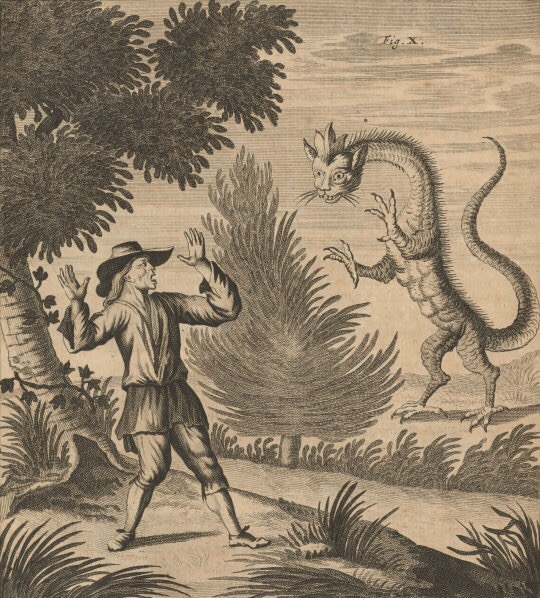
Here we have a menacing alpine dragon – what would be called a tatzelwurm nowadays (a regional name that has since come to conveniently apply to alpine dragons as a whole, but back then they were all simply dragons). Note the feline features. Maybe those were greatly exaggerated wildcat encounters?

Or maybe they just needed an excuse for coming home late after too much lager…

Image from Johann Jakob Scheuchzer’s Itinera Alpina.

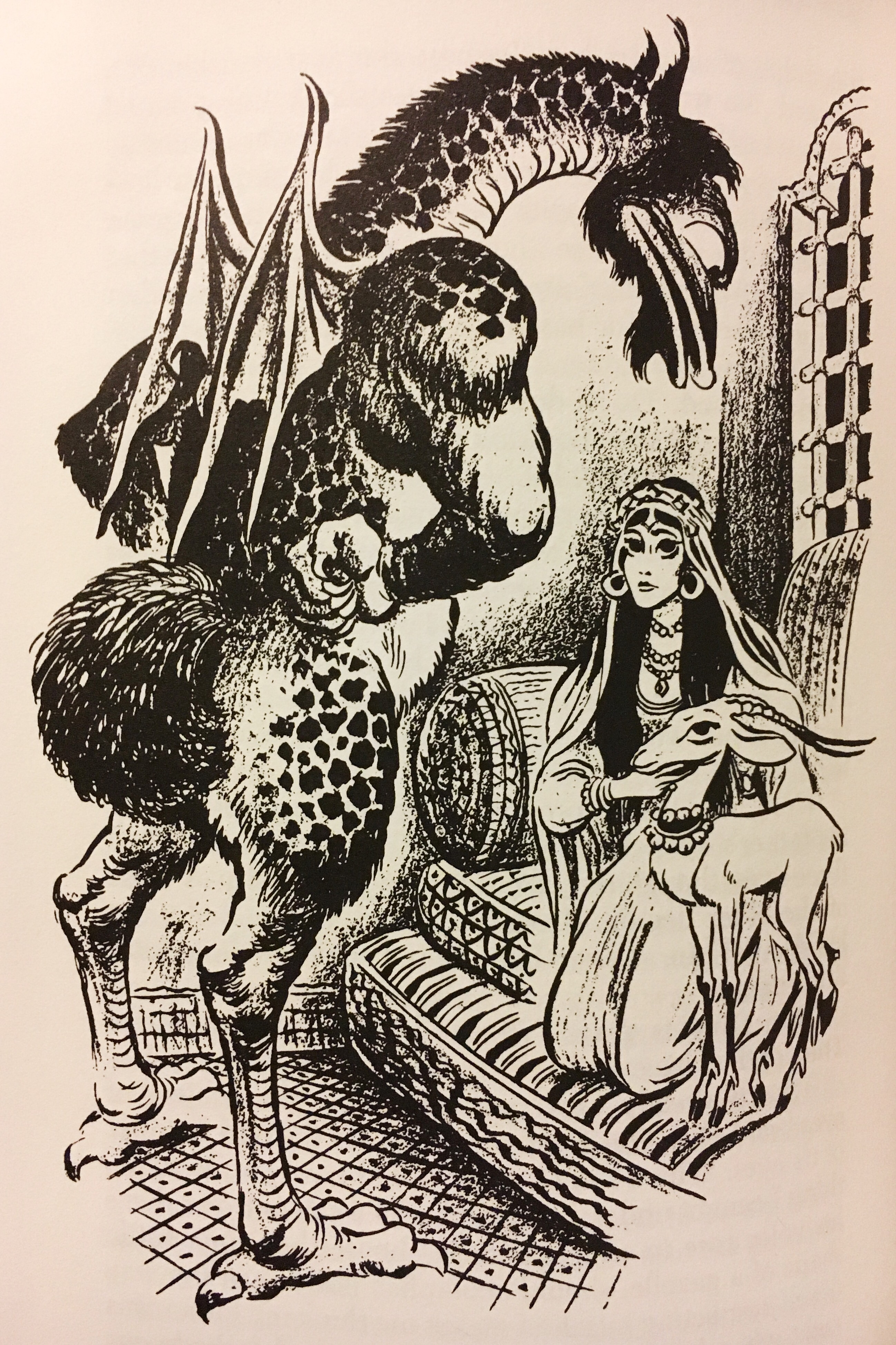
Pop Quiz: which one of these characters is a jinni?

A. The well-dressed woman

B. The demure-looking gazelle

C. The big freaky spotted ostrich monster

D. All of the above

If your answer was D, then you are correct! This illustration by Frit Eichenberg from Eleanor Hoffmann’s Mischief in Fez does a great job of showing just how different jinn can be. A far cry from muscular blue men in bottles.

My first encounter with James Lewicki’s art was in The World We Live In, the best natural history book ever written *inserts bias*. His work was primarily eerie seascapes in that series, but this prolific and talented artist did a lot of art for LIFE Magazine during the 50s and 60s.

His greatest contribution to LIFE is the American Folklore series, which he initiated. According to Lewicki’s biography told here:

It was while working on Christmas legends that a neighbor commented to Jim that the United States really had no strong tradition of folklore and cultural heritage. Jim went to the library to see if this was so, and found volumes to the contrary. He proposed the theme of folklore to Life magazine, and they asked for a for a dummy presentation of 12 pages. Jim found it impossible to condense it all down to one article, so he suggested a series, and much to his surprise the editors agreed. This assignment lasted for five years.

The end result is the gorgeous LIFE Treasury of American Folklore, a collection of American folktales all illustrated by Lewicki. They include travelers’ accounts, Native American legends, colonial stories, northern and southern folklore, tall tales, and the like. The book is, of course, a product of its time, but a lot of it is still as effective today. This post is an appreciation of Lewicki’s work on the book.

Some of the stories in the book would be familiar to most readers. This include good ol’ Rip Van Winkle, seen waking up in incredible detail below…

Photo 9-7-17, 9 30 44 PM

… and such beloved fakelore as Paul Bunyan and Pecos Bill.
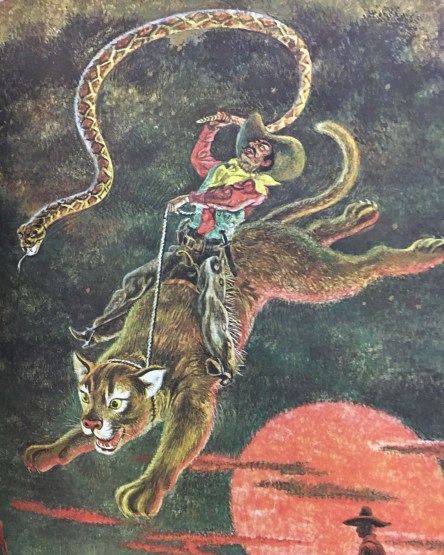
Photo 9-7-17, 9 32 18 PM

There are modern legends too, such as “The Man in the Middle”, which will be familiar to anyone who read Scary Stories to Tell in the Dark (and lost sleep over it).
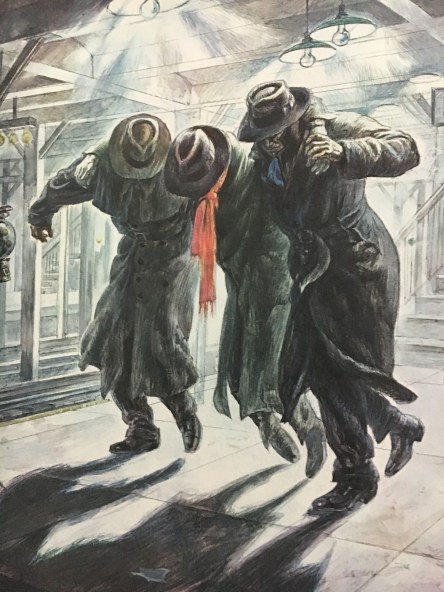
Photo 9-7-17, 9 31 48 PM

The first big picture you get reading the book is the monsters of the Sea of Darkness, and hooboy is it impressive.
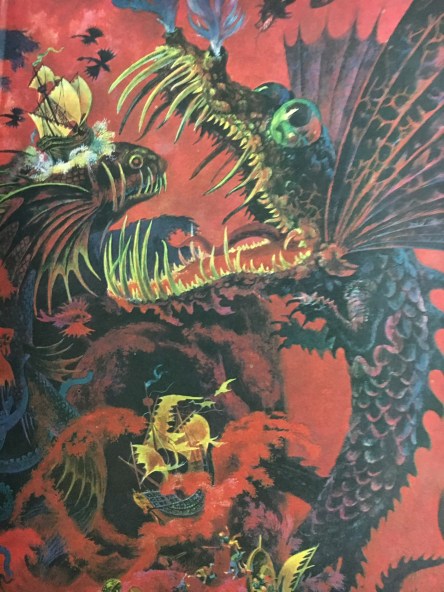
Photo 9-7-17, 9 28 01 PM

Nayenezgani and Tobadzistsini on their journey to the Sun could well pass as a metal album cover.
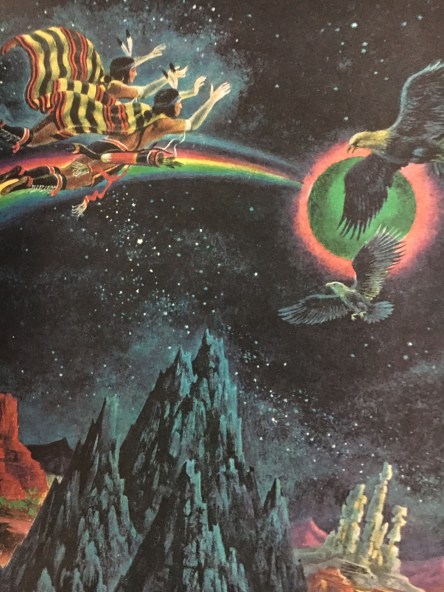
Photo 9-7-17, 9 29 10 PM

Meanwhile Sedna’s fingers giving rise to the beasts of the sea manages to be somehow beautifully stylized and creepy at the same time.

Photo 9-7-17, 9 28 52 PM

The Jersey Devil, seen here with a ghostly pal.
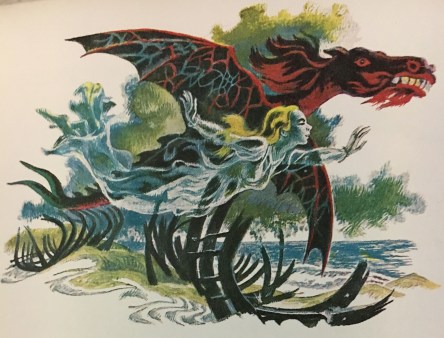
Photo 9-7-17, 9 29 25 PM

Ahhh, ghost pirates. Where would we be without them?

Photo 9-7-17, 9 29 46 PM

Probably the most nightmarish and memorable piece in the book is the witch woman who literally spins her skin off, shedding it like a husk of corn, until nothing remains but an enormous cat. Yikes.
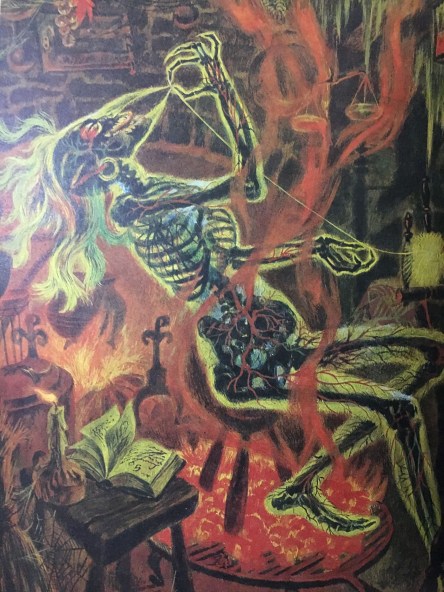
Photo 9-7-17, 9 31 16 PM

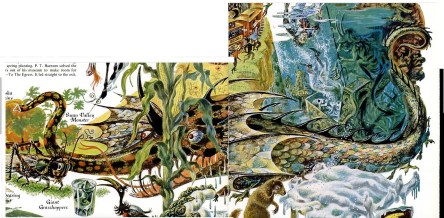
I can’t end this brief appreciation without mentioning Lewicki’s Swan Valley Monster, the first time this awesome monster was visually represented (to my knowledge).
tumblr_osayoeIQnG1vd0dgeo1_1280

What I’m saying is that The Life Treasury of American Folklore is a worthwhile acquisition for fans of folklore, creatures, Americana, and excellent art. I still hold out hope that Time-Life reprints it and The World We Live In in high-quality glossy modern editions, but this will never happen as we all know…

Good news! I got the inside scoop on this ṣafat malarkey. I’d save it for the final ABC product, but I need to nip any misunderstandings in the bud before they get out of hand and people start labeling their giant sky cruisers with that name.

First, some breadcrumbing. The ṣafat bird (note the dot under the s – that’s a ص) seems to have originally come from (where else?) Rose’s Giants, Monsters, and Dragons, which in turn got it from Barber’s Dictionary, which itself obtained it from Lum’s Fabulous Beasts. I do not have that last book. Impasse.

I do, however, have access to the most powerful search engines known to humanity, and hey presto – looks like the ur-reference for the ṣafat is Hanauer’s Tales Told in Palestine.

Going by the title alone, it’s clear that the ṣafat is not an “Arabian” animal. In the text Azrael – the Angel of Death himself – shows off ṣafat eggshells as something that is a cause of death . He describes the ṣafat as a wonderful bird that never lands (no mention is given as to its size, so I can only assume it’s normal-sized and not huge). It even lays eggs in flight, and the young hatch before they reach the ground. But then they are often eaten by a shibah (described as resembling a badger-hyena cross. Zorilla? Aardwolf?), which then becomes rabid, goes mad, bites things, and gives Azrael more customers.

There you have it. Far from being a mere permaflier like the allerion or bird of paradise, it’s literally the cause of rabies.

Clarfication: the eggshells are eaten and cause rabies. The shibah/shibeh is the leopard (!).