Hello all! This was requested of me a while ago – a translation of Colonel Marchand’s account of encountering a mysterious animal – an okapi – in the wild. The original version can be found here. Image from here. Any translation errors are my own.
*****
Colonel Marchand, who, as captain, commanded the Congo-Nile expedition, communicates to me some very curious details on the Okapi which demonstrate the presence of this animal several hundreds of kilometers north of the Semliki River, around which it was discovered for the first time in 1900. This information, which is of the most perfect authenticity, seems interesting enough for me to bring it to the knowledge of the scientific public.
It was on June 16 1890, in the immediate neighborhood of 9° latitude North and 27° 30′ longitude East (Paris meridian), right in the middle of the vast swampy depression of Bahr-el-Gazal, that the officers of the vanguard of the Congo-Nile expedition, having at their head Captain Marchand, encountered an animal that they took for an unknown Antelope.
Here is the passage of the expedition’s travel diary that Mr. Marchand wished to copy for me. After 4 days of navigation on a marsh, the little flotilla left an endless forest of thorny reeds and managed to enter a small lake.
“16 June, at 11 and ½ hours. – All boats of the flotilla have left the great reed bed and gathered in the small lake. Its breadth is no more than 12 to 1400 meters; its length, difficult to estimate from our vantage point, could be estimated to measure 4 or 6 kilometers. Its bank, or rather the perimeter of its vaguely triangular shape, is formed by the edge of the thicket of floating grasses and reeds which we just escaped and which from here seem to envelop us hermetically.
However, we notice a bank of earth or mud of a whitish color, in the form of a little island, 25 to 30 meters in diameter, completely bare, in the middle of the lake, a few hundred meters ahead of us. Beyond, on the south bank, a few Elephants and a herd of Antelopes grazing also indicate the presence of land.
Afternoon ½. – Stopped alongside the small island to have lunch. The whitish color is due to a thick layer of guano deposited there by the countless flights of aquatic Birds that were, at this very moment, quite occupied fishing in the lake.
At 1 o’clock, we continue our movement. The tirailleurs on guard in the first boat almost immediately report, amongst the herd of Antelopes noticed earlier, an individual absolutely different from the others, its shape, its coat, and its gait totally abnormal for the species and for the region. I do not recall ever having seen anything like it in Africa. I order the flotilla to stop its movement, and, armed with a rifle, I go in a light canoe, by means of which I will try to approach the strange animal in order to capture it. I have a hunch that natural history might be interested in the success of my attempt.
But the eminently muddy character of this entire curious lacustrine region makes the depths vary suddenly from 9, 12, and sometimes 15 meters, up to 0.20 m and even less, as the guano island attests. At approximately 200 meters from the Antelopes and the edge of the lake, my canoe is effectively stopped and trapped in a bar of thick and foul-smelling mud. I can no longer advance, and there is no trying to set foot in that which is neither earth, nor water, nor liquid, nor solid.
From this vantage point I perfectly discover the strange object of my greed. The animal gives at this moment manifest signs of agitation and worry and would have certainly fled already, if the other individuals of the its herd, less timid than it, did not continue to graze peacefully on the stems of reeds and ambatch that form the lacustrine vegetation.
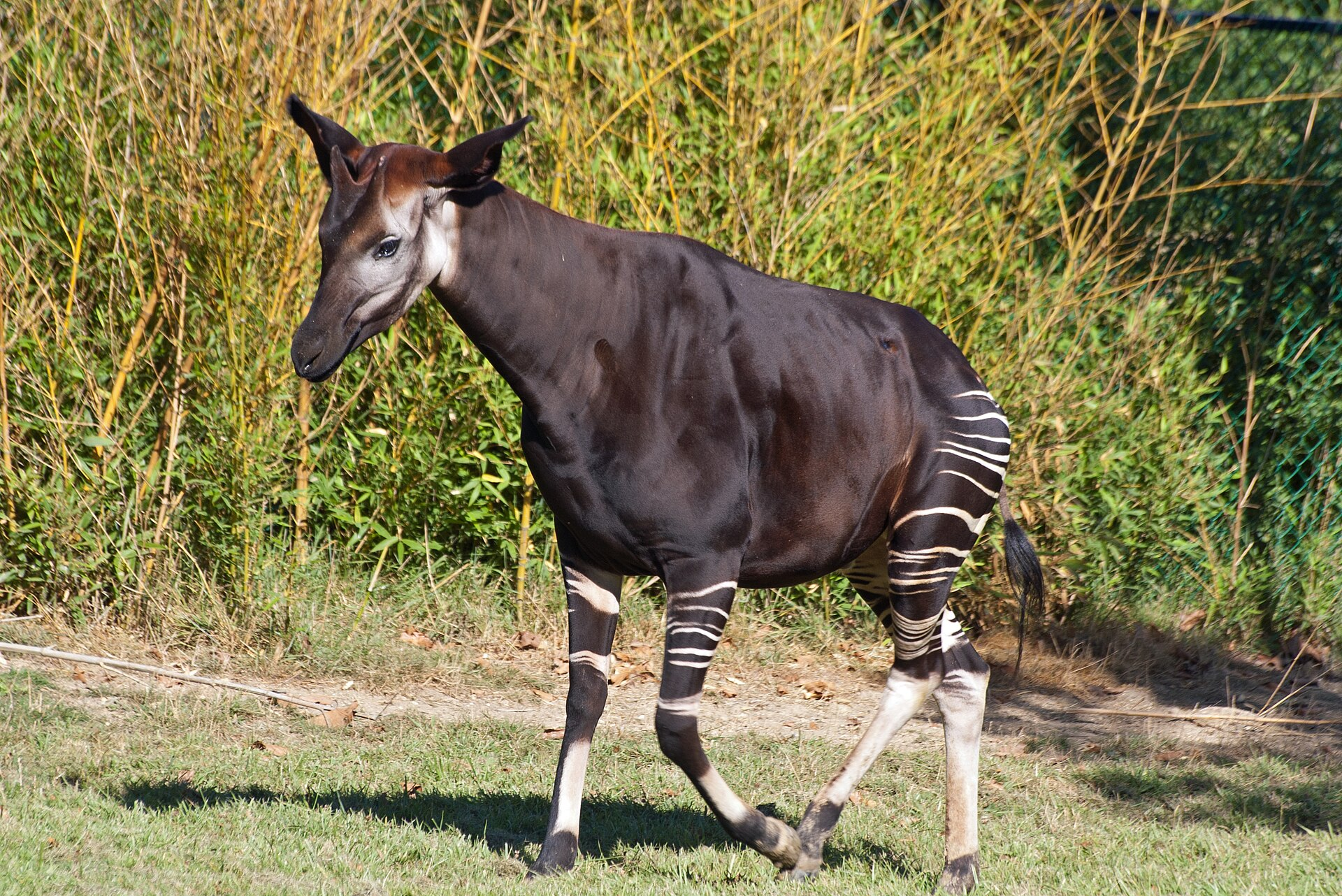
It is big! Much bigger than the others – at least 1 m. 50 at the withers. The color of its coat, the most striking detail at first glance, is a distinct fiery russet, with white spots on the chest that I can see poorly from here.
Were it not for a pair of enormous ears, greyish with reflected light, strangely shaped, and which I almost took for the horns of a Kashmir Mouflon, one could believe oneself, from the general form, to be in the presence of the svelte Donkey of the neighboring region of Abyssinia: the Zebra. But, by the swollen form of the snout and of the head as well as the presence of two curious little horns or protuberances on the crown, it recalls as well the young Giraffe. Certainly, this variety of Antelope – if Antelope it be – is still unknown and undescribed in naturalists’ collections. It seems even foreign to the herd of other Antelopes that it accompanies, more than it makes part of it. It is also more wary and more skittish.
I am furious that I cannot approach it to try to capture it. But even supposing I could shoot it down with one shot of my rifle from where I found myself, the depths of the liquid mud would stop me from recovering the carcass. I must content myself with targeting it… with my telescope.
At this moment in my mental soliloquy, the Antelope-Donkey-Giraffe Calf abandons its companions and runs off – so to speak – like a Zebra [the expression “filer comme un zèbre”, “running off like a zebra”, means “run quickly”]. To square things with my conscience, and in an instinctual hunter’s movement, I fired a bullet that did not reach its mark.
I returned, empty-handed, to the flotilla where my companions Baratier, Emily, Landevoin, Venail had borne witness, with an interest identical to mine, to the failure of an attempt where the naturalist alone had been engaged.”
From this unpublished account it is incontestably clear that the animal seen is indeed an Okapi, that the individuals, uncommon besides, seem to seek relative security among less suspicious and shy animals than them, but that they remain exclusively in marshy and lacustrine regions, among the great reeds, grasses, papyrus, and ambatch.
The testimony of Colonel Marchand and his mission companions allows us therefore to extend at minimum 3 degrees, or 600 kilometers North, the habitat range of the Okapi, which was once thought to be narrowly localized near the Semliki. This fact is also very easily acceptable given the topography of the region. Mr. Marchand also adds that he has reasons to believe that the maximal southern range of the territories occupied by the Okapi must be between the 12th and 13th degrees of latitude North; it is probable that that is where that Nilotic depression and the swamps that fill it end.
One question is asked: is it the Johnston’s Okapi or another species? That is what new explorations will teach us, probably soon.
From this interesting communication I will draw complimentary conclusions for the taxidermists of the Muséum who were able to elevate their profession into an art. The reconstruction made at the Muséum is the exact expression of truth for the pose, the shape of the body, the look, the way its head and ears are carried, for thus from a simple reproduction of a photograph (by Mr. Manteaux), representing the Okapi of the Galleries in profile, Mr. Marchand recognized the animal that had so intrigued him at Bahr-el-Gazal. Besides, the expression he uses, Antelope-Donkey-Giraffe Calf, indicates well that an extreme resemblance with the Giraffe struck him at first sight, and this completely justifies the reconstruction that was made in the taxidermy laboratory of the Muséum by the adept chief of work, Mr. Terrier. We can thus affirm that the taxidermy mount is in no way inferior to those made from animals whose shape and pose we know in the minutest detail.
References
Menegaux, M. A. (1905). Sur la présence de l’Okapi au Bahr-el-Gazal. Bulletin du Muséum National d’Histoire Naturelle, 11, 381-383.
 A Book of Creatures
._Okapi.jpg)
Did not expect this! Fantastic
LikeLiked by 1 person
I was so delighted to receive a Book of Creatures email!! I also love okapi they are so beautiful.
LikeLiked by 1 person
the okapi is certainly an odd animal if you had never heard of or seen one before
LikeLiked by 1 person