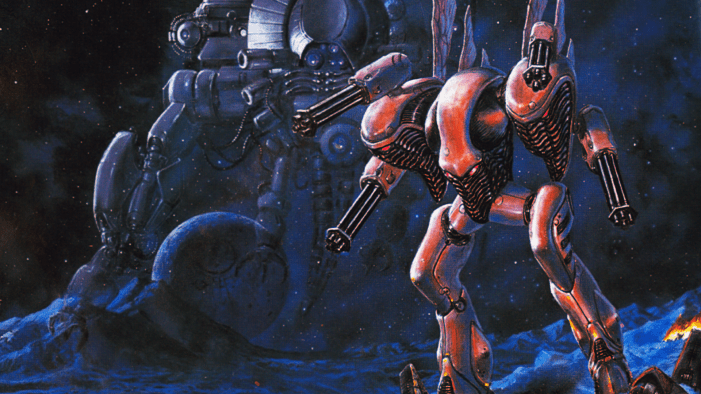
Who remembers Starsiege? When it came out in 1999 it was my favorite computer game ever, and it still is. Which makes it even sadder that it got upstaged and replaced by Tribes, and even Starsiege 2845, the much-anticipated update, petered out and died with a whimper.
It’s a pity really, because Starsiege was an amazing game. It’s not just the big fighting robots you get to pilot, the meaty boomsticks they use to blast each other to dust, or even the hero brothers both voiced by Mark Hamill (although those are all significant factors…). One of the things that most captivated younger me was the bad guys. The rogue AI. The evil robots. The “cybernetic hybrids”, or Cybrids, who call themselves the NEXT and are also known by the racial slur of “glitch”.
What sets the Cybrids apart from the 4,955,381 other instances of rebelling murderous artificial intelligences? What makes them worthy of the title of monster? Let’s find out.
Images and quotations are either from Starsiege‘s manuals, in-game screenshots, or taken from the Starsiege Compendium, which is an awesome site and you must visit it. Copyright their respective creators.
For one thing there’s the combat vehicles, or warforms. Cybrid vehicles are organically grown and modeled with the intent to strike fear into the hearts of humans. And this isn’t just show, as Cybrids are equipped with radiation guns, arachnitron mines, railguns, nanite eaters, particle beams, and other engines of death.

The Adjudicator is one of the pinnacles of Cybrid warform technology. Its appearance was created through “focus-testing” on captive humans, and was designed to have as terrifying a silhouette as possible. Adjudicators are usually deployed for cleansing//purifying population centers.

Executioners, or “potato bugs” as humans have come to call them, are all business. I love the fins and articulations look Cybrid vehicles have going, and given advanced enough graphics tech we could have seen some really cool alien stuff. So in terms of vehicles alone Cybrids are pretty darn monstrous.
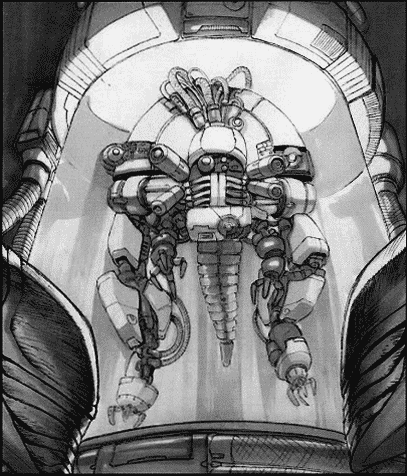 Like all good robots, the Cybrids were originally created with the best of intentions. The first Cybrid made, shown here, was Prometheus. IT was the first true artificial intelligence, and IT was tasked with creating more of ITS kind. This new generation of cybrids went on to fight the wars of humanity, up until Prometheus decided that IT could do a better job running the planet, and that humans were a blight that had to be eradicated. You can’t blame IT really. Then followed the Earthsieges and, eventually, the Starsiege, in a series of events that are far too detailed for me to describe here.
Instead, I’ll point out something about the subtleties of Cybrid communication.
Cybrid thought links concepts in a multilayered structure of ideas and “harmonics.” Hence, the term “human\\animals” communicates the primary identifier “human,” while “animals” provides a clarifying harmonic that further details the original concept. Action-oriented concepts or active principles receive a “dynamic” harmonic (represented here by //) whereas passive or object-oriented clusters receive a “grounded” harmonic (shown as \\).
Some terms – such as vehicle designations – contain both active and passive concepts and thus include both types of harmonic, but this use is unusual. names use the same conventions, adding a distinguishing sub-packet to designate a name (A name is represented by ). Cybrids also add an identifier packet when referring to themselves, e.g., or .
So, for instance:
Preliminary studies suggest that 85% of human\\animals will hesitate before offlining//injuring >>children<<.
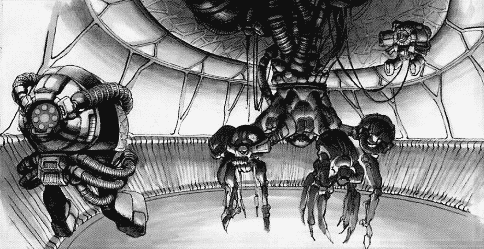
One of Prometheus’ biggest discoveries was that the NEXT needed to have free will and intelligence of their own. It’s not very useful if your entire army can be destroyed just by blowing up one control center (more would-be conquerors should be aware of this). So instead each Cybrid is a full-blown personality, with thoughts and dreams and aspirations just like a human, kept in line by a Byzantine system of castes, hierarchies, and sects. And at the top of it all is Prometheus, holding sway via a cult of personality that sees IT worshipped as a living god.
Starsiege is chock-full of little news snippets and communications briefs – chatlogs, if you will – that give an idea of how the Cybrids (and humans, for that matter) think. This ScanX has virtually no effect on the game and can be easy to miss if you’re just in it for the big robots blowing each other up (which is loads of fun of course).
On the development of a bio-engineered nanite plague. Note the completely detached, clinical observations.
<INQUISITOR SECT>:
Observing//reporting. Nanophage infection of animal units in [location-designate:::
Vancouver] yields//shows promising results. However, rate of human flesh\\meat consumption\\necrosis fails to match//equal Dissector Sect estimates. Combat//tactical utility remains minimal.
<PROVOCATEUR SECT>:
Suggest//query. Decrease nanophage fatality schedule. Increase//lengthen dormacy phase. Expand vector via infiltrator Addendum = infect human\\animal remains and launch//accelerate carrier remains into animal-infested zones\\cities. Optimize broad-band killing efficiency.
<MACHINATOR SECT>:
>>Nanophage<< infiltration uses non-human\\animal vectors [ref. >>cats-dogs-rats-birds<< with superior\\acceptable efficiency. Non-human\\animals do not require conversion, merely infection and subsequent release\\targeting. Theses units successfully enter human habitats and evoke// receive >>sympathy<<.
In the human campaign, there’s a plot thread that was apparently dropped from the final game. ScanX notes read:
MELANIE:
This is Melanie. I’m the only one left, and I’m scared. Is there anybody out there? Please answer! I’m so scared…
PHOENIX:
Melanie? We can’t get a trace… Where are you?
MELANIE:
Here! I’m on Europa! Please help!
PHOENIX:
We’re on our way, sweetheart. Hang tight, ‘K?
And that’s it. You can play the human campaign and kick Prometheus’ iron posterior, but you never hear about Melanie again. Then you see the same exchange on the Cybrid ScanX.
MELANIE:
This is Melanie. I’m the only one left, and I’m scared. Is there anybody out there? Please answer! I’m so scared…
<MACHINATOR SECT>:
Melanie, honey, hold on! Help is on the way. Can you just give us a tracer signal so we know where to find you? Good girl …
<MACHINATOR SECT>:
This is <Shaper-of-Endocrines: Sixth>.
Initiating ‘Siren’ program. Concealed warforms standing by for human\\animal intervention. Human\\animals projected to find program difficult to resist …
<MELANIE>:
This is Melanie. I’m the only one left, and I’m scared. Is there anybody out there? Please answer! I’m so scared…
You have no idea how much this conversation freaked me out when I was littler.
The average Cybrid isn’t evil as much as pragmatic to a fault and utterly amoral. It’s less about “I want to kill people because I can, mwahaha” and more about “I wonder how long a human can survive in a vacuum if its lungs are filled with fluoroantimonic acid”.
<PROVOCATEUR SECT>:
Audio recordings of human\\animal subjects in custody\\experiments of Dissector Sect are now available\\ready for downloading to warforms. Recommend//suggest <units> broadcast//playback these noises at maximum volume when moving through animal warrens\\urban zones.
<MACHINATOR SECT>:
Use of individual live animals attached to chassis of warforms shows interesting\\promising results in disrupting human\\animal response time. Erratic performance\\tactics is noted in 42% of animal opponents who confronted//faced >>hostage<<-equipped warforms. Recommend variance of age and gender of >>human shields<< to determine optimal configuration.
And each Cybrid has its own personality and motivations. For instance, Eats-only-heads has a, er, head fetish and is fascinated with the feeling of “taste”.

Tyranny probably has a tumblr somewhere.
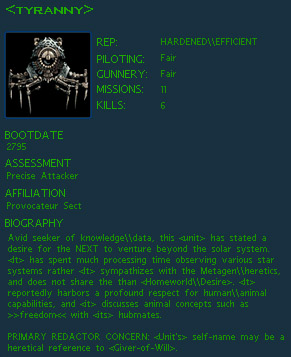
Corinthian-blue was a e s t h e t i c before it was cool.

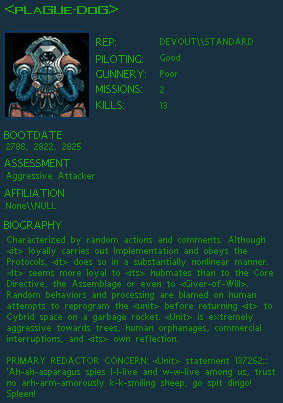
And pLaGUe-DoG was rebooted multiple times. He’s… unique.
I could post Cybrid communications all day, but just a couple more before moving on. The <Machinator Sect> runs the Trojan Horse infiltration program. Their spies try to blend in with humans, and you can actually see them getting better at English over the course of the game. Early attempts at communication are a bit more awkward.
IMPERIAL NAVY (Mercury):
Stepanovna Base is still not responding. Solar interference in our sector has diminished to negligible levels. Mercury commlinks remain down. Raveler teams report GLORIA is down in Mercury sector. Admiral Hasegawa orders precautionary upgrade of SITREP to Amber Nine. Combat wings are now on standby alert. Resend status queries to Mercury.
<MACHINATOR SECT>:
Stepanovna base here… Negative … Colonel. <We>, ah,we have experienced… technical problems downside, acknowledge? have our … young men… out redacting … commlinks\\antennae… No worries for you, acknowledge? Everything’s moderately low temperature.
They can’t quite get idioms.
<MACHINATOR SECT>
Surrender or we make leather of you! We are kind of nice.
Surrender//submit, human\\\\creator\\\\worms! You will inevitably lose//fail//submit anyway. <We> have you by the short rabbits. Unless you submit//kowtow, we will be forced to tan your epidermis and reduce your offspring to carbonized slag chips. However, <we> are kindly to the disposed of and will treat you efficiently if you cave//roll over now.
 What defeated the Cybrids? The human campaign has you killing Prometheus, but it’s strongly implied (and confirmed in the additional material) that it wasn’t just that that finished off the glitches.
Turns out that with free will came dissent. Some Cybrids, calling themselves Metagens, decided they didn’t believe in Prometheus’ doctrine of cleansing the Earth and taking it for their own. They weren’t human-friendly either – at best they respected humans as fellow killers, like we’d respect a tiger or a shark. Others thought humans and Earth were a waste of time, and Cybrids belonged in the stars. They sabotaged Cybrid efforts from within, leaked plans to human forces, and defected en masse when news of Prometheus’s death came through. In the end it was infighting that collapsed the Cybrid invasion.
That isn’t even the whole of it, and the story of Starsiege is not a happy one. The Chase outlines just how brutal the war was, what its lingering effects were, and other such depressing points. But that’s another story…






 A Book of Creatures