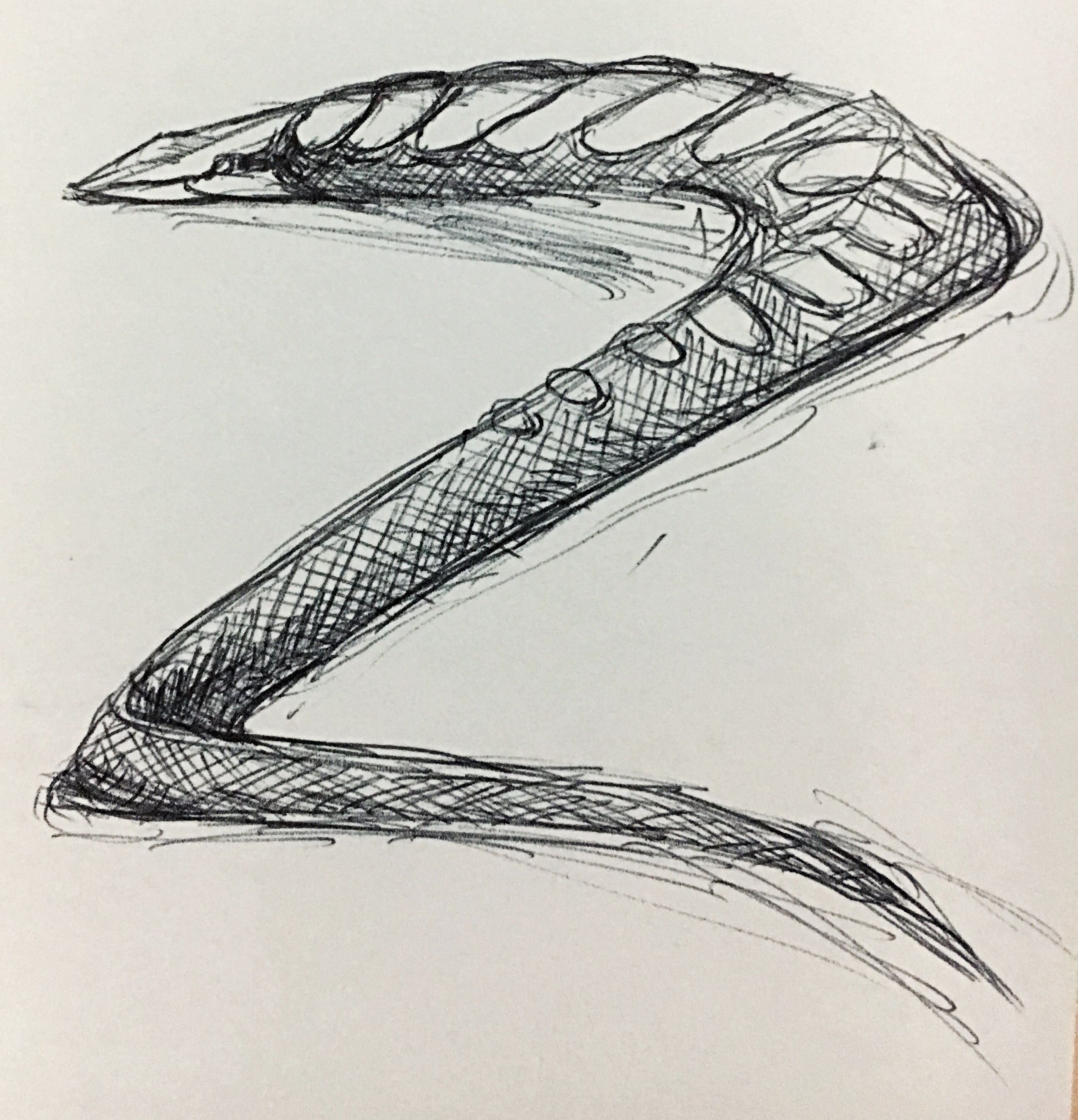
Not Appearing in ABC: The Ol-maima

While searching for information on the dingonek, I found that it’s been synonymized with a whole bunch of other creatures. These include, for instance, the Lukwata (a far more “legitimate” creature), the Ndamathia, and the Olmaima or Ol-umaina. That last one piqued my curiosity, and further research into it serves as a cautionary tale – one that cryptozoologists would do well to heed.

The original reference is Hobley (1913):

At the time this story appeared it was considered that this [Bronson’s account] was probably a traveller’s tale, told to entertain a newcomer, but I have since met a man who a few years back wandering about the Mara River or Ngare Dubash which rises in Sotik, crosses the Anglo-German boundary and runs into Lake Victoria in German territory. He emphatically asserts that he saw the beast [i.e. the Dingonek]. He was at the time where the Mara River crosses the frontier, and the river was in high flood. The beast came floating down the river on a big log, and he estimated its length at about sixteen feet, but could not certain of its length as its tail was in the water. He describes it as spotted like a leopard, covered with scales, and having a head like an otter; he did not see the long fangs described by Mr. Jordan. He fired at it and hit it; it slid off the log into the water and was not seen again.

I made inquiries of the District Commissioner, Kisii, Mr. Crampton, and he wrote recently and said he had visited the Amala River and made inquiries from the Masai in the neighbourhood, and they knew of the beast, which they called Ol-umaina, and described it as follows: About fifteen feet long, head like a dog, small ears marked somewhat after the fashion of a puff adder, has claws, short legs, short neck, is said to lie in the sun on the sand by the river-side and to slip into the water when disturbed; when in the water only its head is visible. This story does not radically disagree with the others…

There are a few conclusions to draw here. First, the author believes the dingonek, the unnamed Mara River creature, and the ol-umaina to be one and the same. Second, the features shared by all three are notable size, scales, spots like a leopard, and possibly a long tail.

Heuvelmans (1958) quotes Hobley (1913) (in fact, almost exactly the previous quote) and concurs that the “description agrees fairly well with the dingonek”. However, he has a comment on the ol-umaina’s description:

The puff-adder has no external ears. Perhaps Hobley means the small horns on the horned viper, but the text is by no means clear.

The ears thing confused me as well, but the most logical conclusions I can come up with is that a) like the puff adder, it has markings by its ears, or b) like the puff adder, it has no visible ears, or c) both of the above.

Finally Karl Shuker, in his In Search of Prehistoric Survivors (1995), straight-up refers to the Mara River creature as a dingonek, and makes a correction to the ol-umaina’s name: it is now the ol-maima.

So what are we to make of all this? Turns out there is a creature that answers to the descriptions given. A normal, unremarkable creature, but not as big as it is claimed to be.

Image from Wikipedia.

That’s right, it’s the humble Nile monitor lizard (Varanus niloticus). Note the scales, the “leopard” spots, the tail, an otter- or dog-like head without long fangs, sharp claws, short neck and legs, and a long tail. It basks in the sun and dives into the water when threatened.

Of course, Nile monitors don’t grow 15 feet long, but this can be chalked up to exaggeration and/or honest overestimation.

The final nail in the coffin is the name ol-maima or ol-umaina. Looking up a reputable Maa dictionary, we discover that ɔl-máɨ́má is the Maa word for a) a cripple and b) a Nile monitor lizard.

There is no need to invoke aquatic walruses, relict dinosaurs, or crocodiles with missing jaws. If the dingonek and the ol-maima are the same animal, then they are no more than fanciful descriptions of Nile monitors. The Dingonek gets a full entry because its description is so unusual, but the ol-maima, literally “Nile monitor lizard” in Maa, will not be so lucky.

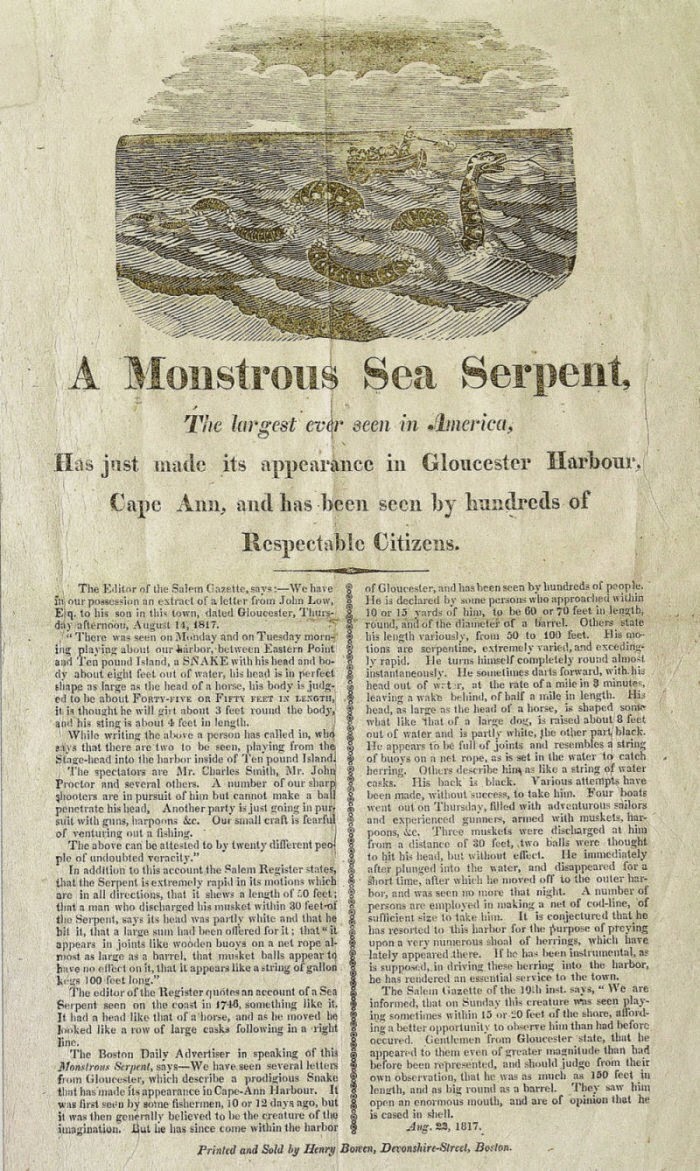
Hmmm…

appears in joints like wooden buoys on a net rope

appears like a string of gallon kegs

diameter of a barrel

appears to be full of joints and resembles a string of buoys on a net rope, as is set in the water to catch herring

a string of water casks

There is a very simple logical conclusion that is not being made here…

Not Appearing in ABC: The Ozaena

The Ozaena is one of those creatures that has gained some traction due to the excellent Bestiary by Jonathan Hunt. I won’t reproduce the image in question, but it can probably be found easily enough. Be careful though as “ozaena” is also a medical condition, and the images are unpleasant.

In it, the entry for O describes the Ozaena or “stink-polyp” as a hideous, be-tentacled blue creature with a foul smell. Hunt makes it look more alien, or something like a sea anemone – a polyp, presumably.. It varies in size from tiny to enormous, with one Spanish terror growing to the size of a ninety-gallon cask.

Quite a memorable creature, eh? Shame it doesn’t exist.

To understand what we’re talking about, we need to specify what polyp means. It’s not polyp as we understand it today, but short for polypus or “many-legs”. It is no more or less than the ancient term for the octopus.

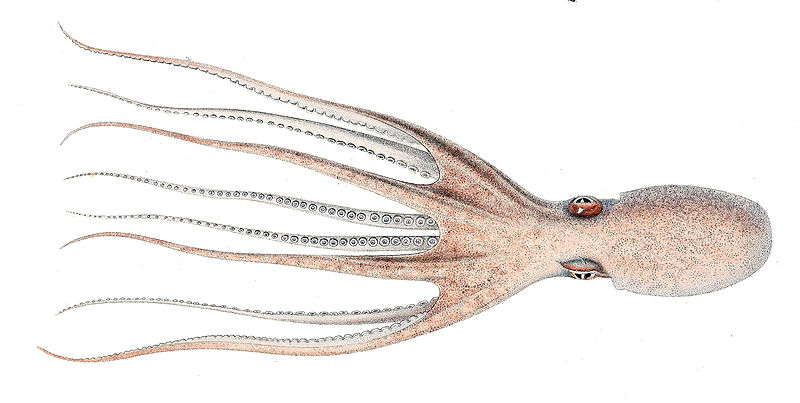
Aristotle distinguishes several kinds of octopus. Amongst those are the eledone, the bolitaena, and the ozolis – what would eventually become the Roman ozaena. Those are small in size and variegated, and have only one set of suckers along their tentacles. In other words, our ozaena is none other than the musky octopus Eledone moschata, which smells of musk. One of its synonyms is Ozoena moschata. It is neither huge nor terrifying.

(Image from Wikipedia)

The giant octopus story is in fact a separate account, unrelated to the ozolis, ozaena, or whatever. An enormous octopus came ashore at Dicaerchia in Italy, where it ravaged the cargo of Iberian merchants. The merchants would leave pickled fish in large jars on the shore, and the octopus would haul itself out of the water, break the jars, and eat the fish. This happened multiple times, and the merchants could not understand who the thief could be. A servant was left on guard one moonlit night, and he reported the incredible occurrence to his masters. The next time the octopus appeared it was assaulted with axes and slain.

So there you have it, a Frankensteined account creating an alien creature from our modern unfamiliarity with archaic terms and our tendency to lump accounts together for convenience.

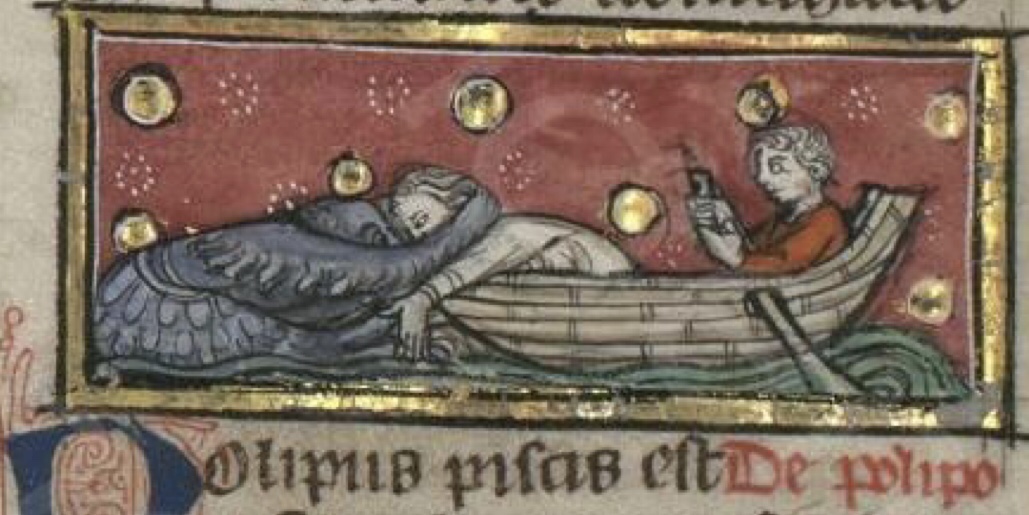
It’s alright. Shake off the heartbreak, there’s plenty more creatures to make up for it. With that I leave you with Thomas de Cantimpré’s imagery of the octopus or polypus, apparently in the process of drowning someone.

Voldemort’s warm embrace.

Welcome to the ABC 2018 Wrap-Up, the part of the blog where I talk about the state of ABC and what this means for me, for you, and for the rest of the known universe. This has been a strange, messed-up year, one in which I’ve been forced to reevaluate everything I knew or thought I knew, and one in which I’ve heeded some important wake-up calls.

What did we learn?

  • A print version of ABC is not coming anytime soon. Why, you ask? See the following points.
  • Writing up all the entries is next to impossible. The relatively relaxed pace of ABC updating allowed me to spend some time doing as much research as possible and painting illustrations I found, if not good, at least acceptable. But doing it all together is dizzying. I don’t even know how to start at it. And my art has deteriorated massively to the point where I hate it.
  • Finding an agent and/or publisher is next to impossible. I’m unpublished and have no credentials, there is no reason for anyone to hire me. And I don’t live in the US or Europe and don’t have easy access to crowdfunding and other such platforms.
  • My mental state has also degraded significantly. Turns out ABC gave me a reason to exist, a goal, a Thing to Do. Without it and without any clear plan for making the blog or a print book, I’ve been as pointless as a fish without a bicycle. More than usual at any rate.

All this paints a pretty bleak picture, doesn’t it? Well, turns out my loss is your gain. I have decided to go back to updating ABC, at least twice a week as before (and maybe three if I put more elbow grease into it). There are a lot of things I want to tell you about and I want to make sure it gets out there.

Watch this space. Watch it closely.

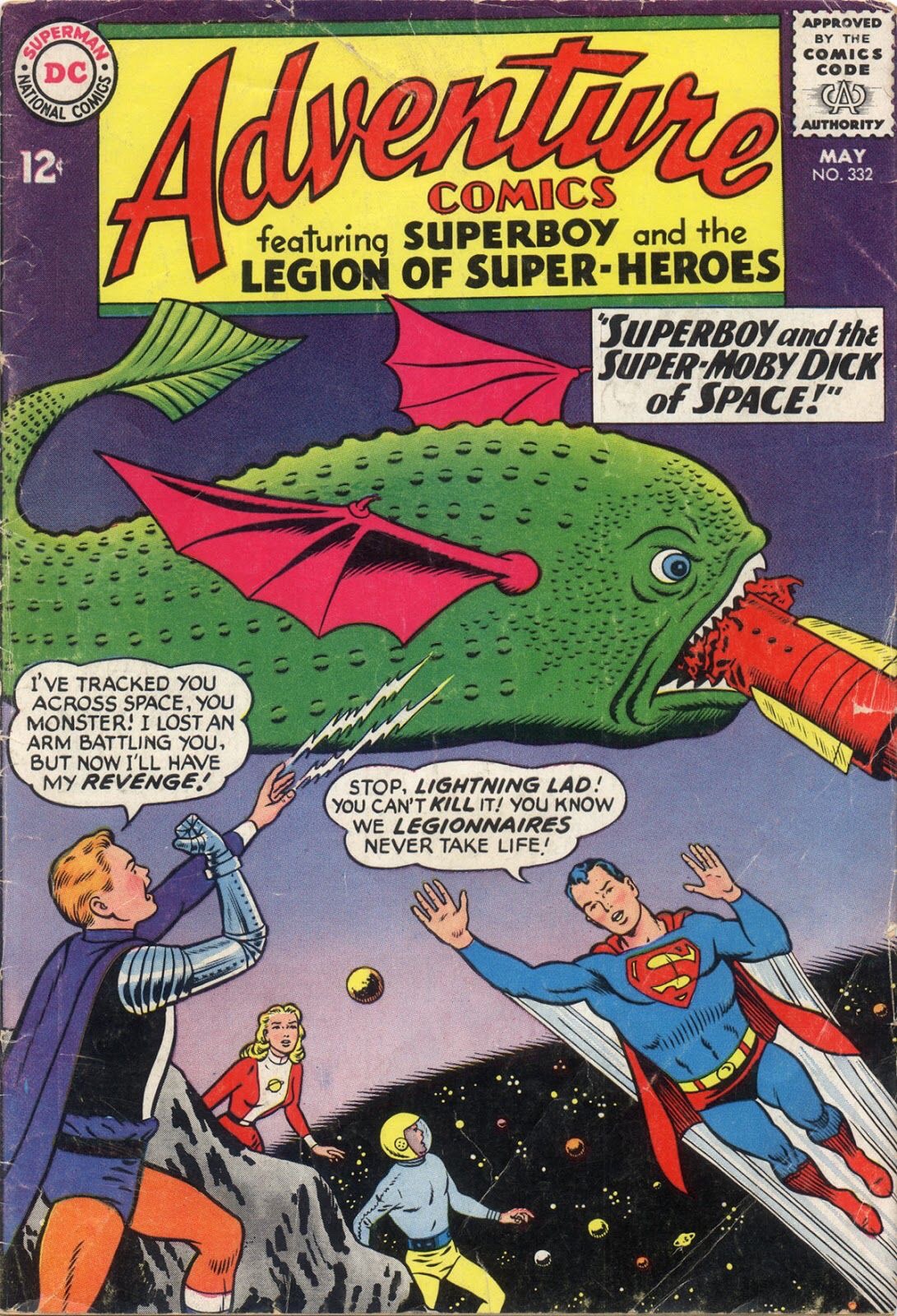
I can’t possibly do justice to this marvel. From the pages of the (excellent) Legion of Super Heroes, it’s a not-veiled-at-all retelling of Herman Melville’s book, and it’s the Super-Moby Dick of Space.

You’re all so happy I informed you of its existence.

Z is for… Zoureg

PUAP7380

The Zoureg is a mysterious Arabian snake. Despite being only a foot long, nothing can stop it once it starts moving. Trees, rocks, human beings – the zoureg goes through them like a hot knife through butter (with fatal results on humans, obviously). The only way to kill it is to decapitate it in its sleep.

Y is for… Ya-te-veo

The Ya-te-veo (literally “I see you”) is, as far as anyone knows, only described by Buel in his book Sea and Land. Since it’s found in both Africa and South America, it’s either a Wegenerian miracle or an amalgamation of all carnivorous plant tall tales. It tends to look like a comfy seat before snaring people in its spiked tentacles and giving them the Iron Maiden treatment. Excellent!