I had the opportunity to reread George MacDonald’s The Princess and Curdie (TPAC for short) and it wasn’t much fun. MacDonald was the precursor to Lewis and Tolkien, and his moralizing is ham-fisted and unsubtle. It’s a sequel to the superior The Princess and the Goblin, one which focuses on the miner boy Curdie. Our Hero is empowered by one of the vanishing few female mystical figures in Christian fantasy (she’s Gandalf or Aslan, if you will); specifically, she gives him the ability to assess souls by shaking hands. Good people have baby hands, bad people’s hands feel like animal paws.

You see where this is going. (*SPOILERS* I guess for the rest of the review) TPAC is drenched with praise for the divine right of kings to rule and disdain for the disgusting greed of the lower classes. Curdie visits a comically evil town where, apparently, people wake up in the morning every day and decide to be bad. He acts like a jerk, destroys the plot to kill the kindly old king, tortures some plebeians at length (so much that it gets uncomfortable) and eventually becomes king himself because – surprise surprise – he has royal blood in him and so is fit to rule. But then he and the princess die without offspring and the unrepentant sinners of the town mine deep enough that everything collapses. Everyone dies. The end!

I didn’t remember any of that. What I remember from reading it as a child was the monsters.

Ohhh, those monsters. Nobody’s quite sure where they come from. In The Princess and the Goblin they’re the descendants of “regular” animals bred by goblins for subterranean life. In TPAC they’re apparently people whose sinful lifestyle transformed them according to their nature, and they’re now making amends for it. I say apparently because it’s mentioned a few times but not really expounded upon. I loved them to bits at any rate and scribbled them all over my school notebooks at the time.

Let’s see what they are, shall we? The images I’ll be sharing here are by Charles Folkard, Helen Stratton, and Dorothy Lathrop, and will be credited accordingly. All quotes are from TPAC.
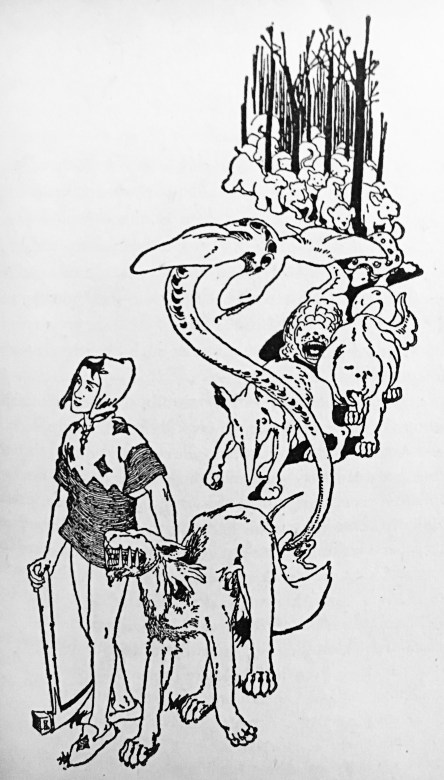
monsters helen stratton

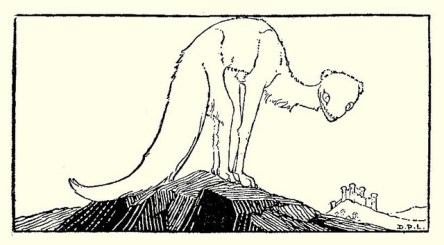
Our first and most notable is the one that accompanies Curdie throughout the book. Her name is Lina, and she is the one in the foreground of the image above by Helen Stratton. Her appearance is striking.

She had a very short body, and very long legs made like an elephant’s, so that in lying down she kneeled with both pairs. Her tail, which dragged on the floor behind her, was twice as long and quite as thick as her body. Her head was something between that of a polar bear and a snake. Her eyes were dark green, with a yellow light in them. Her under teeth came up like a fringe of icicles, only very white, outside of her upper lip. Her throat looked as if the hair had been plucked off. It showed a skin white and smooth.

Of course, Lina accompanies our hero, fights and protects him, and is generally a Good Dog. At the of TPAC she apparently dies happily by incinerating herself in a mass of burning magic roses. Yay?
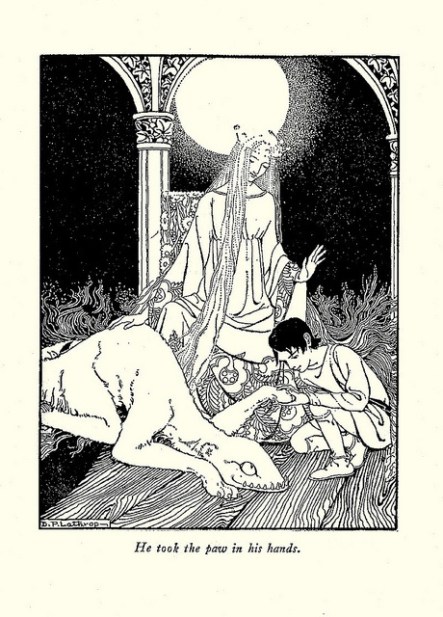
lina dorothy lathroplina paw dorothy lathrop

I must admit that Dorothy Lathrop’s version of her (two images above) is adorable.

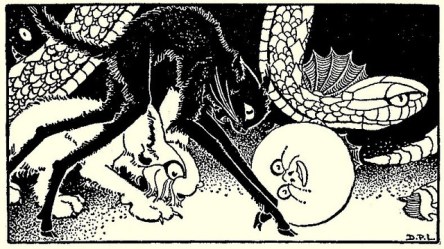
Lina then serves to marshal an army of monsters with which to torment the sinners of the town. Just some of them are shown below in Lathrop’s rendition.

…until at last, before they were out of the wood, she was followed by forty-nine of the most grotesquely ugly, the most extravagantly abnormal animals imagination can conceive. To describe them were a hopeless task. I knew a boy who used to make animals out of heather roots. Wherever he could find four legs, he was pretty sure to find a head and a tail. His beasts were a most comic menagerie, and right fruitful of laughter. But they were not so grotesque and extravagant as Lina and her followers.
monsters dorothy lathrop

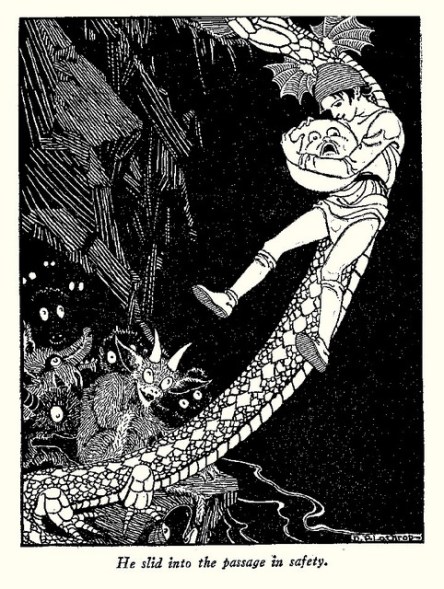
Probably the most memorable of the monsters is the “legserpent”.

One of them, for instance, was like a boa constrictor walking on four little stumpy legs near its tail About the same distance from its head were two little wings, which it was for ever fluttering as if trying to fly with them. Curdie thought it fancied it did fly with them, when it was merely plodding on busily with its four little stumps. How it managed to keep up he could not think, till once when he missed it from the group: the same moment he caught sight of something at a distance plunging at an awful serpentine rate through the trees, and presently, from behind a huge ash, this same creature fell again into the group, quietly waddling along on its four stumps. Watching it after this, he saw that, when it was not able to keep up any longer, and they had all got a little space ahead, it shot into the wood away from the route, and made a great round, serpenting along in huge billows of motion, devouring the ground, undulating awfully, galloping as if it were all legs together, and its four stumps nowhere. In this mad fashion it shot ahead, and, a few minutes after, toddled in again amongst the rest, walking peacefully and somewhat painfully on its few fours.

Imagine Archeops’ desperately flapping wings stapled to a python, and you’re already halfway there.
legserpent dorothy lathrop

The legserpent helps Curdie and friends cross a chasm (image above, Dorothy Lathrop), and participates in enacting grisly vengeance on the Lord Chamberlain…

Now his lordship had had a bedstead made for himself, sweetly fashioned of rods of silver gilt: upon it the legserpent found him asleep, and under it he crept. But out he came on the other side, and crept over it next, and again under it, and so over it, under it, over it, five or six times, every time leaving a coil of himself behind him, until he had softly folded all his length about the lord chamberlain and his bed. This done, he set up his head, looking down with curved neck right over his lordship’s, and began to hiss in his face. He woke in terror unspeakable, and would have started up; but the moment he moved, the legserpent drew his coils closer, and closer still, and drew and drew until the quaking traitor heard the joints of his beadstead grinding and gnarring. Presently he persuaded himself that it was only a horrid nightmare, and began to struggle with all his strength to throw it off. Thereupon the legserpent gave his hooked nose such a bite, that his teeth met through it—but it was hardly thicker than the bowl of a spoon; and then the vulture knew that he was in the grasp of his enemy the snake, and yielded. As soon as he was quiet the legserpent began to untwist and retwist, to uncoil and recoil himself, swinging and swaying, knotting and relaxing himself with strangest curves and convolutions, always, however, leaving at least one coil around his victim. At last he undid himself entirely, and crept from the bed. Then first the lord chamberlain discovered that his tormentor had bent and twisted the bedstead, legs and canopy and all, so about him, that he was shut in a silver cage out of which it was impossible for him to find a way. Once more, thinking his enemy was gone, he began to shout for help. But the instant he opened his mouth his keeper darted at him and bit him,and after three or four such essays, with like result, he lay still.

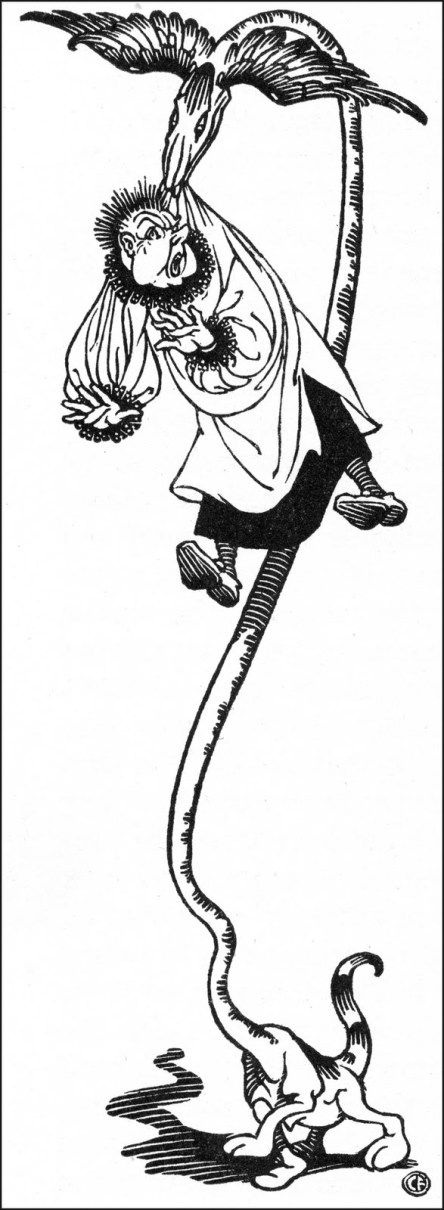
… and the priest on “Religion Day” (image below by Charles Folkard).

At this point of the discourse the head of the legserpent rose from the floor of the temple, towering above the pulpit, above the priest, then curving downwards, with open mouth slowly descended upon him. Horror froze the sermon-pump. He stared upwards aghast. The great teeth of the animal closed upon a mouthful of the sacred vestments, and slowly he lifted the preacher from the pulpit, like a handful of linen from a wash-tub, and, on his four solemn stumps, bore him out of the temple, dangling aloft from his jaws.
legserpent charles folkard

Then there’s a whole bunch of other absurdly adorable monstrosities which barely get time to shine. There’s a Scorpion the size of a giant crab, and a three-foot-long Centipede. The sharp-nosed “tapir” and “Clubhead” work in tandem to destroy a rock wall…

At the very first blow came a splash from the water beneath, but ere he could heave a third, a creature like a tapir, only that the grasping point of its proboscis was hard as the steel of Curdie’s hammer, pushed him gently aside, making room for another creature, with a head like a great club, which it began banging upon the floor with terrible force and noise. After about a minute of this battery, the tapir came up again, shoved Clubhead aside, and putting its own head into the hole began gnawing at the sides of it with the finger of its nose, in such a fashion that the fragments fell in a continuous gravelly shower into the water. In a few minutes the opening was large enough for the biggest creature amongst them to get through it.

The tapir puts its nose to gruesome use.

The tapir had the big footman in charge: the fellow stood stock-still, and let the beast come up to him, then put out his finger and playfully patted his nose. The tapir gave the nose a little twist, and the finger lay on the floor. Then indeed the footman ran, and did more than run, but nobody heeded his cries. […] The master of the horse Curdie gave in charge to the tapir. When the soldier saw him enter—for he was not yet asleep—he sprang from his bed, and flew at him with his sword. But the creature’s hide was invulnerable to his blows, and he pecked at his legs with his proboscis until he jumped into bed again, groaning, and covered himself up; after which the tapir contented himself with now and then paying a visit to his toes.

“Ballbody” is probably the silliest.

…he had neither legs nor head nor arms nor tail: he was just a round thing, about a foot in diameter, with a nose and mouth and eyes on one side of the ball. He had made his journey by rolling as swiftly as the fleetest of them could run. […] …he could do nothing at cleaning, for the more he rolled, the more he spread the dirt. Curdie was curious to know what he had been, and how he had come to be such as he was; but he could only conjecture that he was a gluttonous alderman whom nature had treated homœopathically.

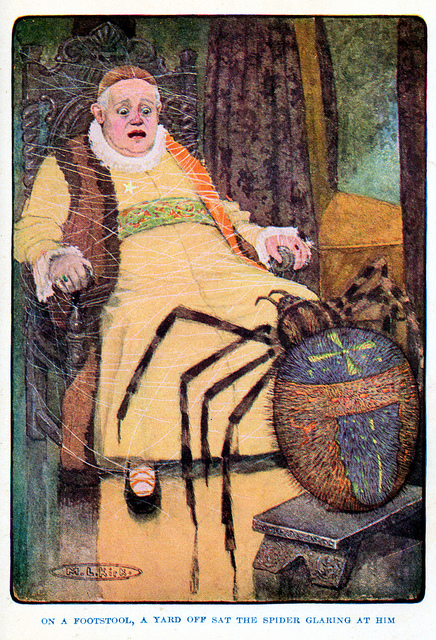
And then there’s the giant spider, which inspired at least two pieces of art, first by Charles Folkard.
spider charles folkard

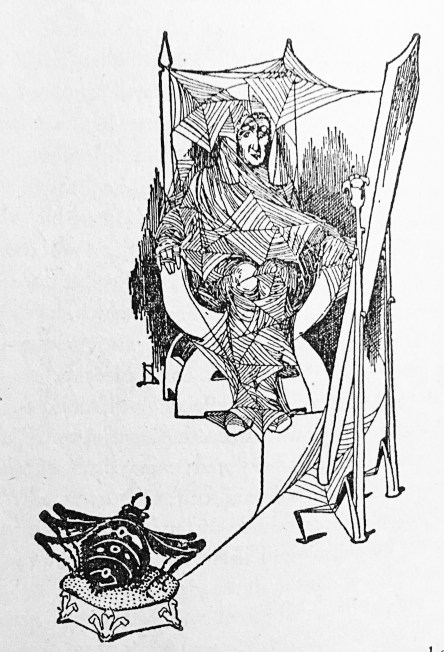
For the attorney-general, Curdie led to his door a huge spider, about two feet long in the body, which, having made an excellent supper, was full of webbing. The attorney-general had not gone to bed, but sat in a chair asleep before a great mirror. He had been trying the effect of a diamond star which he had that morning taken from the jewel-room. When he woke he fancied himself paralysed; every limb, every finger even, was motionless: coils and coils of broad spider-ribbon bandaged his members to his body, and all to the chair. In the glass he saw himself wound about, under and over and around, with slavery infinite. On a footstool a yard off sat the spider glaring at him.
spider helen stratton

And then by Helen Stratton. I cannot properly express how much I love the above image. You can just imagine the spider glaring crossly at the poor guy, all like òÒÓó

Well, that concludes our retrospective through MacDonald’s lovingly designed monstrosities. If TPAC had been only about their adventures it would probably have been far more fun.

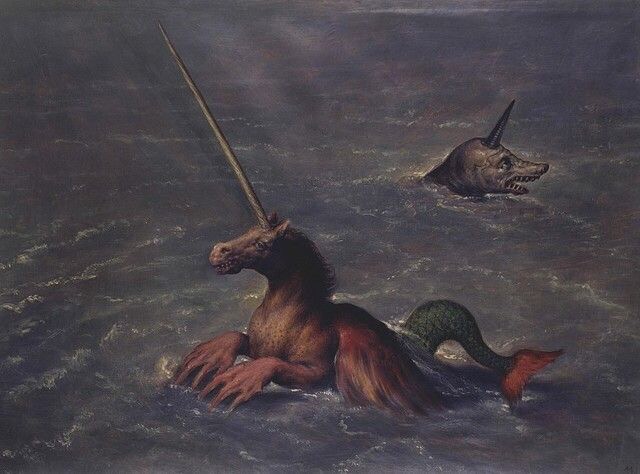
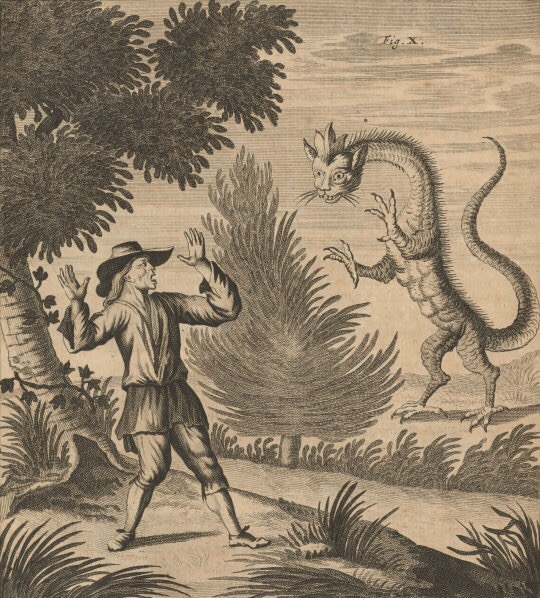
Here we have a menacing alpine dragon – what would be called a tatzelwurm nowadays (a regional name that has since come to conveniently apply to alpine dragons as a whole, but back then they were all simply dragons). Note the feline features. Maybe those were greatly exaggerated wildcat encounters?

Or maybe they just needed an excuse for coming home late after too much lager…

Image from Johann Jakob Scheuchzer’s Itinera Alpina.

9782366720532

Créatures Fantastiques Deyrolle

Jean-Baptiste de Panafieu, Camille Renversade

Everyone knows Deyrolle charts. Well, a lot of people do. And even if you’ve never heard of them, the educational-chart-poster style will look familiar, as will the instructive anatomical layouts. And if you’ve been to Paris, you may have seen or walked by their place/museum. So what happens when you mix fantastic creatures with Deyrolle’s style (with their blessing, of course)? You get something like Créatures Fantastiques Deyrolle (CFD from now on).

If you have deep pockets, you can grab a copy here and here – they’re actually pricey, out of print, and not available on the publisher’s site anymore, but they’re going to get reprinted!

Scope

Global. While not as comprehensive as, say, ABC (yay self-promotion), it covers a wide range of creatures, from bestiary mainstays to literary jokes to cryptozoological darlings.

Organization

Broken up by general groups – reptiles, land mammals, creatures of the air, creatures of the sea, humanoids, and hybrids. Each entry of this large-sized coffee-table book is split in two halves – the left side is the text, the right side is the illustration. More below.

Text

A lot of research has gone into the writing, which is fluid and fun to read, with wry interpretations and commentary throughout. There are citations from the sources, which is always nice. It’s informative and low on embellishment, knocking spots off Dubois’ florid style.

It’s also in French, make of that what you will.

Most importantly, the text has the actual research and what is known about those creatures. Then when you’re done with that, you check out the art…

Images

Lush. There is plenty of artistic interpretation, but not more than I’d deem acceptable. The dragons entry, for instance, has lovely butterfly-esque versions of the Graoully, Grand’Goule, Gargouille, Grand Bailla, Drac… which are entirely the illustrator’s designs, but considering the lack of established iconography (unlike, say, the Tarasque) you can’t blame them. The basilisk is in its eight-legged form, but unlike the detestable lizardlike version common today, it does look like eight plucked mutant roosters mushed together.

Everything gets mock-scientific names, and anatomical cutaways are everywhere. Want to see a sea-serpent’s skeleton? An x-ray of the Loch Ness Monster (represented by a Heuvelmansesque long-necked seal)? What about a comparison of Cetus species (as gigantic anglerfishes) or unicorn species? There’s even fossils of the orabou and the Sarmatian snail discussed at length!

All of the “artistic license” is in the art, so if it bothers you, you can focus on the text and leave out the illustrations (but why would you?)

My only regret is that their version of the coquecigrue is so perfect, I won’t be able to come up with something better.

Research

References are not listed for each entry separately (as in ABC) but are all available at the end in a bibliography. Citations from original texts are cited appropriately. A variety of sources are consulted for a broad view of differing viewpoints. As mentioned, the text is straight-up research, while the art takes more liberties.

The authors have shown their work in spades. There are loads of obscure animals discussed, including a couple even I haven’t heard of!

My only real qualm is that the seps is described as rotting and melting its victims, but the art says it “preserves” its victims…

Summary

Another five-star review? Already? It was bound to happen though. CFD is ridiculously good – well-researched, well-illustrated, with a bibliography and clear separation of fact and artistic license, all wrapped up in a fun faux-scientific retro look. The only thing keeping all teratologists from owning a copy is price and availability. No, it being in French is not a problem. Learn it. Buy this book (when prices are reasonable). Feel good.

5

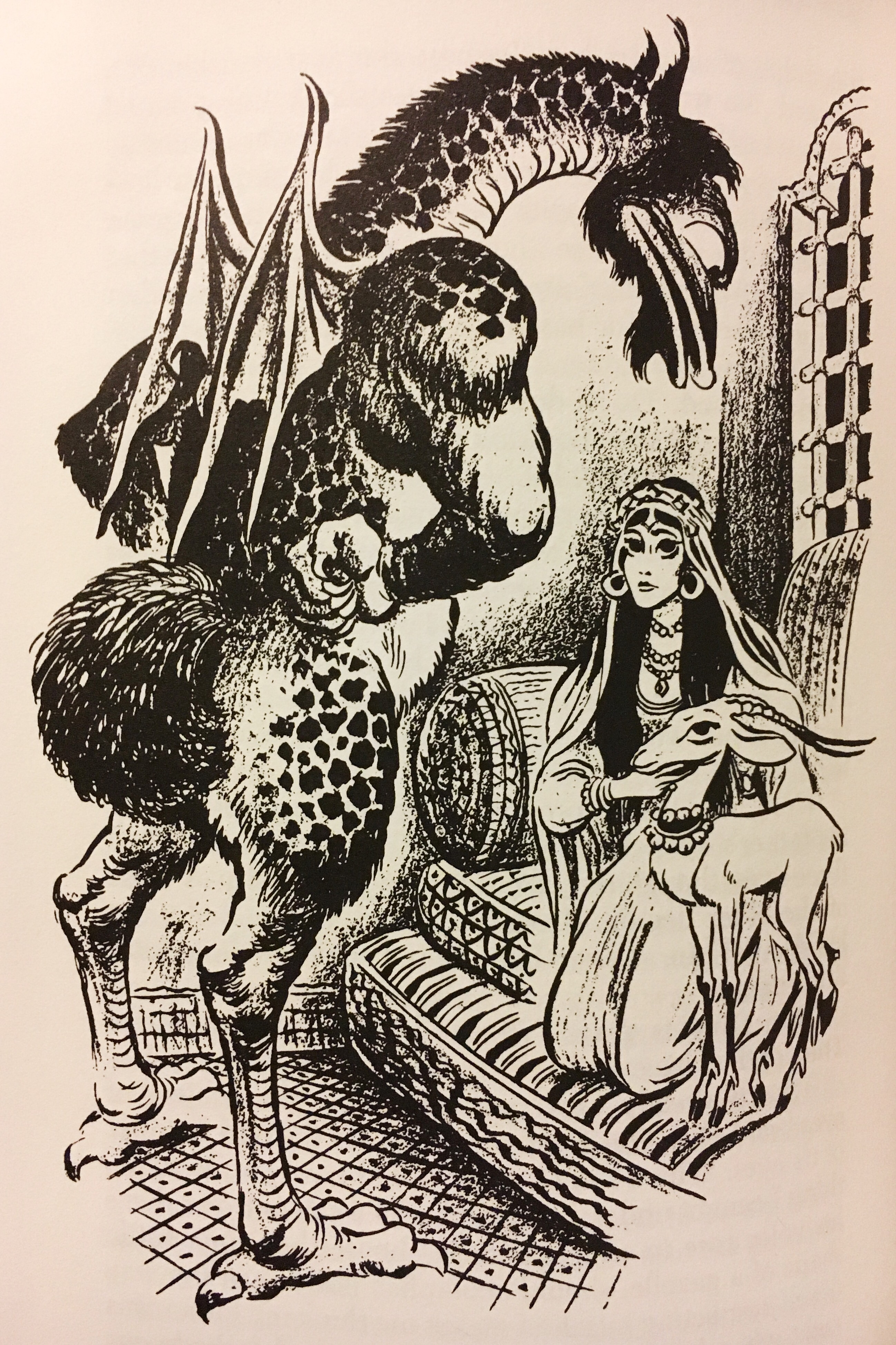
Pop Quiz: which one of these characters is a jinni?

A. The well-dressed woman

B. The demure-looking gazelle

C. The big freaky spotted ostrich monster

D. All of the above

If your answer was D, then you are correct! This illustration by Frit Eichenberg from Eleanor Hoffmann’s Mischief in Fez does a great job of showing just how different jinn can be. A far cry from muscular blue men in bottles.

My first encounter with James Lewicki’s art was in The World We Live In, the best natural history book ever written *inserts bias*. His work was primarily eerie seascapes in that series, but this prolific and talented artist did a lot of art for LIFE Magazine during the 50s and 60s.

His greatest contribution to LIFE is the American Folklore series, which he initiated. According to Lewicki’s biography told here:

It was while working on Christmas legends that a neighbor commented to Jim that the United States really had no strong tradition of folklore and cultural heritage. Jim went to the library to see if this was so, and found volumes to the contrary. He proposed the theme of folklore to Life magazine, and they asked for a for a dummy presentation of 12 pages. Jim found it impossible to condense it all down to one article, so he suggested a series, and much to his surprise the editors agreed. This assignment lasted for five years.

The end result is the gorgeous LIFE Treasury of American Folklore, a collection of American folktales all illustrated by Lewicki. They include travelers’ accounts, Native American legends, colonial stories, northern and southern folklore, tall tales, and the like. The book is, of course, a product of its time, but a lot of it is still as effective today. This post is an appreciation of Lewicki’s work on the book.

Some of the stories in the book would be familiar to most readers. This include good ol’ Rip Van Winkle, seen waking up in incredible detail below…

Photo 9-7-17, 9 30 44 PM

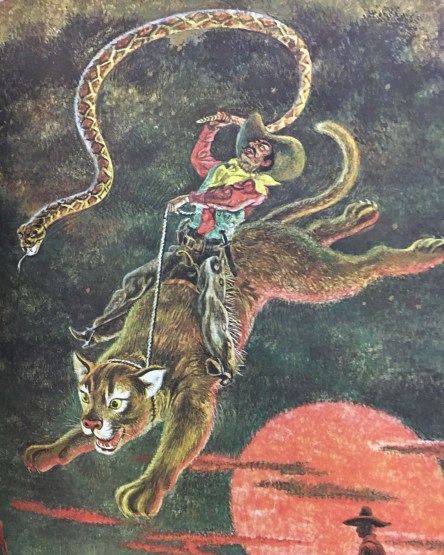
… and such beloved fakelore as Paul Bunyan and Pecos Bill.

Photo 9-7-17, 9 32 18 PM

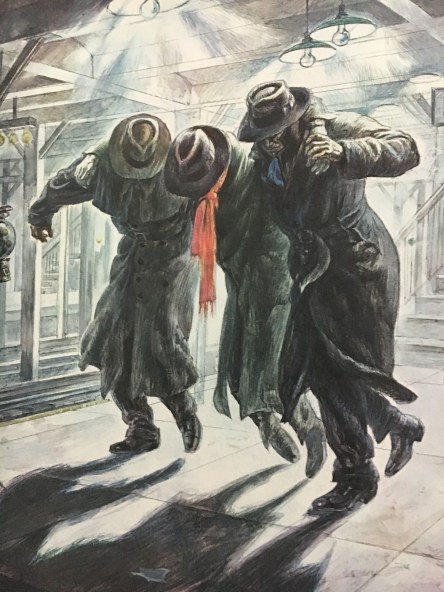
There are modern legends too, such as “The Man in the Middle”, which will be familiar to anyone who read Scary Stories to Tell in the Dark (and lost sleep over it).

Photo 9-7-17, 9 31 48 PM

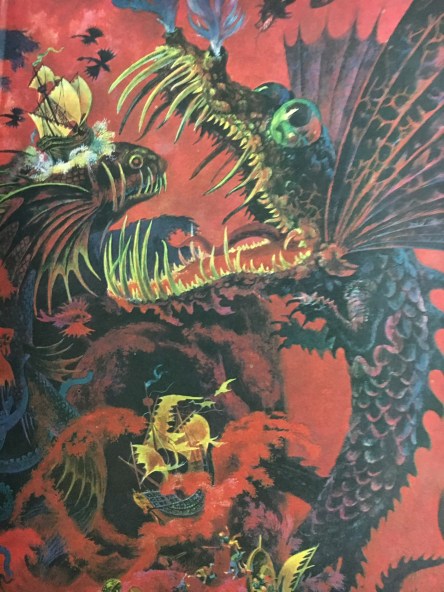
The first big picture you get reading the book is the monsters of the Sea of Darkness, and hooboy is it impressive.

Photo 9-7-17, 9 28 01 PM

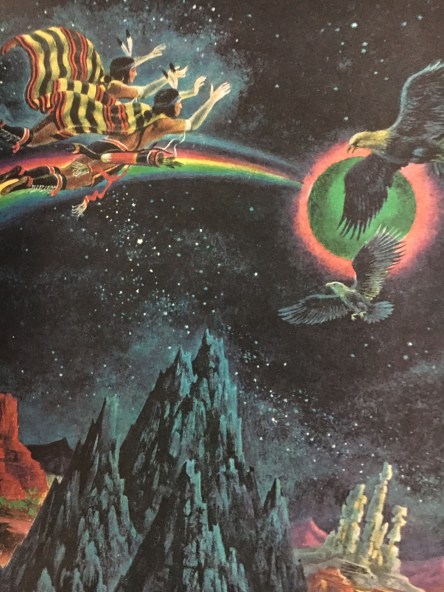
Nayenezgani and Tobadzistsini on their journey to the Sun could well pass as a metal album cover.

Photo 9-7-17, 9 29 10 PM

Meanwhile Sedna’s fingers giving rise to the beasts of the sea manages to be somehow beautifully stylized and creepy at the same time.

Photo 9-7-17, 9 28 52 PM

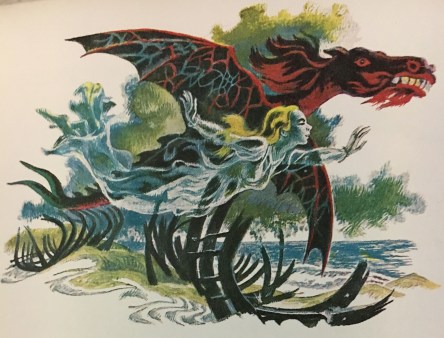
The Jersey Devil, seen here with a ghostly pal.

Photo 9-7-17, 9 29 25 PM

Ahhh, ghost pirates. Where would we be without them?

Photo 9-7-17, 9 29 46 PM

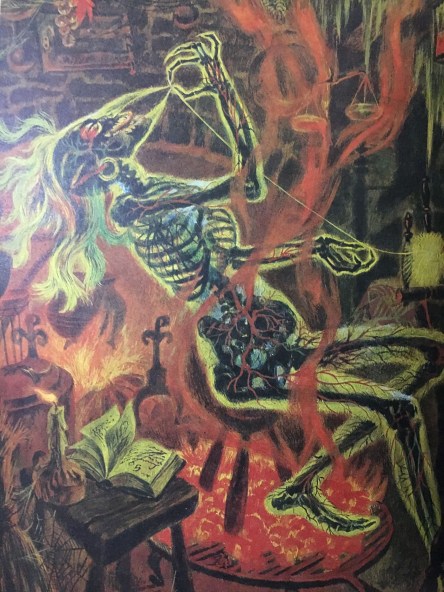
Probably the most nightmarish and memorable piece in the book is the witch woman who literally spins her skin off, shedding it like a husk of corn, until nothing remains but an enormous cat. Yikes.

Photo 9-7-17, 9 31 16 PM

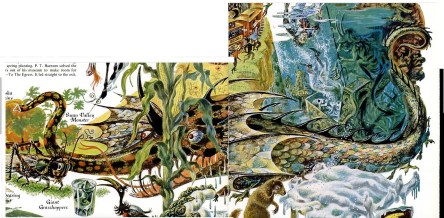
I can’t end this brief appreciation without mentioning Lewicki’s Swan Valley Monster, the first time this awesome monster was visually represented (to my knowledge).

tumblr_osayoeIQnG1vd0dgeo1_1280

What I’m saying is that The Life Treasury of American Folklore is a worthwhile acquisition for fans of folklore, creatures, Americana, and excellent art. I still hold out hope that Time-Life reprints it and The World We Live In in high-quality glossy modern editions, but this will never happen as we all know…

url

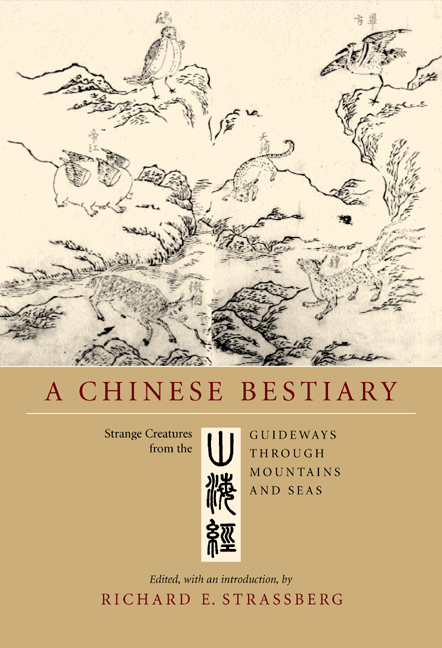
A Chinese Bestiary

Richard E. Strassberg

The Shan Hai Jing is the seminal Chinese bestiary, in fact one of the most creature-packed creature books in existence! (It’s also where Borges got his Chinese fauna from) And if you’re in the unfortunate position of being unable to read Chinese, like myself, you’re going to need a translation. This is where Strassberg’s A Chinese Bestiary (ACB) comes in, and it delivers in spades.

You can get your grubby mitts on it here and here.

Scope

It’s the Shan Hai Jing. Need I say more? I do? Oh. It’s an English translation of the Guideways, with ample commentary and the original illusrations.

Once more, this is not a complete compendium of mythical creatures nor does it pretend to be. Its narrow focus is what makes it good.

Organization

Introductions and Notes frame the Shan Hai Jing translation, which is the meat of the book. The text is broken up by region and by creature, with each notable creature having its own number to identify it in the illustration and (in most cases) commentary. Straightforward and easy to use.

Text

It’s a translation of a classic Chinese text. And I don’t read Chinese, so I can’t comment on how good of a translation it is (Chinese-reading ABC readers should feel free to chime in with opinions, if any). But it’s written clearly, thoroughly referenced and footnoted.

Images

Black and white and simple enough, but most importantly they are the original illustrations. So what you’re seeing is what people at the time (or at least, one artist at the time) thought those creatures look like. As opposed to, you know, some teratologist with delusions of competence presenting a subjective interpretation…

Research

As mentioned above, there are references and notes for just about everything. As the Shan Hai Jing is itself an ur-reference, there is little need for more – but there is more! These range from folklore notes to Guo Pu’s commentaries and everything in between.

If it’s not academic enough for you, there’s always the massive Mathieu translation, which is extremely academic. Also it’s in French.

Summary

I can’t really sing the praises of this book enough. It’s good. Like Meeting with Monsters it has a (relatively) narrow subject and it uses that to excellent effect. Another must-have book for anyone with a passing interest in Chinese teratology.

5

Good news! I got the inside scoop on this ṣafat malarkey. I’d save it for the final ABC product, but I need to nip any misunderstandings in the bud before they get out of hand and people start labeling their giant sky cruisers with that name.

First, some breadcrumbing. The ṣafat bird (note the dot under the s – that’s a ص) seems to have originally come from (where else?) Rose’s Giants, Monsters, and Dragons, which in turn got it from Barber’s Dictionary, which itself obtained it from Lum’s Fabulous Beasts. I do not have that last book. Impasse.

I do, however, have access to the most powerful search engines known to humanity, and hey presto – looks like the ur-reference for the ṣafat is Hanauer’s Tales Told in Palestine.

Going by the title alone, it’s clear that the ṣafat is not an “Arabian” animal. In the text Azrael – the Angel of Death himself – shows off ṣafat eggshells as something that is a cause of death . He describes the ṣafat as a wonderful bird that never lands (no mention is given as to its size, so I can only assume it’s normal-sized and not huge). It even lays eggs in flight, and the young hatch before they reach the ground. But then they are often eaten by a shibah (described as resembling a badger-hyena cross. Zorilla? Aardwolf?), which then becomes rabid, goes mad, bites things, and gives Azrael more customers.

There you have it. Far from being a mere permaflier like the allerion or bird of paradise, it’s literally the cause of rabies.

Clarfication: the eggshells are eaten and cause rabies. The shibah/shibeh is the leopard (!).

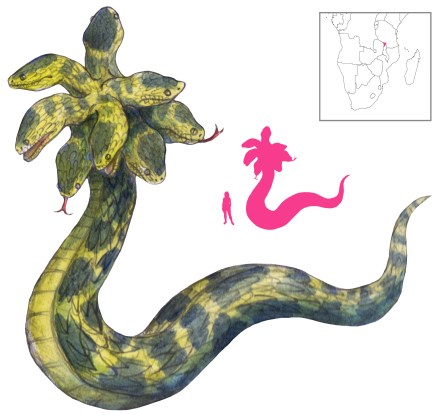
Nyuvwira

Variations: Inifwira

Nyuvwira

The Nyuvwira is an enormous snake restricted to the Chitipa District of Malawi. It is found in association with minerals, especially precious minerals of monetary value. It can also be found in the mines of South Africa. It is known as Inifwira in Sukwa.

A nyuvwira has eight heads and is the largest snake in the world. It generates electricity and lights at night. It lives underground, which is fortunate as it is extremely toxic. When it moves (about every 200 years) it causes death and disaster. Airplanes flying over a nyuvwira crash.

The skin of a nyuvwira, held in one’s pocket, prevents planes from moving and is a powerful charm for wealth. To kill a nyuvwira one must construct a spiral hut and line it with razors, then entice the snake in by ringing bells. It will crawl over the razors and cut itself to death.

References

Hargreaves, B. J. (1984) Mythical and Real Snakes of Chitipa District. The Society of Malawi Journal, Vol. 37, No. 1, pp. 40-52.