
“About those shoes you sold me yesterday…”
Centaur at the Village Blacksmith’s Shop by Arnold Böcklin, 1888.
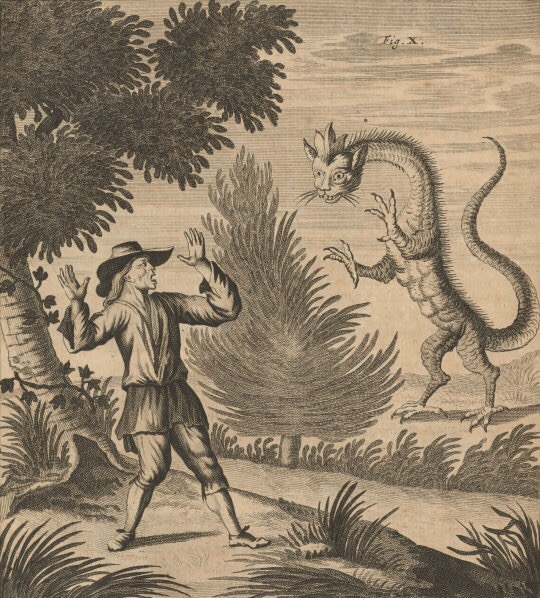
Here we have a menacing alpine dragon – what would be called a tatzelwurm nowadays (a regional name that has since come to conveniently apply to alpine dragons as a whole, but back then they were all simply dragons). Note the feline features. Maybe those were greatly exaggerated wildcat encounters?
Or maybe they just needed an excuse for coming home late after too much lager…
Image from Johann Jakob Scheuchzer’s Itinera Alpina.

Créatures Fantastiques Deyrolle
Jean-Baptiste de Panafieu, Camille Renversade
Everyone knows Deyrolle charts. Well, a lot of people do. And even if you’ve never heard of them, the educational-chart-poster style will look familiar, as will the instructive anatomical layouts. And if you’ve been to Paris, you may have seen or walked by their place/museum. So what happens when you mix fantastic creatures with Deyrolle’s style (with their blessing, of course)? You get something like Créatures Fantastiques Deyrolle (CFD from now on).
If you have deep pockets, you can grab a copy here and here – they’re actually pricey, out of print, and not available on the publisher’s site anymore, but they’re going to get reprinted!
Scope
Global. While not as comprehensive as, say, ABC (yay self-promotion), it covers a wide range of creatures, from bestiary mainstays to literary jokes to cryptozoological darlings.
Organization
Broken up by general groups – reptiles, land mammals, creatures of the air, creatures of the sea, humanoids, and hybrids. Each entry of this large-sized coffee-table book is split in two halves – the left side is the text, the right side is the illustration. More below.
Text
A lot of research has gone into the writing, which is fluid and fun to read, with wry interpretations and commentary throughout. There are citations from the sources, which is always nice. It’s informative and low on embellishment, knocking spots off Dubois’ florid style.
It’s also in French, make of that what you will.
Most importantly, the text has the actual research and what is known about those creatures. Then when you’re done with that, you check out the art…
Images
Lush. There is plenty of artistic interpretation, but not more than I’d deem acceptable. The dragons entry, for instance, has lovely butterfly-esque versions of the Graoully, Grand’Goule, Gargouille, Grand Bailla, Drac… which are entirely the illustrator’s designs, but considering the lack of established iconography (unlike, say, the Tarasque) you can’t blame them. The basilisk is in its eight-legged form, but unlike the detestable lizardlike version common today, it does look like eight plucked mutant roosters mushed together.
Everything gets mock-scientific names, and anatomical cutaways are everywhere. Want to see a sea-serpent’s skeleton? An x-ray of the Loch Ness Monster (represented by a Heuvelmansesque long-necked seal)? What about a comparison of Cetus species (as gigantic anglerfishes) or unicorn species? There’s even fossils of the orabou and the Sarmatian snail discussed at length!
All of the “artistic license” is in the art, so if it bothers you, you can focus on the text and leave out the illustrations (but why would you?)
My only regret is that their version of the coquecigrue is so perfect, I won’t be able to come up with something better.
Research
References are not listed for each entry separately (as in ABC) but are all available at the end in a bibliography. Citations from original texts are cited appropriately. A variety of sources are consulted for a broad view of differing viewpoints. As mentioned, the text is straight-up research, while the art takes more liberties.
The authors have shown their work in spades. There are loads of obscure animals discussed, including a couple even I haven’t heard of!
My only real qualm is that the seps is described as rotting and melting its victims, but the art says it “preserves” its victims…
Summary
Another five-star review? Already? It was bound to happen though. CFD is ridiculously good – well-researched, well-illustrated, with a bibliography and clear separation of fact and artistic license, all wrapped up in a fun faux-scientific retro look. The only thing keeping all teratologists from owning a copy is price and availability. No, it being in French is not a problem. Learn it. Buy this book (when prices are reasonable). Feel good.

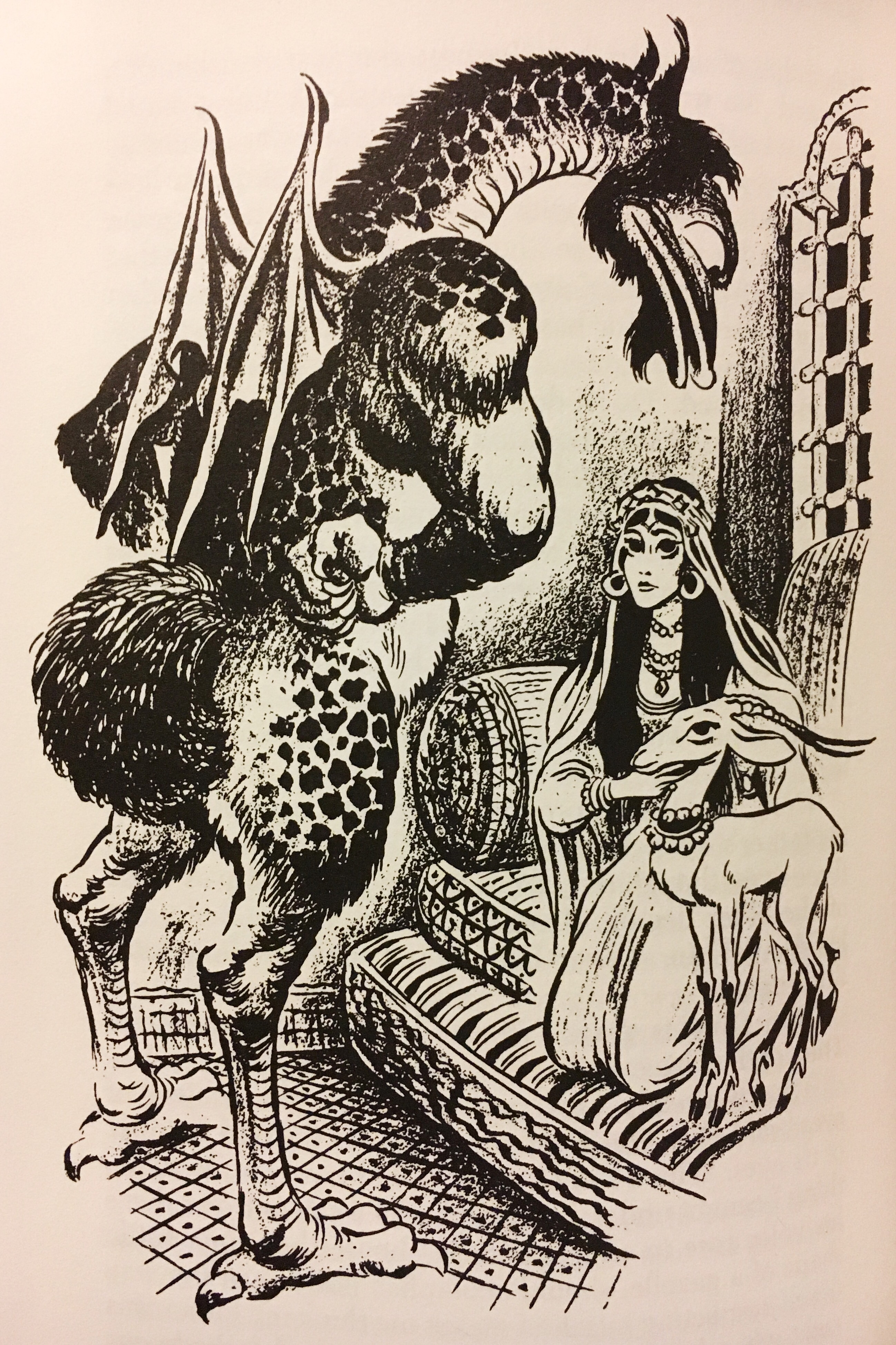
Pop Quiz: which one of these characters is a jinni?
A. The well-dressed woman
B. The demure-looking gazelle
C. The big freaky spotted ostrich monster
D. All of the above
If your answer was D, then you are correct! This illustration by Frit Eichenberg from Eleanor Hoffmann’s Mischief in Fez does a great job of showing just how different jinn can be. A far cry from muscular blue men in bottles.
My first encounter with James Lewicki’s art was in The World We Live In, the best natural history book ever written *inserts bias*. His work was primarily eerie seascapes in that series, but this prolific and talented artist did a lot of art for LIFE Magazine during the 50s and 60s.
His greatest contribution to LIFE is the American Folklore series, which he initiated. According to Lewicki’s biography told here:
It was while working on Christmas legends that a neighbor commented to Jim that the United States really had no strong tradition of folklore and cultural heritage. Jim went to the library to see if this was so, and found volumes to the contrary. He proposed the theme of folklore to Life magazine, and they asked for a for a dummy presentation of 12 pages. Jim found it impossible to condense it all down to one article, so he suggested a series, and much to his surprise the editors agreed. This assignment lasted for five years.
The end result is the gorgeous LIFE Treasury of American Folklore, a collection of American folktales all illustrated by Lewicki. They include travelers’ accounts, Native American legends, colonial stories, northern and southern folklore, tall tales, and the like. The book is, of course, a product of its time, but a lot of it is still as effective today. This post is an appreciation of Lewicki’s work on the book.
Some of the stories in the book would be familiar to most readers. This include good ol’ Rip Van Winkle, seen waking up in incredible detail below…

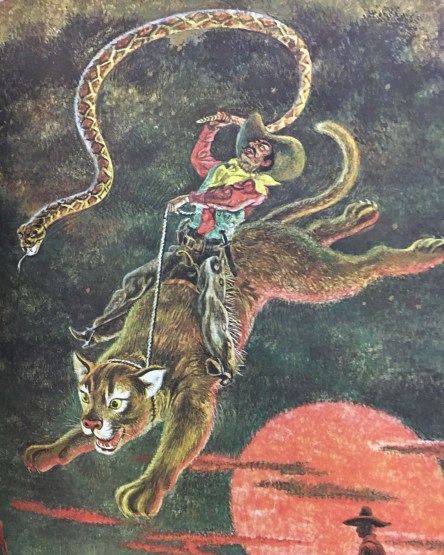
… and such beloved fakelore as Paul Bunyan and Pecos Bill.
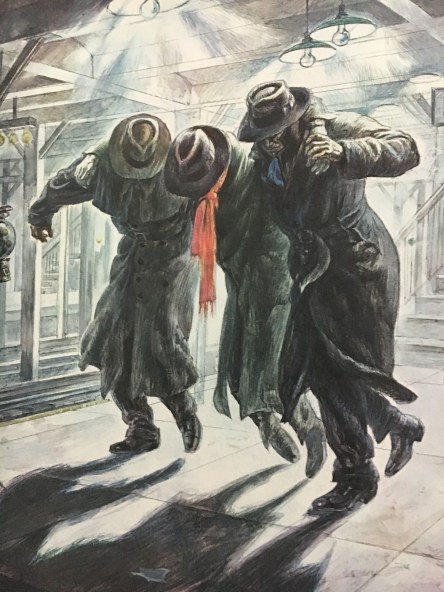
There are modern legends too, such as “The Man in the Middle”, which will be familiar to anyone who read Scary Stories to Tell in the Dark (and lost sleep over it).
The first big picture you get reading the book is the monsters of the Sea of Darkness, and hooboy is it impressive.
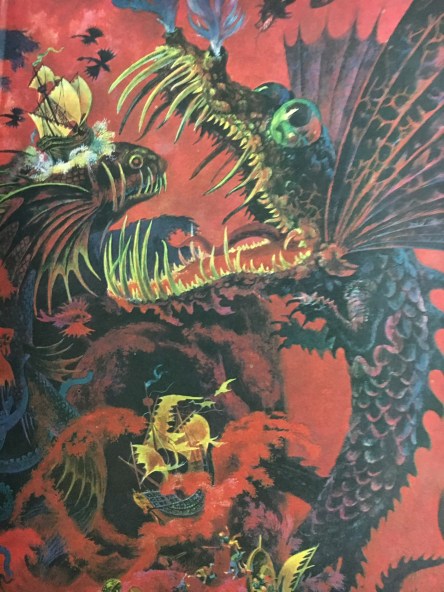
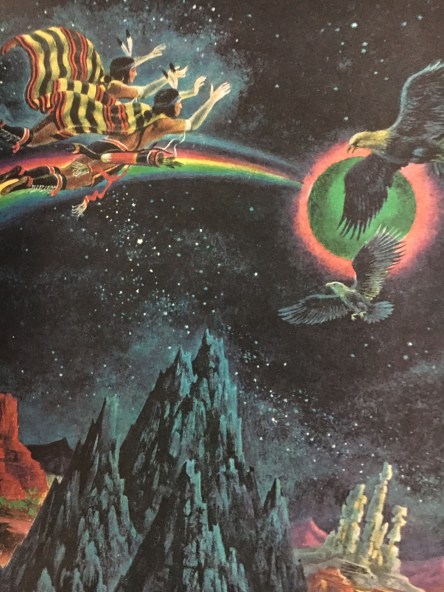
Nayenezgani and Tobadzistsini on their journey to the Sun could well pass as a metal album cover.
Meanwhile Sedna’s fingers giving rise to the beasts of the sea manages to be somehow beautifully stylized and creepy at the same time.

The Jersey Devil, seen here with a ghostly pal.
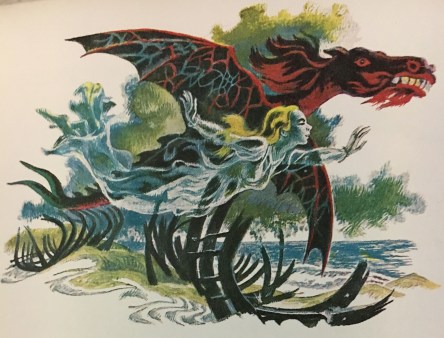
Ahhh, ghost pirates. Where would we be without them?

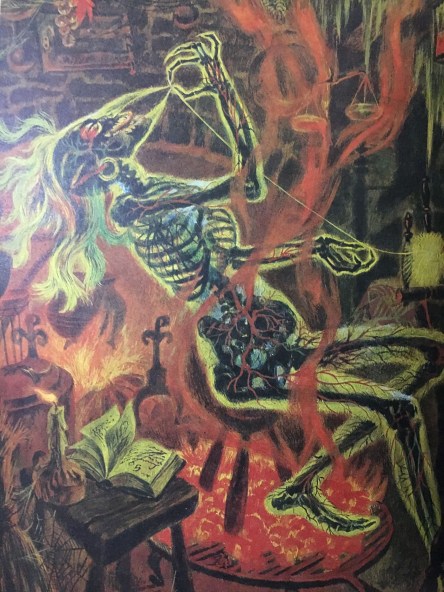
Probably the most nightmarish and memorable piece in the book is the witch woman who literally spins her skin off, shedding it like a husk of corn, until nothing remains but an enormous cat. Yikes.
I can’t end this brief appreciation without mentioning Lewicki’s Swan Valley Monster, the first time this awesome monster was visually represented (to my knowledge).
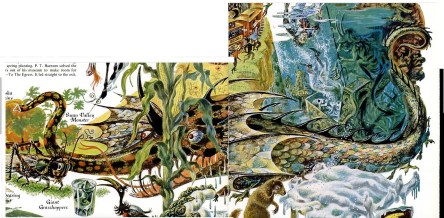
What I’m saying is that The Life Treasury of American Folklore is a worthwhile acquisition for fans of folklore, creatures, Americana, and excellent art. I still hold out hope that Time-Life reprints it and The World We Live In in high-quality glossy modern editions, but this will never happen as we all know…
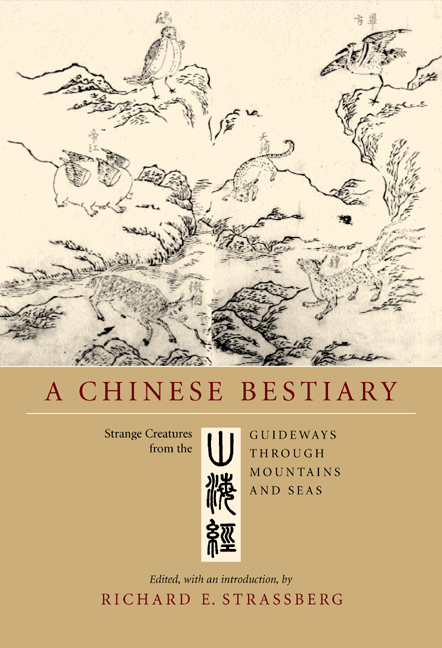
A Chinese Bestiary
Richard E. Strassberg
The Shan Hai Jing is the seminal Chinese bestiary, in fact one of the most creature-packed creature books in existence! (It’s also where Borges got his Chinese fauna from) And if you’re in the unfortunate position of being unable to read Chinese, like myself, you’re going to need a translation. This is where Strassberg’s A Chinese Bestiary (ACB) comes in, and it delivers in spades.
You can get your grubby mitts on it here and here.
Scope
It’s the Shan Hai Jing. Need I say more? I do? Oh. It’s an English translation of the Guideways, with ample commentary and the original illusrations.
Once more, this is not a complete compendium of mythical creatures nor does it pretend to be. Its narrow focus is what makes it good.
Organization
Introductions and Notes frame the Shan Hai Jing translation, which is the meat of the book. The text is broken up by region and by creature, with each notable creature having its own number to identify it in the illustration and (in most cases) commentary. Straightforward and easy to use.
Text
It’s a translation of a classic Chinese text. And I don’t read Chinese, so I can’t comment on how good of a translation it is (Chinese-reading ABC readers should feel free to chime in with opinions, if any). But it’s written clearly, thoroughly referenced and footnoted.
Images
Black and white and simple enough, but most importantly they are the original illustrations. So what you’re seeing is what people at the time (or at least, one artist at the time) thought those creatures look like. As opposed to, you know, some teratologist with delusions of competence presenting a subjective interpretation…
Research
As mentioned above, there are references and notes for just about everything. As the Shan Hai Jing is itself an ur-reference, there is little need for more – but there is more! These range from folklore notes to Guo Pu’s commentaries and everything in between.
If it’s not academic enough for you, there’s always the massive Mathieu translation, which is extremely academic. Also it’s in French.
Summary
I can’t really sing the praises of this book enough. It’s good. Like Meeting with Monsters it has a (relatively) narrow subject and it uses that to excellent effect. Another must-have book for anyone with a passing interest in Chinese teratology.
Good news! I got the inside scoop on this ṣafat malarkey. I’d save it for the final ABC product, but I need to nip any misunderstandings in the bud before they get out of hand and people start labeling their giant sky cruisers with that name.
First, some breadcrumbing. The ṣafat bird (note the dot under the s – that’s a ص) seems to have originally come from (where else?) Rose’s Giants, Monsters, and Dragons, which in turn got it from Barber’s Dictionary, which itself obtained it from Lum’s Fabulous Beasts. I do not have that last book. Impasse.
I do, however, have access to the most powerful search engines known to humanity, and hey presto – looks like the ur-reference for the ṣafat is Hanauer’s Tales Told in Palestine.
Going by the title alone, it’s clear that the ṣafat is not an “Arabian” animal. In the text Azrael – the Angel of Death himself – shows off ṣafat eggshells as something that is a cause of death . He describes the ṣafat as a wonderful bird that never lands (no mention is given as to its size, so I can only assume it’s normal-sized and not huge). It even lays eggs in flight, and the young hatch before they reach the ground. But then they are often eaten by a shibah (described as resembling a badger-hyena cross. Zorilla? Aardwolf?), which then becomes rabid, goes mad, bites things, and gives Azrael more customers.
There you have it. Far from being a mere permaflier like the allerion or bird of paradise, it’s literally the cause of rabies.
Clarfication: the eggshells are eaten and cause rabies. The shibah/shibeh is the leopard (!).
Variations: Inifwira
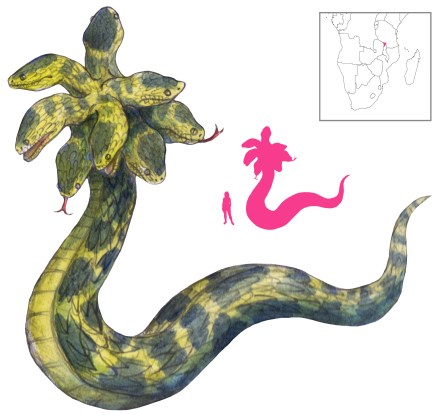
The Nyuvwira is an enormous snake restricted to the Chitipa District of Malawi. It is found in association with minerals, especially precious minerals of monetary value. It can also be found in the mines of South Africa. It is known as Inifwira in Sukwa.
A nyuvwira has eight heads and is the largest snake in the world. It generates electricity and lights at night. It lives underground, which is fortunate as it is extremely toxic. When it moves (about every 200 years) it causes death and disaster. Airplanes flying over a nyuvwira crash.
The skin of a nyuvwira, held in one’s pocket, prevents planes from moving and is a powerful charm for wealth. To kill a nyuvwira one must construct a spiral hut and line it with razors, then entice the snake in by ringing bells. It will crawl over the razors and cut itself to death.
References
Hargreaves, B. J. (1984) Mythical and Real Snakes of Chitipa District. The Society of Malawi Journal, Vol. 37, No. 1, pp. 40-52.
Okay, I’m cheating a little. Those aren’t exactly obscure or modern – in fact, they’re some of the best-known, oldest, and most enduring mythical creatures. But they are unique renditions of those creatures, and have influenced modern views of them in surprising ways, including providing the answer to a mystery that has plagued DnD scholars.
In its April 23, 1951 issue, LIFE Magazine ran a short (4 pages) article titled “Mythical Monsters”, subtitled “These Beasts Existed Only In Man’s Imagination”. It featured seven mythical creatures illustrated by another of my favorite illustrators, Rudolf Freund (I really need to do an effortpost on LIFE artists including Lewicki and Freund). They are beautiful, detailed, and feature some… unusual design choices.

The depiction of the su is representative of Freund’s approach. Reading a mustached woman’s face, palm-frond tail, tiger stripes, frog babies, and ample udders into the description is definitely a first.

The griffin, on the other hand, is standard, although modern artists would give it eagle’s forelimbs. Pedants would argue that this isn’t a griffin but an opinicus. They’re wrong.

The yale in particular looks like it could actually exist, and I love the dynamic pose it’s in.

Going to go out on a limb here and claim that this here is the reason why so many basilisks today are drawn as lizards instead of little crowned snakes or freaky reptochickenmutants. Nothing in the text suggest anything lizardy either, so Freund may have been elaborating here.
Disclaimer: the break in its middle is because it’s spread across two pages.
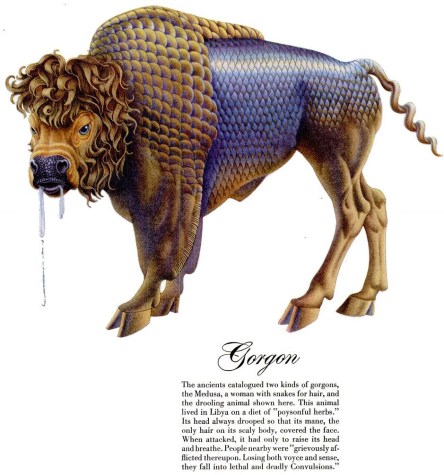
Looks familiar? That’s right, LIFE used Topsell’s gorgon (itself a renamed catoblepas). In turn, I humbly suggest that this was the inspiration for Dungeons and Dragons’ gorgon. You can stop worrying about where Gygax got his gorgon from and start sleeping easy.
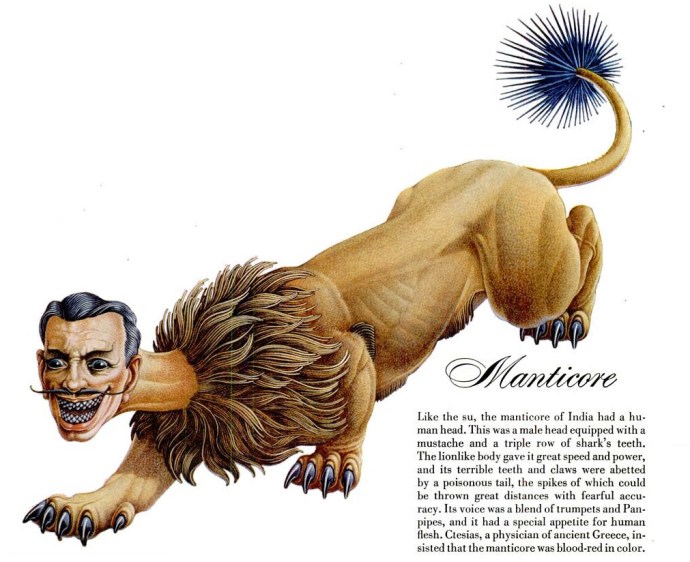
Freund’s manticore is scarier than anything else. It’s also the most dapper of manticores. Check out that handlebar mustache and the slicked hair! I suspect the manticore in Page and Ingpen’s encyclopedia of Things That Never Were was based in part on this. References to this manticore pop up in odd places, including…
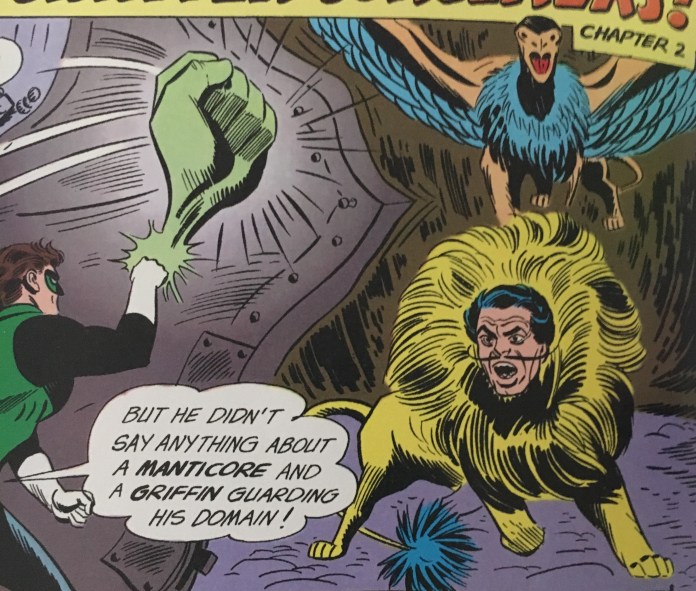
… that one JLA comic where a manticore and a griffin double-team our heroes. The manticore is yellow, of course.
I always thought that was a cop-out weakness too.
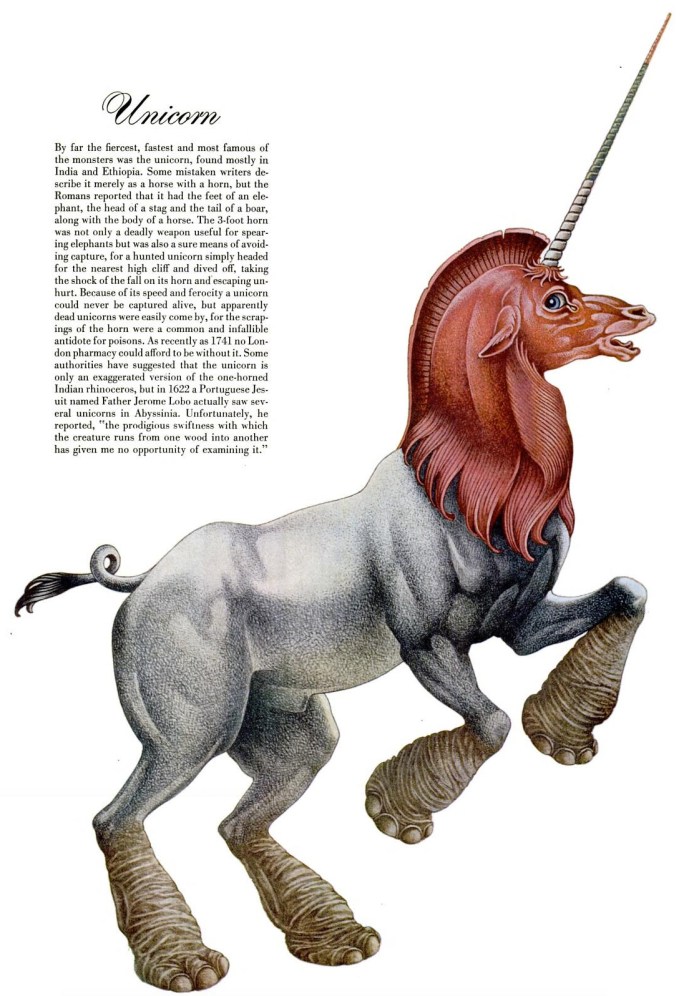
The last and best is this spectacular unicorn. I love the different colors and the mismatched elephant feet. This is exactly what unicorns should look like – garbled third and fourth hand accounts of rhinos.
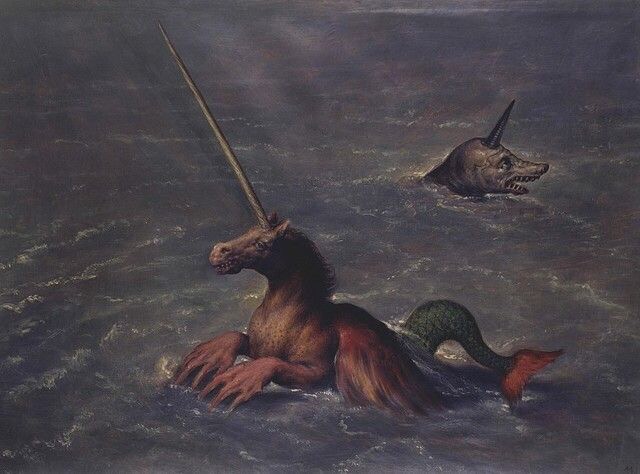
 A Book of Creatures